




 AFP
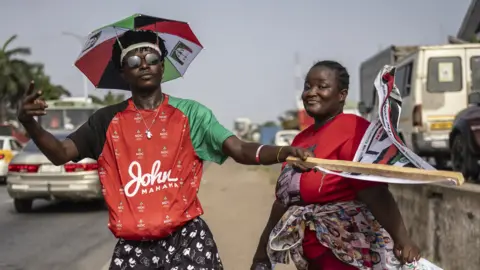
AFPGhana’s former President John Mahama won a landslide election victory last month, but will be under enormous pressure to live up to voters’ expectations when he takes office on Tuesday.
After more than three years of economic hardship, Ghanaians want a quick solution.
Mahama returned to power after eight years in opposition and ran what political analyst Nansata Yakubu described as a ‘masterclass’ in campaigning.
He defeated Vice President Mahamudu Bawumia with 56.6% of the vote to 41.6%, the largest margin of victory for a candidate in 24 years.
The National Democratic Congress (NDC), led by Mahama, also secured an overwhelming majority, securing 183 out of 276 seats in the National Assembly.
They are one seat short of the two-thirds majority needed to pass laws and approve budgets and contracts without votes from lawmakers from opposite sides of the political divide.
The results for one seat are yet to be declared due to discrepancies. The NDC is contesting four other seats in court.
However, voter turnout was lower than in the 2020 elections, especially in some centers of the New Patriotic Party (NPP) in Bawumia, suggesting that some people disillusioned with the NPP’s performance in government stayed home.
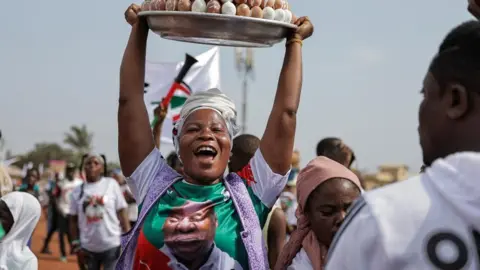
As Mahama’s supporters celebrated his victory, Belinda Amuzu, a teacher in the northern city of Tamale, Mahama’s stronghold, summed up their hopes.
She told the BBC: “I hope the new government will transform the economy and reduce the difficulties. Corrupt officials should be prosecuted so that they can serve as a lesson to others.”
“Hard times” became a common phrase in Ghana after the economy bottomed out in 2022, creating a cost-of-living crisis that shattered Bawumia’s reputation as an “economic genius” and led to his defeat. Mahama’s.
But outgoing President Nana Akufo Addo said in his State of the Nation address on Friday that he would leave the recovered economy behind.
“We are handing over to this country total foreign reserves of about $8 billion (£6.4 billion) – more than the $6.2 billion our government inherited in 2017,” he said.
The International Monetary Fund (IMF) has disbursed approximately $1.9 billion to support the country’s economic recovery since Ghana signed up to the program in 2022.
But opposition lawmakers disagree with Akufo Addo’s assessment.
“The people of Ghana have already passed their verdict on the real situation in the country and the verdict has been very clear: economic hardship, massive debt overruns, high youth unemployment and despair,” said minority lawmaker Emmanuel Armah Kofi Boah.
Ghanaian economist Professor Godfred Bokpin told the BBC that the challenges facing the next government were enormous.
“What Ghana needs now is credible leadership, lean government and efficiency in public service delivery. Without that there can be no future,” he said.
Mahama has pledged to reduce the size of his cabinet from more than 80 to around 60, but Professor Bokpin argued that the size of the cabinet should be reduced further, while political analyst Dr Kwame Asa-Asante emphasized that appointments should be based on merit rather than loyalty.
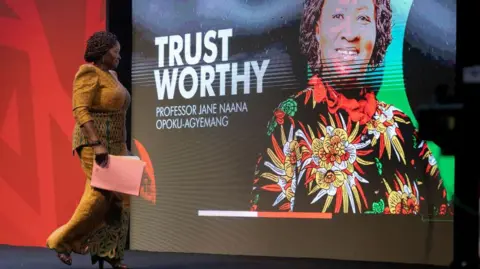
Next to President Mahama will be former Minister of Education, Naana Jane Opoku-Agyemang, who will become Ghana’s first female Vice President.
Dr Yakubu said her appointment was not one based on “tokenism” and she was not someone who could be “manipulated”.
“We have a fantastic first female Vice President in Professor Naana Jane Opoku-Agyemang,” she said. BBC Africa Focus Podcast.
 getty images
Mahama served his first four-year term as president after winning in 2012, but lost re-election in 2016 when Nana Akufo-Addo took office with Bawumia as his running mate.
Dr Yakubu said Mahama contested the 2016 election based on his track record on building roads, schools and hospitals, but voters rejected him because their mantra at the time was “we don’t eat infrastructure”.
But she said voters had come to appreciate the infrastructure his government had built during the Covid pandemic, especially hospitals.
This, coupled with the fact that under the current government the economy has fallen into deep crisis and required a $3 billion (£2.4 billion) bailout from the IMF, Dr Yakubu added, has enabled Mahama to be re-elected.
She told the BBC that Mahama was now expected to deliver on campaign promises to cut unemployment to almost 15% and scrap some taxes to create jobs to ease the cost of living crisis. “Illegal tax”.
Mahama promised to make Ghana a ‘24-hour economy’ through the creation of night-time jobs in both the public and private sectors. He said he would provide tax incentives for businesses to open at night and lower electricity prices.
But his critics remain skeptical, noting that Ghana was plunged into its worst power crisis during his first term, with blackouts so severe that Mahama joked that he was known at the time as “Mr Dumsor”. “dum” means “off.” “sor” means “on” in the local Twi language.
He has promised to scrap a number of taxes, including an electronic levy on mobile transactions and a tax on carbon emissions from petrol or diesel vehicles.
Professor Bokpin said he doubted whether the Mahama administration would be able to deliver on its promises.
“They haven’t done a cost-benefit analysis. There’s no budget space to actually translate those commitments,” he said.
Professor Borkin believes full economic recovery and growth will take a long time.
He said: “If you’re talking about economic transformation and inclusive productivity growth, you’re probably looking at 15 years or more of consistently doing the right thing.
“In Ghana we can’t do the right thing consistently for a long time. We do the right thing between elections and then we make mistakes.”
But Mahama said he was confident he would prove his critics wrong and planned to renegotiate the terms of the IMF loan to free up funds for “social intervention programs” in a country where 7.3 million people live in poverty.
In an interview before the election, Mahama told the BBC that the IMF wanted “some balance” in the government’s finances.
“If we can reduce spending, increase revenue, and increase non-tax revenue, we can achieve balance,” he said.
 Reuters
Dr. Asah-Asante said Mahama’s experience as a former president would greatly assist him in navigating Ghana’s treacherous waters.
“Of course he is likely to face difficulties, but he has the ability to turn things around,” the analyst added.
Apart from the economy, corruption is one of the biggest problems facing Ghana, but not everyone is convinced that Mahama can solve this scourge.
Mahama has been dogged by allegations of corruption during his time in government as vice president and president, but he has consistently denied any wrongdoing.
In 2020, a British court found that aviation giant Airbus used bribes to secure military aircraft contracts with Ghana from 2009 to 2015.
An investigation was then launched in Ghana, but the Office of the Special Prosecutor concluded in a decision issued months before the election that there was no evidence that Mahama was directly involved in corrupt activities.
The outgoing government has also been dogged by allegations of corruption, including on the controversial National Cathedral project, which involved buying ambulance spare parts for $34.9 million and spending $58 million on construction without making any progress.
Mahama promised that the government would fight corruption and ensure that public officials are prosecuted for wrongdoing.
“We are thinking of a special court,” he told the BBC.
Mahama has already launched Operation Recover All Loot to probe state funds and assets allegedly stolen by outgoing government officials.
Dr Asa-Asante said Mahama should demand financial responsibility from the outgoing government at the transition stage so that “whatever went wrong can be put right” as soon as the government takes office next month.
The analyst added that Mahama, who will take office, said: on tuesday When President Akufo-Addo resigned after two terms in office, he had no choice but to live up to the expectations of Ghanaians. Otherwise, they will “punish his government just as they punished the NPP.”
“The expectations of the Ghanaian people are very high and we cannot disappoint them,” Mahama said in his victory speech.
“Our best days are not behind us. Our best days are ahead of us. Keep moving forward – never back.”


 Getty Images/BBC







