




 TSGT Scott Reed, USAF
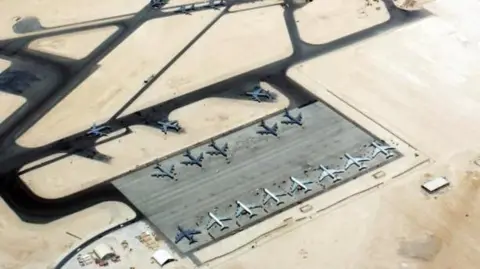
The United States and Britain are reducing personnel at Al Udeid Air Base in Qatar as President Donald Trump considers whether to take action against Iran’s crackdown on anti-government protests.
Officials told the BBC’s US partner CBS that the country’s partial withdrawal was a “precautionary measure”. The BBC understands some British soldiers are also being removed.
The Qatari government said in a statement that the U.S. action was “a response to current regional tensions.”
President Trump previously said the United States would take “very strong action” against Iran if authorities executed protesters. Iran said it would retaliate if the United States attacks.
According to human rights groups, more than 2,400 anti-government protesters have recently died due to violent repression by Iranian authorities.
Regarding the withdrawal of soldiers, the Qatari government said, “We will continue to implement all necessary measures to prioritize the safety and security of citizens and residents, including measures related to the protection of critical infrastructure and military facilities.”
Al-Udeid is the largest US military base in the Middle East, with approximately 10,000 personnel and approximately 100 British staff stationed there. It’s unclear how many people will leave.
A British Ministry of Defense spokesman declined to comment on reports that British troops had withdrawn “for operational security reasons”.
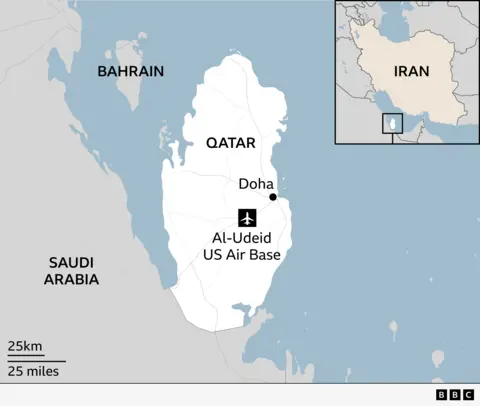
Reuters, citing diplomats, reported that some personnel had been told to leave the base, but there were no immediate signs of a large-scale withdrawal of troops as before the Iranian attack last year.
A senior adviser to Iran’s Supreme Leader Ayatollah Ali Khamenei warned Donald Trump on Wednesday that the June attack demonstrated Iran’s ability to respond to any attack.
“It will certainly help us to really understand Iran’s willingness and ability to respond to any attack,” Ali Shamkhani wrote in a post to X.
Meanwhile, the U.S. Mission to Saudi Arabia advised its employees and citizens to “exercise increased caution and limit non-essential travel to all military installations in the region.”
The United States has threatened to intervene in Iran over the killings of protesters. On Tuesday, President Trump took to his Truth Social platform to urge people to “continue to protest”, saying Iranian authorities “will pay a heavy price” for the killings.
He also said Iranian leaders had called him and “wanted to negotiate,” but that the United States “may have to take action before the talks.”
Iran’s government has accused the United States of “creating a pretext for military intervention,” and the parliament speaker warned that Israel and American military bases and shipping centers in the region would all be legitimate targets if the United States attacked.
The latest protests in Iran began in late December as the country grapples with a collapsing currency and soaring costs of living in the country.
They quickly escalated into demands for political change and became one of the most serious challenges to the clerical establishment since the 1979 Islamic Revolution.
The US-based Human Rights Action News Agency (HRANA) said it had so far confirmed that 2,403 protesters and 12 children had been killed despite the internet blackout. The group also reported that more than 18,434 protesters were arrested during the unrest.







