



The new Y-20B variant conducted its first overseas flight to repatriate from Korea the remains of Chinese soldiers who participated in the Korean War, replacing the older Y-20A in this role.
The ‘B’ variant of the People’s Liberation Army Air Force (PLAAF) Y-20 strategic transport aircraft made its first overseas deployment on April 20, 2026, when it flew for a ‘repatriation mission’ to South Korea. The aircraft returned to Korea on April 22 to transport the remains of Chinese People’s Volunteer Army (CPV) fighters who participated in the Korean War against South Korea and the United States from 1950 to 1953.
repatriation flight
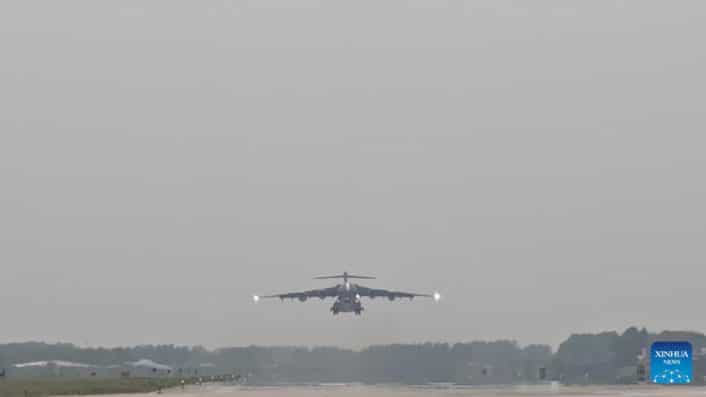
Footage of the first leg of the trip only showed the front view of the Y-20B taking off. The brief statement noted that the aircraft took off from an unidentified airport in central China on the afternoon of April 20.
For the return flight, the aircraft took off from Incheon International Airport on April 22 and landed at Shenyang Taoxian International Airport. The Y-20B was welcomed with a water cannon salute upon landing after being escorted by four J-20 fighter jets in Chinese airspace. myth showed it
The remains of 12 Chinese People’s Volunteer Army (CPV) martyrs who lost their lives in the War of Resistance against the US and Aid (1950-1953) were repatriated from Korea to China on Wednesday. Read updates: https://t.co/AXY2YkGvkO pic.twitter.com/13Y4Q7PvD7
— China Xinhua News Agency (@XHNews) April 22, 2026
Previous repatriation missions in South Korea were flown with earlier Y-20A variants, and this marks the first time the newer Y-20B has been used. This was also confirmed in a statement from the Chinese Ministry of National Defense.
“This is the first time that the People’s Liberation Army Air Force of China has dispatched a Y-20B for repatriation. (…) The Air Force will also dispatch four J-20 fighter jets to escort the Y-20B after it re-enters Chinese airspace.”
The Y-20A has been part of several international deployments, the main deployments being the delivery of Chinese-made FK-3 air defense missiles (an export version of the HQ-22) to Serbia in April 2022 and participation in the large-scale Eagles of Civilization exercise with the Egyptian Air Force in May 2025.
A Chinese Air Force Y-20B military transport plane departed for South Korea through an airport in central China on April 20 to repatriate the remains of the 13th Army of the Chinese People’s Volunteer Army (CPV) who died in the battle against the United States. pic.twitter.com/I2zuQ3ZqLX
— CCTV+ (@CCTV_Plus) April 20, 2026
The PLAAF Y-20A has been part of the annual flight repatriating Chinese soldiers killed in South Korea since 2015. The most recent cases occurred in November 2024 and September 12, 2025.
The latter marks the 12th repatriation of remains of CPV soldiers and also the first time the transport aircraft was escorted by four J-20 fighter jets as it entered Chinese airspace. As mentioned earlier, the Ministry of Defense provided fighter escorts this year as well.
The Y-20B in question has the tail number ‘20343’. An image of the Y-20B from a Chinese defense blog uploaded on June 25, 2025, shows this aircraft, along with two more, assessing that they could be deployed to the 13th Transport Aviation Division under the Central Theater Command (CTC).
At approximately 13:00 on April 20, a PLAAF Y-20B transport aircraft took off from Zhejiang, central China, toward Korea.
His classmate is in charge of the mission of returning the body of the 13th anti-American resistance fighter Jo. Scheduled to return home on the 22nd.This will be the Y-20B’s first external mission. https://t.co/bvGCWTOFVM pic.twitter.com/ak1AchX4p4
— Sugar wsnbn (@sugar_wsnbn) April 20, 2026
diplomatic background
myth “A Chinese Air Force Y-20B heavy transport plane carrying the remains of fallen soldiers and 146 personal belongings landed at Taoxian International Airport in Shenyang, the capital of northeastern China’s Liaoning Province.” The publication added that China has so far cooperated with South Korea to repatriate “the remains of 1,023 Chinese Communist Party martyrs.”
The remains of 12 Chinese People’s Volunteer Army (CPV) martyrs who lost their lives in the War of Resistance against the US and Aid (1950-1953) were repatriated from Korea to China on Wednesday. The Chinese Air Force Y-20B large transport aircraft… pic.twitter.com/FdMA2Dt8hX
— China Xinhua News Agency (@XHNews) April 22, 2026
World War II and the subsequent Chinese Civil War and Korean War continue to influence China’s strategic affairs and relations with Taiwan, Japan, and the United States today. This appears to be a major factor in the geopolitics of East and Southeast Asia in general.
Tensions in Northeast Asia are characterized by tense relations between the Republic of Korea (South Korea) and the Democratic People’s Republic of Korea (North Korea) and Japan’s acrimonious relations with China, Russia, North Korea, and South Korea.
There is a consensus among observers that China and South Korea, despite being on opposing sides in the Korean War, have found some common ground over events that occurred from the 1900s to the 1950s. The Y-20 flight to South Korea is an expression of this effort, but how and whether it will determine changes in military dynamics in the region is yet to be seen.
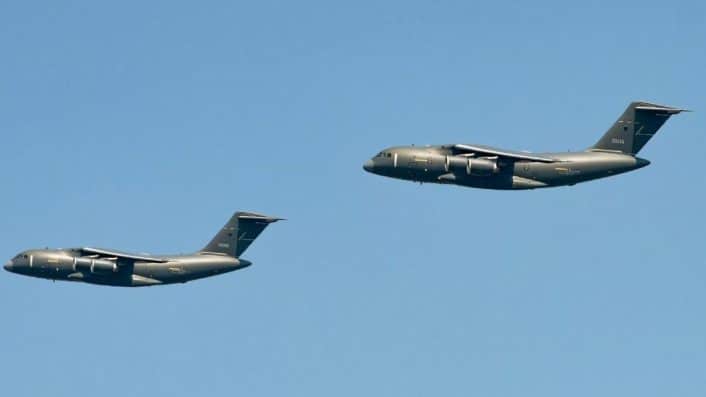
Y-20B transport aircraft
The Y-20 can be considered the Chinese equivalent of the American C-17 Globemaster III. The new ‘B’ variant includes many improvements over the previous Y-20A and an increase in Chinese-specific systems.
The Y-20B variant can be distinguished by its shorter, more robust WS-20 turbofan engine. The Y-20A, depending on the production batch, was powered by Russian D-30KP-2 and Chinese WS-18 engines, recognizable by its longer shape.
that GT A report on the Y-20B’s flight to Korea noted the WS-20’s improved performance capabilities. The report said the deployment “demonstrates that the new domestically developed high bypass rate engine has gone through a period of testing and validation and is now mature and reliable.”
The Y-20 was developed in China to replace the Russian Ilyushin Il-76. The airframe serves as a base for several special aircraft, including the KJ-3000, the PLAAF’s newest and largest airborne AEW&C, based on the Y-20B.
The Y-20A also has a Multi-Role Tanker Transport (MRTT) type version, called YY-20A/YU-20A, which is equipped with a three-point hose-and-drogue refueling system and was notably used in EAF exercises in May 2025. Similar variants are expected for the newer Y-20B.
It’s not interesting. 20343 lost its formation markings but gained a huge PRC flag on its tail. pic.twitter.com/n8pABP8kvo
— @Rupprecht_A (@RupprechtDeino) April 14, 2026
that GT The report also quoted Chinese defense expert Wang Yunfei as saying that the Y-20B’s visit to South Korea means the aircraft has achieved “final design certification” for its “proven stability.” “This aircraft has gained full confidence (…) and will be gradually deployed for long-range and more complex strategic transport missions,” Wang said.
To explain the Y-20B, myth It said the aircraft “features a new generation of domestically manufactured aircraft engines (…) with extended range, increased payload and higher flight speeds and boasts powerful long-range strategic airlift capabilities.” The engine delivers higher fuel efficiency and greater driving range with “the same amount of fuel.”
AFAIK photos of the Y-20 production line have been leaked for the first time. pic.twitter.com/aobZu7pupk
— @Rupprecht_A (@RupprechtDeino) April 17, 2026
Other upgrades include improved power supply, hydraulic controls, navigation, communications and flight control systems to support “improved adaptability to harsh natural environments” and “national strategic airlift” mission capabilities “under more complex operational conditions.” Wang added that the Y-20B will likely lead to aerial refueling tankers and “even aerial early warning aircraft.” As mentioned earlier, the KJ-3000 is based on the Y-20B, so the latter already exists.







