



In a document submitted to Congress, the Air Force expressed its desire to nearly double its orders for EA-37B electronic attack aircraft while reducing its fleet of relatively new E-11A BACN jets by fiscal year 2028.
Amazingly, the U.S. Air Force’s unique and highly active E-11A Battlefield Airborne Communications Node (BACN) aircraft may be retired just a few years after regular flight deployment.
Based on Bombardier’s Global 6000 business jet, the E-11 was initially deployed for operations over Afghanistan. They replaced the NASA WB-57 Canberra aircraft used across the country with a prototype BACN payload. Afghanistan’s mountainous terrain presented military planners with major headaches when trying to coordinate existing communications networks. Regular VHF or UHF radios suffered from line-of-sight limitations, and satellite communications (SATCOM) systems were expensive and relatively bulky.
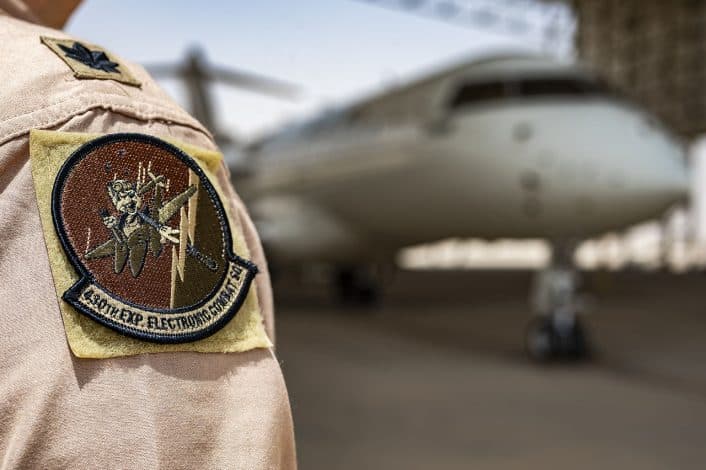
Aircraft with BACN payloads operating at high altitudes can form a communication bridge between different units and alleviate challenges caused by terrain. The advantages of these systems, which could interface between various types and formats of communications systems, soon became apparent in other situations as well, with the E-11A being used extensively throughout the Middle East during Operation Inherent Resolve and more recently Operation Epic Fury. BACN is often labeled ‘Wi-Fi in the sky’, but those who run the system insist this only scratches the surface of what they can do.
Now, the Air Force says it will be able to fill the gap left by the retirement of the E-11A platform through the development of a modern SATCOM that leverages the abundance and ease of connectivity with new low-Earth-orbit (LEO) satellite constellations. Additionally, pod versions of the BACN payload have already been developed previously and these latest variants do not require a dedicated fleet and can be deployed on a variety of aircraft as needed.
BACN is insufficient. The USAF plans to sell all E-11As by 2028.
From SECAF/CSAF/CSO Opening Remarks to today’s House Appops: pic.twitter.com/o6ESY74xJl
— Brian Everstein (@beverstine) April 30, 2026
But this raises the question of why the E-11 remains an important and essential capability in America’s high-intensity military operations. Before Operation Epic Fury began, open source flight tracking analysts recorded a proportionately large number of E-11A aircraft moving into theater. Just five years ago, this capability was considered important and unique enough to warrant a major expansion of the fleet beyond simple expeditionary use.
🇺🇸 #USAF E-11A BACN Fleet (7); Last reported location 2026-04-24Z 🥓
Ø Six (87.5%) fleets are (and probably still are) deployed and operating at Prince Sultan Air Base.
Prince Sultan Air Base 🇸🇦 (6)
Ø N770AG (11-9355) #ae4de1) #AA690E
Ø 22-9046 #ae77a3
Ø 22-9047 #ae77a4
Ø… https://t.co/6QV7tcHcJ3— Stephen Watkins (@steffanwatkins) April 25, 2026
The most recent known E-11A is 24-9049, manufactured by Bombardier in 2024 and delivered to the US Air Force in 2025. By FY 2028, this aircraft and many others in the fleet will still have significant service life remaining and will be very attractive for overseas sales. The remaining question is whether the United States will allow the export of this technology, or even the aircraft it was once equipped with.
EA-37B Expansion
In the same document, the U.S. Air Force advocates expanding plans for the EA-37B Compass Call electronic warfare aircraft from 12 to 22. The EA-37B is also a business jet-based platform based on the Gulfstream G550. After initial delivery in 2024, the first EA-37B training mission began in May 2025.
Two EA-37Bs arrive at RAF Mildenhall in their first possible operational deployment.
Two EA-37B Compass Call aircraft stopped at RAF Mildenhall for fuel during the first overseas operational deployment of this type, with reports suggesting Turkey as the destination.
story:…
— The Aviation Expert (@TheAviationist) March 31, 2026
In early April of this year, we received confirmation that the deployment of EA-37B aircraft to the Middle East was a suspected combat deployment as part of Operation Epic Fury. This means the aircraft has transitioned from initial training sorties to operational missions in less than a year, a rare occurrence for new military aircraft that could be forced into service due to EC-130H Compass Call aircraft (scheduled for replacement) reportedly suffering damage in theaters due to Iranian attacks.
Aside from the obvious platforms, the aircraft that had the greatest overall impact on the success of Operation Absolute Resolve to capture Maduro was the EC-130H Compass Call. A king ‘confused’ that few truly understand. pic.twitter.com/Wfx1Fxt1Gg
— Tyler Rogoway (@Aviation_Intel) February 26, 2026
Like the EC-130H, the EA-37B, which is in the process of being replaced, is a dedicated electronic warfare platform with the ability to disrupt and deny hostile communications networks and navigation systems. Combined with the RC-135’s electronic intelligence (ELINT) capabilities, the aircraft’s electronic warfare package can be precisely targeted at the enemy’s most active or vital capabilities.
The 22 EA-37Bs take the fleet beyond the levels reached by the EC-130H, demonstrating how important the electronic warfare role is on the modern battlefield.







