



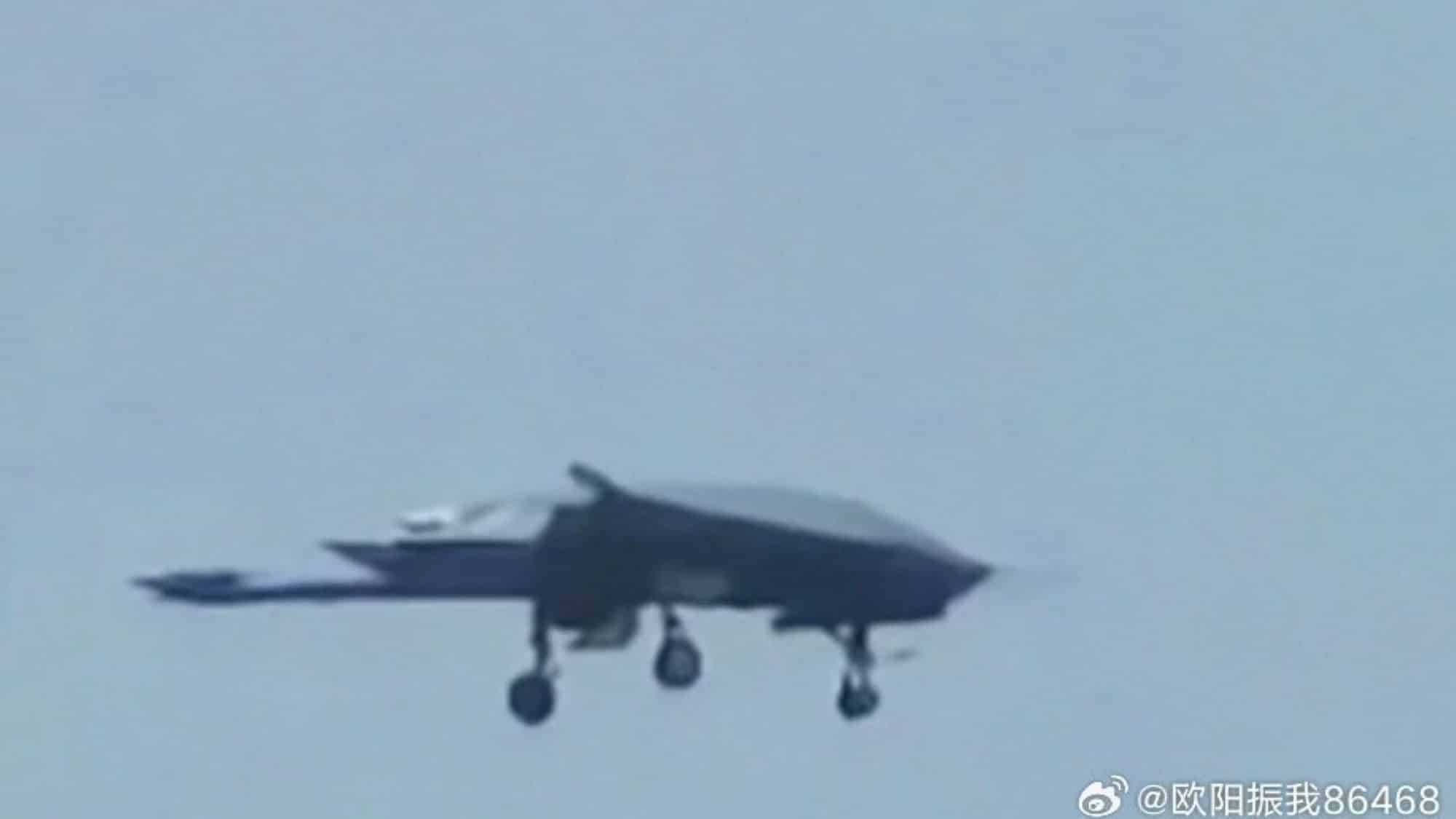
The GJ-21 is considered a Navy variant of the GJ-11 cooperative combat aircraft, as evidenced by features such as launchers and arrester hooks for flight from the Type 076 Sichuan LHD.
New unofficial photos of China’s GJ-21 Naval Unmanned Combat Aerial Vehicle (UCAV) were released on April 30, 2026, showing the aircraft with extended landing gear. It is unclear when and where the photo was taken.
Previously, it was assessed that the unmanned aerial vehicle, a naval version of the GJ-11, was scheduled to take off from the Type 076 LHD (Landing Helicopter Dock) amphibious assault ship. The November 2025 image shows a bottom view of the aircraft with the landing gear and arrestor hooks extended.
A model of the aircraft also appeared on Type 076 at the Shanghai Hudong-Zhonghua Shipyard in late January 2026. The large ship tested its EMALS (Electromagnetic Launch System) configuration catapult launch system located on the port side of the deck in October 2025.
The People’s Liberation Army Navy (PLAN) reported on April 21 that the Type 076 was undergoing eight sea trials off Shanghai. Therefore, it is unclear whether the image was taken from another location during China’s CCA testing or while it was preparing to land on the Type 076 Sichuan.
GJ-21 https://t.co/MWxnXCdKBK pic.twitter.com/goPxOFV6df
— Sugar wsnbn (@sugar_wsnbn) April 30, 2026
The Navy’s official page stated in
The Type 076 amphibious assault ship PLANS Sichuan (Hull 51), part of the Chinese PLA Navy, recently conducted a scientific research, testing and training mission to evaluate the operational performance of various systems and platforms in the South China Sea.
After launch,… pic.twitter.com/rVVyDXzzC4
— Chinese Military Bugle (@ChinaMilBugle) April 21, 2026
latest image
The latest images basically show a rear angle that also captures important aspects of the GJ-21. In fact, the arrester hooks are not visible here, but the catapult launchers on the front landing gear are visible.
The faint outline of a flight data probe on the nose can also be observed, and a segmented control surface is visible on the trailing edge of the starboard (right) wing. Another feature that helps confirm the identity of the drone as the GJ-21 is the obscured exhaust system seen on the PLA Air Force’s GJ-11, which was shown flying as a J-20 in November 2025.
Chinese military aviation researcher Andreas Rupprecht previously said: aeronautics The GJ-21 can be described as a naval version of the GJ-11. “It was previously designated GJ-11H and later GJ-11J within the OSINT community,” he said.
As you can see, for the first time a clear image has been posted of the GJ-21 in flight, and this image is based on the pitot still installed, tail hook down. pic.twitter.com/5h1nVZHzIe
— @Rupprecht_A (@RupprechtDeino) November 1, 2025
The large dorsal hump containing the air intake is also clearly visible. This feature has been consistent in all models and renderings of the GJ-11 seen so far. The GJ-11 aircraft was first officially unveiled at a parade in October 2019. He was later depicted flying aboard the J-20 in a 2022 concept video. CCTV 7GJ-11J/GJ-21 models before and after the parade on September 3, 2025.
We don’t have any images of the GJ-11J/GJ-21’s internal weapons bays so far. This may give you an idea of its role when flying in Sichuan Province and as a wingman drone for the J-20 (offboard sensor, offboard weapons discharge, or both). For Sichuan, we assessed that it could provide an organic ISR attack capability capable of supporting amphibious forces and armored landings on Taiwan’s beaches without relying on the remaining PLA Navy surface combatants and PLAAF assets.
Weird and interesting 🤔 … This GJ-21 – as seen here during a parade rehearsal – has much more visible Chinese Navy markings and titles including “21”.
So it was repainted right before the parade?(via @Qitian’s grandson Monkey) pic.twitter.com/kAXPMwy0uo
— @Rupprecht_A (@RupprechtDeino) October 3, 2025
The drones could also provide unmanned high-rotation time aerial assets for PLAN strike groups while laying the foundation for future unmanned systems to be operated from CNS Fujian.
Apparently, 076 LHD-51 Sichuan embarked on its third sea trial today. pic.twitter.com/jPAVXejq1M
— @Rupprecht_A (@RupprechtDeino) April 20, 2026
New CCA/UCAV
On April 11, a new video also appeared featuring an as-yet-unknown CCA, or UCAV, from China. The aircraft was captured in grainy side view footage from a person on the ground and appears to have a cranked kite-type wing configuration and segmented aft control surfaces.
This aircraft appears to be different from any other known or unknown flying wing type aircraft reported to date. It could also be a decoy system as we know it.
well! Another drone/CCA/UCAV discovered in China? 🤔
Via https://t.co/vFEDFCjiLE pic.twitter.com/L9Qh0lwFax
— @Rupprecht_A (@RupprechtDeino) April 11, 2026
As mentioned in previous reports about China’s next-generation J-36 and J-XDS aircraft, the periodic appearance of new aircraft in unofficial footage cannot happen without approval from Chinese authorities. The leak has propaganda value as it not only promotes China’s industrial and technological advancements, but also entices enemy intelligence agencies to track the aircraft.







