



The Rapid Dragon program, now called Dragon Cart, has transitioned into a program of record and will allow cargo aircraft to deploy palletized cruise missiles by 2027.
The Air Force Life Cycle Management Center (AFLCMC) announced that the U.S. Air Force’s Rapid Dragon program became the Official Program of Record (PoR) on April 30, 2026. PoR status means the system has been officially approved by the government and is guaranteed an allocation of parliamentary funding in future budgets.
Rapid Dragon saw the Air Force use cargo aircraft such as the C-130J Hercules and its variants, as well as the C-17 Globemaster III, to carry out ‘palletized launches’ of large numbers of standoff surface strike missiles. The project is now designated Dragon Cart after transferring oversight from the Air Force Research Laboratory (AFRL) to AFLCMC.
The system is expected to be deployed by 2027 using the Middle Tier Acquisition (MTA) – Rapid Fielding pathway. AFLCMC has also designated the Family of Affordable Mass Munitions (FAMM) series missiles, developed under the Extended Range Attack Munition Initiative (ERAM), as the Dragon Cart’s weapons.
Zone 5 Technologies Rusty Dagger and Co-Aspire’s Rapidly Adaptable Affordable Cruise Missile (RAACM) was created under the FAMM/ERAM program. The former underwent a series of live warhead tests and integrated tests with the F-16 in January and March 2026, respectively.
Beginning May 2026, the Rapid Dragon palletized ammunition system is transitioning from development to an official program of record called Dragon Cart, with operational deployment expected in 2027.
This will revolutionize the way the USAF approaches precision targeting from day one. pic.twitter.com/sI0TY3RSsH
— Sean Naub (@SKnaub77323) May 8, 2026
The FAMM program has now evolved into FAMM-Beyond Adversary Reach (BAR) procurement. The April 20, 2026 AFLCMC Request for Information seeks companies that can design and manufacture FAMM weapons that can be launched as transportables and pallets and that can meet production orders of 1,000 to 2,000 missiles per year for the U.S. government and foreign buyers.
Dragon Cart is now PoR.
The original Rapid Dragon’s palletized munitions program was tested several times using live units and surrogate missiles from the AGM-158B Joint Air-to-Surface Standoff Missile-Extended Range (JASSM-ER). The service said Dragon Cart “is built on lessons learned from experimental campaigns.”
Polish Air Force, Air Force Europe-Air Forces U.S. Air Forces in Africa, U.S. Special Operations Command Europe and Special Operations Command Europe members conduct palletized precision effects cargo training on a Polish C-130 Hercules Nov. 8 in Powisz, Poland. Is it a joint air-to-ground missile? pic.twitter.com/OKH8MdQg0b
— Ryan Chan Chan Gabaru (@ryankakiuchan) November 9, 2022
AFLCMC said the Dragon Cart’s strength lies in its ability to leverage existing “standard airlift inventory and airlift equipment” and U.S. government-owned combat management systems. This allows locomotion systems such as FAMM and JASSM in a palletized configuration to be “rolled onto an airlift aircraft, dropped backwards, and distributed in the air around the world.”
JiaJia Lee, Dragon Cart’s program manager, said the concept provides “operational ambiguity, adversary deterrence, and additional command options to maximize operational effectiveness.” Lee also said this “gives us the option to transform a mobile aircraft into a powerful strike platform, unlocking capabilities we wouldn’t normally have in how we utilize our airborne fleet.”
Dragon Cart also quickly became a program of record because, unlike other traditional defense procurement programs, it emphasized government control of weapons data and technology. Kent Mueller, Systems Engineering Program Manager, highlighted the Model-Based Systems Engineering (MBSE) approach that helps quickly modify FAMM designs to accommodate new payloads.
“We own the engineering, so if a new payload requires a slightly longer launch module, we model that, do a load path analysis, and send that model to our production vendor,” Mueller said.
#destruction A video of a successful test firing of the 352nd Special Operations Group’s pallet-type joint air support range missile (JASSM). Successful extraction of deployment box, release of JASSM through wing extension, motor binding during exercise #Atreus22 #SOFinEurope pic.twitter.com/3hLcXDJ3bl
— US Spec Ops Europe (@US_SOCEUR) November 9, 2022
Additionally, the service explained, “By assembling proven existing technologies in new ways and maintaining tight control over the digital architecture, the program office removed traditional obstacles and enabled rapid expansion and future upgrades.”
Interestingly, the Air Force previously stated that the program’s name is derived from “a 1,000-year-old Chinese military-designed crossbow catapult that fires multiple crossbow bolts with a single trigger pull, raining destruction at enormous ranges.” These weapons were called Ji Long Che – Rapid Dragon Carts.
Launch of Rapid Dragon and pallet type
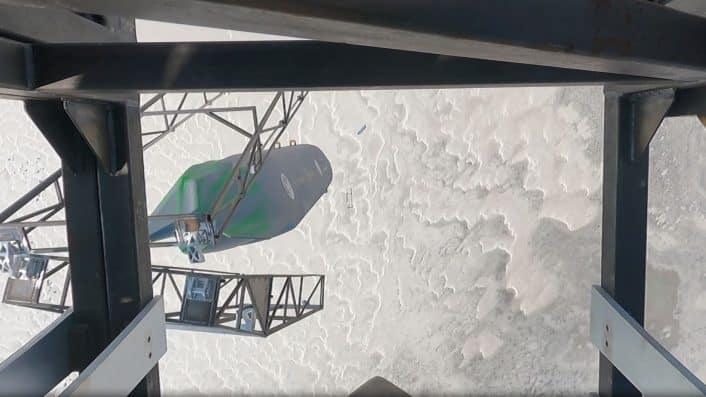
One test at the White Sands Missile Range in New Mexico in August 2021 saw representative missiles ejected from the cargo hold of a C-17A Globemaster III and EC-130SJ. Another test conducted at Eglin AFB, Florida in December 2021 saw the MC-130J Commando II receive targeting data, upload it to the FTV, and then airdrop a four-cell Rapid Dragon deployment system containing a flight test vehicle (FTV) and three mass simulation units.
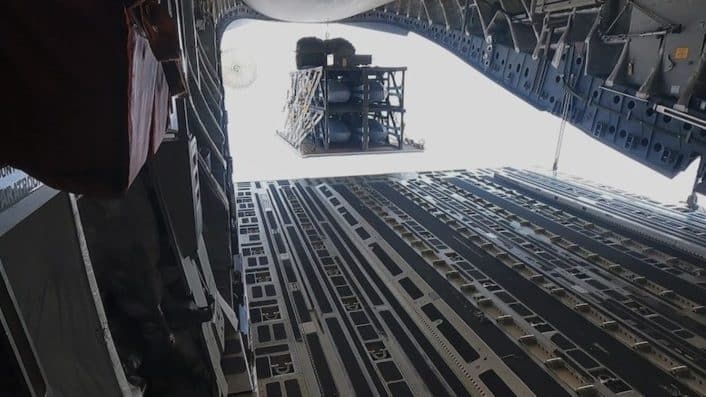
In a third test in November 2022, an MC-130J Commando II from the 352nd Special Operations Wing (352nd SOW) deployed one such pallet over the Norwegian Sea. JASSM-ER successfully exited the pallet and began powered flight.
Regarding the future of the program, an April 20 AFLCMC RFI stated: “The program office seeks to streamline the battlespace by developing a single, common air-to-ground munition that is affordable, adaptable, and possesses significant standoff range. The core concept is a single design that allows for a primary deployment method through Palletized for long-range strike from cargo aircraft. The government is also addressing trade space for a secondary deployment method of the same single design through Lugged: For fighters and additional aircraft. Long distance employment.”
Other industry leaders have also developed their own cost-effective, scalable pallet-launched air-to-ground missiles. These include Leidos’ Black Arrow, which the Air Force designated AGM-190A in February, and Lockheed Martin’s Common Multi-Mission Truck (CMMT). CMMT has a non-powered glide vehicle called CMMT-D and a smaller powered variant called CMMT-X.







