



Following its first flight, the U.S. Navy’s MQ-25 Stingray unmanned tanker has reached Milestone C and received Low Rate Initial Production (LRIP) approval.
Acting Secretary of the Navy Hung Cao announced at a Senate Armed Services Committee hearing on May 19, 2026, that the MQ-25 Stingray unmanned tanker has reached Milestone C and has been approved for transition to Low Rate Initial Production (LRIP). This milestone comes less than a month after the first flight on April 25, 2026.
The LRIP Lot 1 contract for three aircraft is expected to be awarded this summer, according to a press release from the Navy’s Portfolio Acquisition Executive Aviation. The contract also includes pricing options for three aircraft as part of Lot 2 and five aircraft as part of Lot 3.
Today at a Senate Armed Services Committee hearing, I announced that the MQ-25A Stingray is transitioning to production.
Integrating unmanned refueling expands the lethality of our Carrier Strike Group and gives our forces a decisive advantage to fight and win. pic.twitter.com/uBs7Gc5mdX
— Acting Navy Secretary Hung Cao (@SECNAV) May 19, 2026
“Unmanned refueling expands our reach against all adversaries,” said Acting Navy Secretary Hung Cao. “Moving the MQ-25A Stingray to Milestone C and entering production equips our fighters with capabilities that increase the lethality of our carrier strike groups. This is a critical advantage that gives our fighters what they need to fight and win.”
The secretary’s comments were echoed by Portfolio Acquisition Executive Aviation Vice Adm. John E. Dougherty IV, who said, “Milestone C approval marks a significant step for this program. The MQ-25A will provide continuous aerial refueling and unlock greater capacity across the air wing, ensuring the carrier strike group remains lethal, flexible, and forward-ready.”
MQ‑25A Stingray reaches Milestone C and officially enters production. @USNavy We’re one step closer to delivering the world’s first operational aircraft carrier-based unmanned aerial vehicle.
🔗: https://t.co/CtMvxEzdxz
(Photo = Provided by Boeing) pic.twitter.com/cvEZpitCAw
— PAE(A) (@PAEAviation) May 19, 2026
Boeing, which produces aircraft, also welcomed this news. “Boeing is honored to work with our U.S. Navy partners to achieve this historic milestone in the development life cycle of the MQ-25A Stingray,” said Troy Rutherford, vice president of Boeing MQ-25 Programs. “We remain focused on getting these game-changing unmanned aerial vehicles into the hands of the fleet and integrating them into the carrier air wing.”
first flight
After years of waiting, the first test flight of the production representative operational MQ-25A Stingray unmanned tanker took place on April 25, 2026. aeronautical scientist The aircraft landed at MidAmerica St. in Mascoutah, Illinois. It was the first and only media outlet to report on the milestone immediately after landing at St. Louis Airport.
Production limited.
thank you, @USNavyWe look forward to your trust and partnership in the MQ-25A Stingray™. Milestone C paves the way for low-rate initial production. Deploying this game-changing unmanned aerial refueling tanker to the aircraft carrier fleet is our mission and commitment to you. pic.twitter.com/y67O1eOLyH
— Boeing Defense (@BoeingDefense) May 19, 2026
The MQ-25A flew for approximately two hours, with Boeing and Naval Aircraft Pilots (AVPs) controlling the aircraft from the Unmanned Carrier Aviation Mission Control System (UMCS) MD-5 ground control station, which integrates Lockheed Martin’s MDCX system. The Stingray was accompanied by a company-owned TA-4J Skyhawk and a U.S. Navy UC-12M Huron as tracker aircraft.
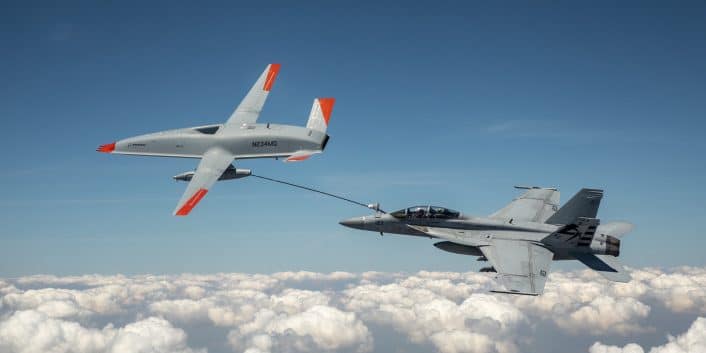
As noted in previous reports, the first flight of the production flagship MQ-25 occurred nearly seven years after the first flight of the T1 test asset on September 19, 2019. The drone was already equipped with the same Cobham ARS pods used by the F/A-18, which can deliver up to 14,000 to 16,000 pounds of fuel at 500 nautical miles, the Navy told Congress in August. 2025 report.
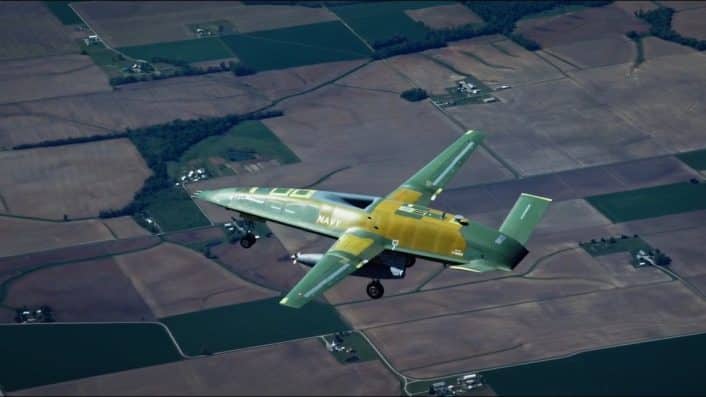
The first flight demonstrated the MQ-25’s ability to autonomously taxi, take off, fly, land, and respond to commands from the GCS. The flight followed a predetermined mission plan that included a series of maneuvers and tests and successfully validated the aircraft’s basic flight controls, engine performance and handling characteristics, according to the Air Force and the company.
The aircraft is the first of four Engineering Development Model (EMD) aircraft to be delivered to the Navy under an $805 million contract awarded in 2018. The company said multiple aircraft are being built to conduct the necessary testing, including four EDM aircraft, five system demonstration test items and two ground test items for static and testing.
MQ-25 Stingray
The Boeing MQ-25 Stingray is an aerial refueling drone that is the result of the Carrier-Based Aerial-Refueling System (CBARS) program, which evolved from the earlier Unmanned Carrier-Launched Airborne Surveillance and Strike (UCLASS) program.
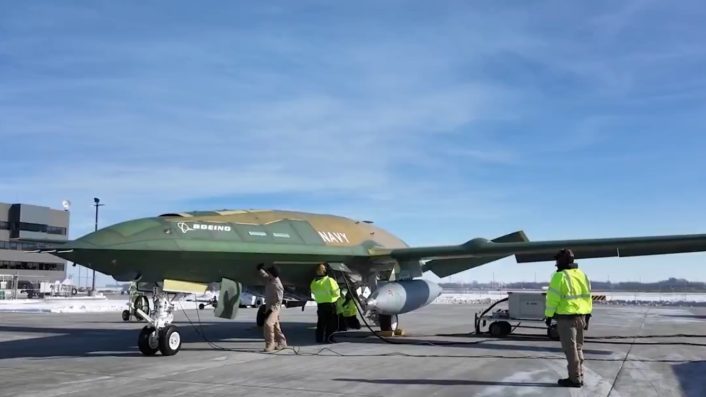
The MQ-25 Stingray’s origins date back to the U.S. Navy’s need for a carrier-based unmanned aerial vehicle (UAV) capable of providing aerial refueling for assets in a carrier strike group. The MQ-25’s primary mission is to significantly expand the endurance and operational flexibility of carrier-based aircraft by providing on-demand refueling support.
The MQ-25 Stingray performed the first air-to-air refueling operation between an unmanned tanker and a manned receiver in 2021. This milestone was achieved by the Boeing-owned MQ-25 T1 test asset, which uses the same Cobham Aerial Refueling Depot (ARS) used by the F/A-18 to perform refueling operations.
The U.S. Navy plans to procure 76 MQ-25s, including engineering development model aircraft and system demonstration test aircraft. It will replace the F/A-18E Super Hornets that currently serve in an aerial refueling role as part of the Carrier Air Wing, allowing more fighters to be used for operational missions.
The MQ-25 will also be the first operational carrier-based UAV. The service says it will serve as a “guide for the future of unmanned aircraft carriers” and “at the forefront of integrating unmanned systems with manned platforms within the CVW.”
“The MQ-25 will relieve the F/A-18E/F Super Hornet of its aerial refueling mission, increasing the overall lethality of the CVW by using a weapon that can replace the refueling storage on the F/A-18’s pylons. As a secondary mission, the MQ-25 will perform recovery tank and organic intelligence, surveillance and reconnaissance (ISR) for the CSG,” the Unmanned Carrier-Launched website says. Multipurpose Squadron 10 (VUQ-10), the Fleet Replacement Squadron (FRS) for the MQ-25 Stingray, was established at Naval Air Station Patuxent River, Maryland, on October 1, 2022.
In addition to VUQ-10, operational MQ-25A squadrons VUQ-11 and 12 are scheduled to be established. Following the first flight, additional sorties are expected before the aircraft moves to Pax River later this year in preparation for carrier qualification, which was scheduled to take place aboard the USS Theodore Roosevelt (CVN-71).







