



Although American Airlines Flight 191 and UPS Flight 2976 were not identical accidents, their similarities attracted serious attention from investigators and aviation safety experts.
On May 25, 1979, American Airlines Flight 191 began a routine mid-afternoon departure from Chicago O’Hare International Airport (ORD).

The McDonnell Douglas DC-10-10 aircraft bound for Los Angeles International Airport (LAX) was carrying 258 passengers and 13 crew members. As I accelerated along Runway 32R and spun into the air, the unthinkable happened. The left engine and pylon separated from the wing, tearing off part of the leading edge. As the aircraft continued to climb, the engine hit the runway and briefly reached approximately 325 feet.
What happened next happened in seconds.
When the engine quit, the leading edge slats of the left wing folded unevenly. Its left wing stalled without warning, and the DC-10 rolled sharply to the left (maximum bank was recorded at 112°). Just 31 seconds after takeoff, it crashed into a field near a trailer park, about 4,600 feet from the runway. All 271 people on board died, as did two people on the ground.

The NTSB later determined that the disaster occurred as a result of the left wing’s outer forward slat retracting without command, resulting in an asymmetric stall and resulting roll. The cause of the failure was traced to separation of the No. 1 engine and pylon assembly due to damage from maintenance.
Investigators found that American Airlines’ maintenance procedures, which included using forklifts to support the engines and pylons during removal and reinstallation, caused hidden structural damage to the top flanges of the pylons. In the aftermath, the FAA grounded the DC-10 fleet for 37 days while inspections and repairs took place.
More than 40 years later, Flight 191 remains the deadliest single aircraft crash in U.S. history.
Steve Forness, an aviation safety expert and managing director of Air Flight Technical, later pointed out the design vulnerabilities exposed that day. He noted that in both the DC-10 crash and the subsequent UPS incident, the engine appeared to spin around the forward bulkhead before completely leaving the wing.
A reputation the DC-10 never fully recovered from.

The accident did more than destroy an aircraft. This seriously (and permanently) damaged the DC-10’s reputation.
In the days that followed, the FAA temporarily revoked the aircraft’s type certificate, grounded all U.S.-registered DC-10s, and banned foreign DC-10s from U.S. airspace. Even after modifications to the slate, warning system and power supply, public trust was never fully restored.
After Flight 191, the DC-10 became a symbol of danger to the flying public, whether that reputation was entirely fair or not. Sales suffered. McDonnell Douglas lost approximately $200 million in market value, and production of the DC-10 ended in 1989 after 386 aircraft had been built.
Aviation has always had technologically improved aircraft following tragedies. However, public perception may be that they are more difficult to repair than metal.
Louisville: UPS Flight 2976

On November 4, 2025, as another McDonnell Douglas triple jet rolled down the runway, history seemed to reverberate in a chilling way.
UPS Flight 2976, an MD-11F cargo plane, departed from Louisville Muhammad Ali International Airport (SDF) and was bound for Honolulu (HNL). The aircraft was built in 1991 and has accumulated over 93,000 flight hours and over 21,000 cycles. There were three crew members on board the ship.
Immediately after V1 on Runway 17R, the left engine and pylon separated from the aircraft.
MD-11 climbed approximately 30 feet before losing control. It crashed into an industrial area south of the airport, hitting several buildings and bursting into flames. All three crew members were killed and 12 people on the ground were killed. 51 days after one of the victims died from injuries, the final death toll was 15. Additionally, 23 people on the ground were injured.
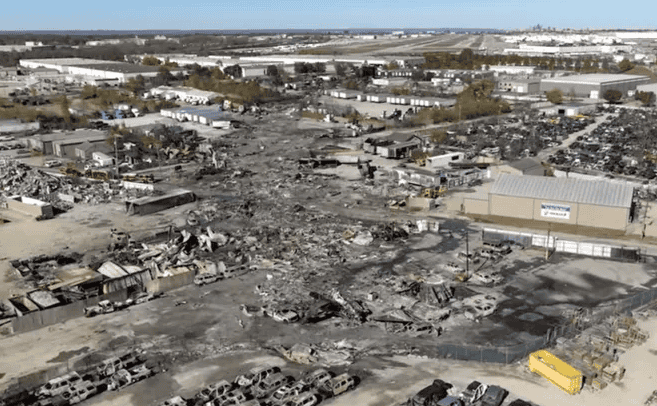
This was the deadliest accident in UPS Aviation history.
The NTSB’s preliminary report and subsequent hearing identified fatigue cracks in the rear mount of the left pylon, specifically the rear and front lugs of the spherical bearing assembly. Investigators found that metal fatigue and excessive stress were the causes of the failure.
The similarities to American Airlines Flight 191 cannot be ignored. Both aircraft were from the same McDonnell Douglas wide-body triplejet family. Both lost their left number one engine and pylon during takeoff. Both aircraft became uncontrollable almost immediately. Both accidents ended in fire, fatalities, and loss of life on the ground.
In response, the FAA temporarily grounded the MD-11 fleet. This represents a significant portion of the UPS fleet (approximately 9% of the total fleet). In the weeks following Flight 2976, the airline announced the early retirement of its remaining MD-11s, completing the phase-out in early 2026.
Former NTSB major accident investigator Stephen Carbone raised concerns about large-scale maintenance oversight, warning that airlines could lose control if major maintenance tasks are outsourced. He noted the need for stronger FAA and airline oversight of third-party maintenance, repair and overhaul providers.
Similarities, Differences, and Lessons Learned

The similarities between American Airlines Flight 191 and UPS Flight 2976 are striking, but the accidents are not identical.
The 1979 crash was caused by maintenance damage during engine removal and reinstallation. The NTSB’s findings so far indicate the 2025 crash was caused by long-term metal fatigue in a key bearing assembly. One incident was caused by a hazardous maintenance procedure. The other involves old structural parts that fail after years of use.
Nonetheless, both incidents point to the same uncomfortable truth. This meant that the aircraft’s engine pylon structure was a critical area where failure could quickly lead to disaster.
At the NTSB hearing, FAA technical expert Dr. Melanie Violette explained that decades ago the severity of bearing failures was misunderstood. At the time, this was not considered critical to the integrity or safety of the aircraft.
These details may be one of the most important lessons learned from Louisville.

Commercial aviation today is much safer than it was in 1979. Maintenance practices, inspection techniques, crew training, certification standards and supervision have all improved dramatically. But Flight 2976 shows that even mature aircraft designs can still have hidden risks. This is especially true as aircraft age and airframes require cargo service long after their passenger careers have ended.
The DC-10 and MD-11 are now largely gone from the skies, with only a few exceptions still flying. But the lessons of Chicago and Louisville will remain part of the safety conversation for years to come.
Commercial aviation is much safer now than it was in 1979, but Flight 2976 showed how quickly old, proven designs can become dangerous if hidden structural problems are missed. This is especially true for cargo aircraft, which continue to fly long after passenger service ends and undergo many challenging flight cycles.
Although the DC-10 and MD-11 have largely been removed from regular service, the problems raised by the Chicago and Louisville crashes will not soon be forgotten. Now investigators, airlines, regulators and maintenance teams are focused on finding what was missed, understanding why and ensuring these kinds of failures never happen again.
The final NTSB report on Title 2976 is expected to be released this November.







