



Boeing unveiled new features in its MQ-28 Ghost Bat roadmap at ILA Berlin 2026, including internal weapons bays and larger wings.
Boeing unveiled new features to be added to the MQ-28 Ghost Bat as part of its drone technology roadmap at the ILA Berlin 2026 Airshow. The company said this will “further enhance the flexibility, reach and capacity of our platform for our global customers.”
What’s new
Announced improvements include a 25 percent larger wing that will allow the MQ-28 to carry an additional 2,000 pounds of fuel, storage and mission payload. The increased wingspan allows the drone to reach a maximum takeoff weight (MTOW) of 12,000 lb (5,400 kg) and payload of 4,500 lb (2,000 kg).
“The additional capacity gives operators the freedom to balance payload and endurance to suit the mission at hand, whether that means carrying additional fuel for long-range operations, increased weapons carry, or a combination of the two,” said Glen Ferguson, MQ-28 global program director.
✅ >25% larger wings
✅ Increased fuel and payload capacity
✅ Beyond line-of-sight functionality
✅ Internal weapon stations to increase mission configurabilityThe MQ-28 Ghost Bat enhancements provide increased flexibility, range and capacity.
See more: https://t.co/IPZLUy5Qub pic.twitter.com/7EK5fUD11h
— Boeing Australia (@BoeingAustralia) June 10, 2026
Upgrades also apply to software that complies with government reference architectures and a modular mission nose. This architecture customizes weapons, payloads, command and control, and mission autonomy based on the customer’s operational requirements, while the upgraded nose provides enhanced payload configuration options and supports third-party capability insertion.
The new provisions allow it to internally carry two AIM-120 AMRAAM missiles or four GBU-39/GBU-53 small diameter bombs (SDBs). Additionally, Boeing said there is an option for three external weapons stations if the customer requests them.
The upgrade is complete with Beyond Line of Sight (BLOS) communications, allowing the MQ-28 to be controlled “from an unlimited distance.” The Ghost Bat has a range of more than 2,000 nautical miles (3,700 km), and operators control it from a surface or aerial platform.
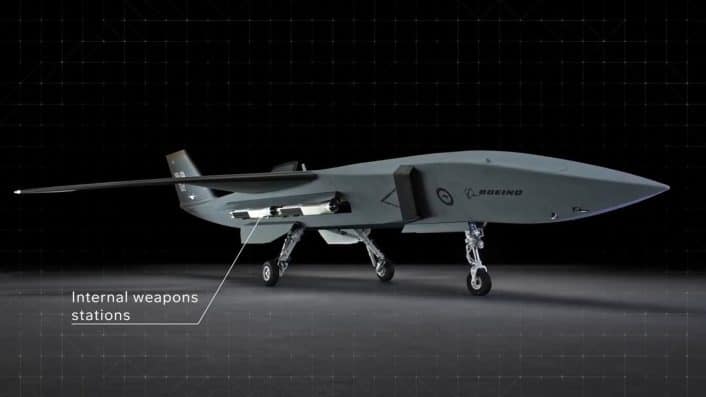
“Developed in partnership with the Royal Australian Air Force, these capabilities will be progressively rolled out to the fleet through a spiral upgrade program and made available to interested allies,” Ferguson said. “The inclusion of capabilities like the BLOS capability is a direct result of our learning to date, along with feedback from the Air Force as they understand more about the role and integration of CCA into joint force operations.”
In its press release, Boeing did not link the new capabilities to Block 2 or the upcoming Block 3 of the MQ-28 currently in production. However, the new features appear to be consistent with some details already revealed in Block 3.
Aviation Weekly Report Earlier this year, Block 3’s wingspan was increased to 20 feet (6 m), but now 25 percent of its 24 feet (7.3 m) span is just 6 feet (1.8 m). Block 3 was also expected to include weapons bays sized for AMRAAM and SDB.
Additionally, Boeing said it recently conducted radar cross section (RCS) testing on the MQ-28. The company said the test validated the aircraft’s stealth capabilities, which improved the Ghost Bat’s survivability.
“The advanced maturity of the MQ-28 system allows it to continuously adapt to a changing operational environment and minimize risk as it transitions to operations,” Amy List, vice president and managing director of Boeing Defense Australia, said at ILA 2026. “These capability enhancements, combined with the MQ-28’s confirmed low observability characteristics and survivability upgrades, support more flexible mission concepts and allow defense customers to spread operational risk.”
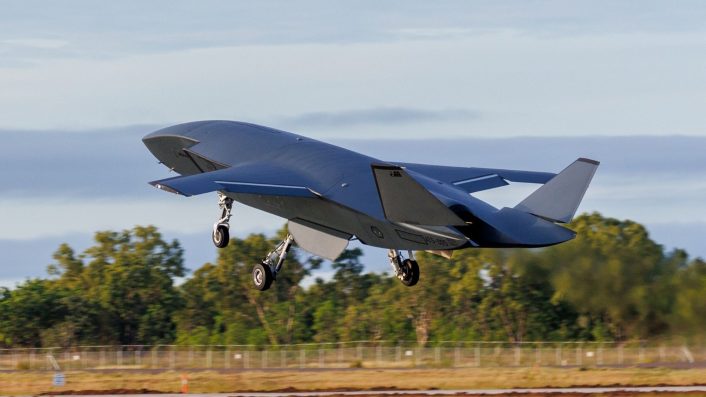
MQ-28 Ghost Bat
Designed by Boeing Defense Australia for the RAAF as a multi-role system capable of operating with crewed aircraft, the Ghost Bat was initially known as the Boeing Airpower Teaming System (ATS). Development began in 2013, and the prototype was first unveiled at the 2019 Australian Airshow, with its maiden flight taking place at the Woomera Range Complex in southern Australia on February 27, 2021.
The multipurpose unmanned platform has a 1.5 cubic meter nose that can accommodate interchangeable payloads for intelligence, surveillance and reconnaissance (ISR), airborne radar surveillance, EW/ELINT sensors and other attack munitions. The aircraft has been described as the next-generation Loyal Wingman, with 55 Australian companies involved in its development and, as of February 2024, receiving $600 million in funding.
According to Boeing, the Ghost Bat “utilizes artificial intelligence (AI) to collaborate as a smart team with existing military aircraft to complement and expand its airborne mission.” The size of a compact, lightweight fighter jet with side air intakes, cranked kite wings and a slanted V-shaped tail, the MQ-28 can fly nearly 2,000 miles (3,200 km) and can “fly independently” through AI.
Boeing’s renderings showed the Ghost Bat flying with support and special mission aircraft such as the E-7A Wedgetail AEW&C aircraft and the F-15EX. According to Ferguson, “During a typical mission, launch and recovery operators (…) supervise the aircraft while it is in flight.”
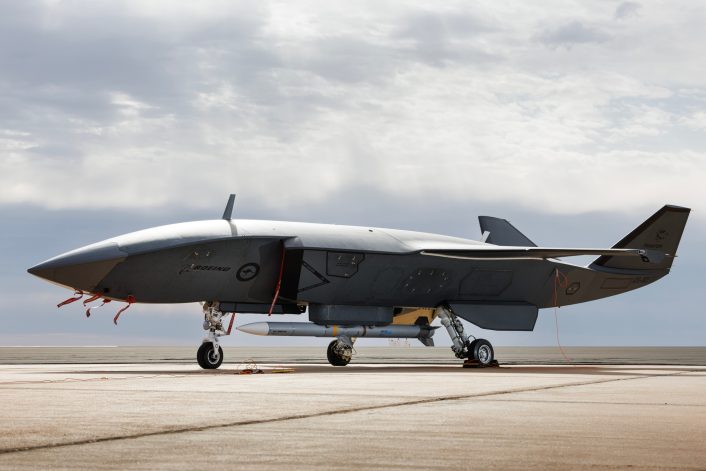
Explaining the operational concept, Ferguson added, “It is then handed over to a crewed aircraft, such as an E-7A, F-35A, or F/A-18F, where the crew performs intelligence, surveillance, and reconnaissance missions.” Manned-unmanned teaming (MUM-T) does not necessarily have to be conducted in close formation, but can operate even when the aircraft are tens of kilometers or more apart, depending on mission requirements.
The stealth-oriented design has also been seen in the renders, which feature three nose sections with integrated Infrared Search and Track (IRST) sensors. Depending on their appearance, the other two could imply ISR and EW/ELINT roles, the latter being concerned with locating, jamming or overwhelming enemy ground radars.
The MQ-28 can also serve as an escort for high-value support assets such as E-7A AEW&C aircraft or KC-30 tankers. However, it is not known whether unmanned aerial vehicles are considered vulnerable systems used to improve the survivability of manned platforms. After the mission is complete, “the aircraft will be returned to the launch and recovery operator to oversee the landing, deceleration and complete stopping of the vehicle,” Ferguson said.
Unmanned aerial vehicles have reached several important milestones in the past year. Among them was a June 2025 test that saw an E-7 Wedgetail control two MQ-28s on a mission against simulated aerial targets.
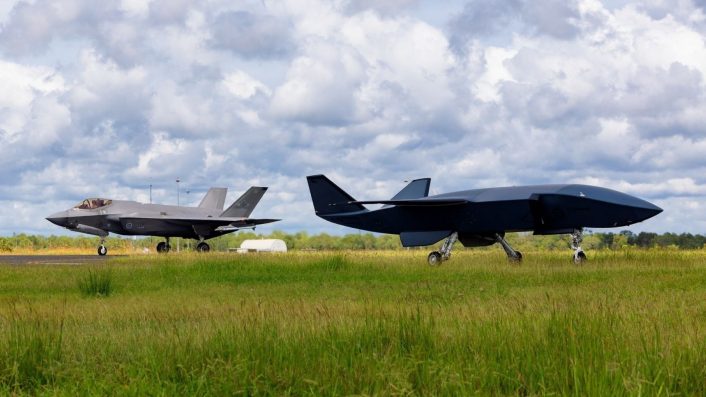
In December 2025, Boeing unveiled the first live-fire test of the MQ-28 equipped with the AIM-120 Advanced Medium-Range Air-to-Air Missile (AMRAAM). At the time, the aircraft teamed with the Royal Australian Air Force (RAAF)’s E-7 Wedgetail and F/A-18F Super Hornet.
The RAAF described it as “a demonstration of Cooperative Combat Aircraft (CCA) using air-to-air weapons against aerial targets in an operationally relevant scenario.” The Ghost Bat likely served as an offboard weapons release platform, leveraging sensors, detection, control and guidance data from the crewed platform.
In May 2026, Boeing revealed that the MQ-28 Ghost Bat is currently flying what is defined as its first overseas flight in the United States. Previously, the aircraft only flew in Australia, where the MQ-28 was developed and built by Boeing Australia.
To date, the drone has completed three operational flight tests in the Point Mugu Sea Range off U.S. Naval Station Ventura County at Point Mugu, California. The company did not disclose when these flights were conducted.
However, it is already known that at least one MQ-28 was at NAS Ventura County, as the aircraft was clearly visible in a video released after its installation by U.S. Secretary of War Pete Hegseth in December 2025. However, since two different aircraft can be seen in the videos from December 2025 and May 2026, it is possible that two aircraft are there now.







