



The long awaited Defence Investment Plan has finally been published for public viewing and it seemingly generates more questions for UK Defence than it answers.
In one of his last acts as Prime Minister of the United Kingdom, Sir Keir Starmer has released the UK’s Defence Investment Plan (DIP), cementing the largest sustained funding increase for the UK’s Armed Forces since the Cold War. Questions however remain as to whether the document and the commitments within it go far enough, fast enough, to deter and, if needed, defeat the threats facing the UK today.
The DIP is based on findings that emerged from the UK’s Strategic Defence Review (2025) published just over a year ago, in which the threat of the Russian Federation was labelled “an immediate and pressing threat” to UK sovereignty and NATO security. The DIP was supposed to be published not long after the SDR.
However, questions quickly arose as to how the government would find the money to expand the Armed forces in the face of both the threat posed by Russia and later by growing instability in the Middle East. So too did question’s emerge around some of the defence programmes announced in the SDR, including the RAF’s re-adoption of the nuclear strike role and the continued disruption and ongoing problems surrounding the Army’s next generation reconnaissance vehicle Ajax, among others.

This led to a severe delay in the publication of the DIP as the government was forced to deal with the ongoing strife caused by the above issues. Further problems arose two weeks ago, when Defence Secretary John Healey, who had a hand in producing the DIP, suddenly resigned, believing that the Prime Minister was “unable” to find the money, with the treasury being “unwilling” to provide any extra.
It was then reported that of the £28bn requested by the Armed Forces only £13.5b was made available by the Treasury, forcing the Armed Forces to make cuts that were unsustainable, so as to afford increases in spending on other capabilities. This represented only 2.68% of GDP spent on core Defence by 2030, far below the set NATO target of 3%.
Even after Healey’s resignation and the increased spotlight on Defence spending, the Treasury has only promised £15bn in added spending, which is still below what the Armed Forces has requested, prompting sharp criticism from both outside and within the Labour Party.
Watch live: my speech on defence. https://t.co/dakuzY637u
— Keir Starmer (@Keir_Starmer) June 30, 2026
Sir Keir Starmer in his speech announcing the DIP stated: “This plan delivers on last year’s Review, but in light of our rapidly changing world, the changing nature of conflict and the imminent and growing threats we face, it goes further still.”
The Defence Investment Plan sets out how we’ll invest in defence, at a time in which our Armed Forces matter more than ever.
In my message to Defence I set out our focus to move faster and more effectively to equip our people and deliver the capabilities our nation needs. pic.twitter.com/dswjCO2w5P
— Chief of the Defence Staff (@UKCDS_MOD) June 30, 2026
Whilst, in a message to British defence personnel, the UK’s military chief Sir Richard Knighton emphasised that “difficult choices” have been made as part of the government’s announcements. As a result, a number of cut capabilities and cut programmes are present in the DIP, with deep impacts felt by the military.
But the question remains, what does this mean for the UK’s Armed Forces?
Good News for UK Air Power
Whilst there is disappointment over many programmes within the DIP, this is still a noticeable increase in defence spending and an expansion of the UK’s Armed Forces, which had been since the Cold War on an ever turning downward spiral.
For starters, the DIP has secured £8 billion in investment for the Royal Air Force’s Global Combat Air Programme (GCAP), ensuring that the next generation manned fighter will see service. Concerns had been growing for some time in Japan and Italy about the UK’s willingness to pause funding or to delay the programme over treasury concerns, but this announcement ensures the programme can continue with a jet demonstrator aiming to take off in late 2027.

Alongside this, £250 million is being spent on Project PANTHEON, the UK’s new investment in collaborative combat aircraft (CCA) for the Queen Elizabeth class aircraft carriers to enable the formation of a “Hybrid” carrier air wing. Money will be spent on developing a new CCA for the Royal Navy to operate alongside the F-35B, with money also spent on trials aboard the carriers and any upgrades necessary for the operation of these aircraft.
More importantly, however, money has been put aside for the operation of a drone based AEW&C system, allowing the much maligned CROWSNEST helicopter-borne AWACS to finally bow out, given its short and ineffective tenure as the UK’s primary airborne radar capability.

It is looking highly likely that the Royal Navy will acquire a variant of Saab’s LoyalEye radar sensor to be paired with a short take off unmanned MQ-9B aircraft produced by GA-ASI. This would be the first time the Royal Navy has flown a fixed wing AEW&C aircraft off an aircraft carrier since the retirement of the Fairey Gannet in the 1960s.
The RAF is excited to announce the procurement of 12 new F-35A jets.⚡💪
These fifth-gen aircraft can fly in @NATO nuclear crisis missions, strengthening our nuclear deterrence, & ensuring we are ready to fly, fight and win against threats.
Read more: https://t.co/5Oj0v2Ft4R pic.twitter.com/NT6MOo8ogg
— Royal Air Force (@RoyalAirForce) June 25, 2025
On the nuclear front, the RAF is confirmed to be ordering 12 F-35As, allowing the UK to join NATO’s nuclear mission and re-equip itself with free fall nuclear weapons. More importantly, however, is the impact that will be felt in 207 Squadron, as these aircraft will help to relieve the training burden that currently falls on the F-35B.
The Bravo variant is more maintenance intensive and has a shorter range, so buying a number of Alphas will allow for longer training sorties per day. This generates a better value for money out of the whole platform, with F-35Bs focused more on the carrier strike mission than before.
Great News for the Royal Navy
£63 billion has been ring fenced for the Royal Navy’s nuclear enterprise, which ensures the recapitalisation of the entire force, at a size not seen since the Cold War. This money means the continued upkeep of the four Vanguard class nuclear ballistic missile submarines (SSBN), and continued funding for its replacement the Dreadnought class.
An important line in the DIP also announced that planning will be conducted for the Dreadnought’s eventual successor. Planning this far ahead aims to prevent problems similar to what are ongoing today in which delays to planning and funding the Dreadnought class led to the Vanguards serving far longer than intended.
As a result of their age, these boats are enduring extended maintenance periods and life extension programmes that force individual boats on six month long patrols, taxing the crew, the boat and the wider naval service.
1. Dreadnought
The Defence Nuclear Enterprise currently accounts for c.18% of the Defence budget with RUSI recently writing that could rise to 25% within the lifespan of this plan.
Dreadnought is a non-negotiable but it will be interesting to see just how much of the budget it… pic.twitter.com/OtDqZgaSwP
— Ben Obese-Jecty MP (@BenObeseJecty) June 30, 2026
Money will also be spent on giving the UK’s Trident nuclear missiles a new warhead, enabling their continued use in the nuclear deterrent into the 2040s. The government has also doubled down on its plan to build “up to” 12 SSN-AUKUS submarines for the Royal Navy, doubling the current fleet from its current number of six Astute class attack submarines.
The phrase “up to” is a concern and indicative that a number could be cut for cost saving measures in the future, as happened with the Type 45 destroyer in which from the ten originally ordered, only six were built.

The most significant announcement affecting the submarine force is the £26 billion being spent over the next decade in Project Royal Oak, which will upgrade the Royal Navy’s bases at Faslane, Portsmouth and Devonport. The Royal Navy has struggled with submarine maintenance as a result of only having a small number of drydocks with the Vanguards taking up most of the maintenance space as a result of their age.
This has forced all six of the Astute SSNs to be stuck alongside in Devonport as no dry docks are available for maintenance to be carried out. This investment for the funding of three new floating dry docks at HMNB Faslane will allow the submarines to be out doing their job rather than rotting alongside.
The Stockpile Expands
Beyond the Royal Navy, £11 billion is to be spent on increasing munitions stockpiles for the Armed Forces, allowing the UK to pursue its conventional deterrent of operating 7,000 missiles that can hit Russia if war came to pass. These weapons will feature a high low mix, with new investments into MBDA’s Stratus long range cruise missile, as well as low cost alternatives such as those found in Project BRAKESTOP.
The UK will also invest in its collaboration with Germany on the 2000 km Deep Precision Strike missile (DPS), unlike the Stratus they will be primarily ground launched, although the government will explore air and naval capabilities for the missile.

The UK will also join the United States and Australia in the Precision Strike Missile (PrSM) Programme. This missile is a next-generation, surface-to-surface ballistic missile developed by Lockheed Martin to replace the aging MGM-140 ATACMS.
It can be launched from existing HIMARS or M270 platforms of which the British Army operates a significant number, with more ordered as a result of their fantastic use in Ukraine. Their range of 499+ km will allow the UK to provide a powerful long range weapon for NATO in the case of a conflict with Russia.
The DIP seems to confirm that the UK will purchase Lockheed Martin’s PrSM tactical ballistic missile. This was hugely effective when used against Iranian military targets. Unfortunately, the USA exhausted its entire stock, which conveniently means we will have to wait before… pic.twitter.com/2FYj5KzNHr
— Nicholas Drummond (@nicholadrummond) July 1, 2026
The Royal Navy’s Type 31 Inspiration class frigates have also been selected to operate the Norwegian Naval Strike Missile (NSM), enhancing the firepower of these smaller general purpose frigates, which many had called under armed for their intended role. While Stratus will eventually become the ship-launched cruise missile of choice, the NSM will allow the Type 31s to operate with a significant firepower boost until Stratus is mature enough for operations.
Finally, the UK will invest £5 billion for the next four years to fund a drone transformation, using lessons from Ukraine to make the Armed Forces manned when necessary, and unmanned where able. It is hoped that in doing so the UK’s Armed Forces can expand its size and effectiveness whilst keeping personnel count the same, which has been a long term issue for the UK in general.
This will help to fund the use of surveillance, attack and uncrewed ground drones for the British Army as well as the new Hybrid Navy concept which will see unmanned warships take the place of conventional platforms.
Defence Cuts
As with any news on defence investment, it comes with hard choices that foresee the end of capabilities that the military has relied on for many years. The DIP is no different, with two aircraft leaving service much earlier than expected, joined by more Type-23 frigates as well as the fabled Storm Shadow missile.

Firstly, and as discussed in their own separate articles, the Wildcat AH1 Battlefield Reconnaissance Helicopter and the Shadow R1 surveillance aircraft are to be retired earlier than expected. The government cites a difficult cost benefit analysis as to the primary reasoning for the retirements, with both systems not considered survivable in peer conflict due to the prevalence of advanced surface to air missile systems on the modern battlefield.
In Ukraine a large number of helicopters have been lost to ground fire, with the recon role now taken over almost entirely by drones. Separately, attack helicopters such as the Kamov Ka-52, whilst taking an extreme number of losses, have performed well in the anti-tank role, with these aircraft cited as having blunted Ukraine’s armour led counter attacks in Zaporizhzhia back in 2023.
Whilst the Apache gets a stay of execution in the British Army, sadly the Wildcat does not.
The Army’s 34 AH1 Wildcat helicopters are being axed (unclear if they will be held in storage, transferred to the RN or sold abroad). Helicopters have struggled to survive over the battlefields of Ukraine. Fortunately, the RN’s Wildcats survive the axe.
Meanwhile, in March the… pic.twitter.com/exXEXVJk5a
— Navy Lookout (@NavyLookout) June 30, 2026
For the UK, this is a pivot away from the counter insurgency military that the British Army had become to fight the wars in Afghanistan and Iraq. With peer war on the horizon, it is understandable that systems of increasingly limited utility are being axed to save cash for more survivable capabilities.
For the Wildcat, it will be replaced by a fleet of 24 armed autonomous drones that will operate alongside the AH-64E Apache under Project NYX. Whilst the Shadow R1 will be replaced, likely in part, by the Protector RG1 already in service which contains very similar electro-optical equipment and subsystems.

There are still questions about exactly how their replacements will work, as helicopters are useful in a variety of other roles, such as the movement of troops and supplies around the battlefield which the drones may not be able to fulfil. Additionally, the Shadow replacement will not have the dedicated analysts on board to assess intelligence as the aircraft is in flight due to its unmanned nature, so it will be interesting to see how the Armed Forces deal with any of these limitations. The Wildcat in operation with the Royal Navy will remain in service, although at some point in the future it will also be replaced by a drone.
It has also been confirmed that the Duke class Type 23 frigate will leave service two years sooner than the Navy had wanted, being axed by 2033 instead of 2035. These stalwarts of the fleet have served far longer than their original intended 18 year service life and the material state of the ships is now downright condemnable.
Markings on hull of Ex HMS Northumberland (in Fareham creek awaiting scrapping) indicating plate thickness and clear demonstration of why so many of the Type 23 frigates are becoming beyond economic repair
Via @AWenham1 pic.twitter.com/K3DsDkrMHl
— Navy Lookout (@NavyLookout) May 10, 2026
The fact that they have served as long as they have is nothing more than a miracle thanks to the teams of engineers and mechanics that have worked tirelessly to keep these ships operational. HMS Richmond, which came back from the carrier strike group last year, is to be retired this year and the others will follow suit as the Type 26 and Type 31 frigates join the fleet.

The final loss of note is the Storm Shadow missile employed by the RAF from the Typhoon FGR4, even if these missiles have proved to be exceptional over their years of service. They have been deployed by RAF Tornado GR4 fighter bombers on operations from Iraq War in 2003, to Libya in 2011 and lastly in Syria in 2018, before they were replaced by the Typhoon.
They are to be replaced in service both by the Stratus future cruise/anti-ship missile as well as with missiles provided by Project BRAKESTOP, constituting a high-low mix for the UK’s Armed Forces, ensuring more bang for their buck.

In essence, the provision of Storm Shadow to Ukraine has shown how expensive missiles can be devastatingly effective if used correctly, but that their limited numbers can place a bottleneck on the country using them. Currently the vast majority of Storm Shadow missiles produced by MBDA are sent to Ukraine, with the company having restarted production on the missile so that they can maintain the supply.
However, the high costs have meant that number remains low, and this is something that the UK wants to avoid in the future. It is unknown when the last Storm Shadow will be employed from an RAF Typhoon but, with Stratus on the horizon, its time has sadly come.
Hybrid Navy and Amphibious Warfare
Alongside the above cuts, the Royal Navy has also seen the cancellation of the planned Type 32 Frigate and the Type 83 air warfare destroyer. Whilst these ships were still unfunded concepts, they represented an expansion of the Royal Navy to include another surface combatant in the Type 32, and the next generation of air warfare destroyer in the Type 83, a class of ship that has proved to be invaluable over the last three years.
American Arleigh-Burke class destroyers and the British Daring class Type 45 provided air defence to civilian shipping in the Red Sea, whilst they were under concerted attack by the Houthis. Many cruise and ballistic missiles fell to these systems, which the Royal Navy now seemingly wants to abandon entirely.

The Daring class will instead be retired early in 2035, with no life extension, despite most ships of the class having well preserved hulls as a result of their early engine trouble. Instead the Royal Navy will move to use unmanned systems in place of the manned Type 45.
Dubbed the “Hybrid Navy”, £1.5bn has been assigned to produce a new class of six manned Common Combat Vessels (CCV) which will act as control ships, acting alongside a fleet of uncrewed systems. These are the Type 91 missile platform, the Type 92 uncrewed underwater sensor platform, the Type 93 extra-large uncrewed underwater vessel (XLUUV) and the Type 94 uncrewed radar platforms.
Each ship will have its own specific function, allowing creating a disaggregated network of systems that make the overall fleet more survivable. The idea being more ships, more targets, a more survivable fleet. As of right now however, the CCV is completely undefined in its scope and its armament, with some fearing that it will be entirely unarmed and unable to defend itself.

Moreover, many naval officers have questions around the seakeeping of such vessels, their numbers, their cost and their survivability once they are hit. Traditionally, the crew will perform damage control duties, fighting fires and patching the hull below the waterline to save the ship after it has been hit. During the Falklands War at least three warships, HMS Plymouth, HMS Glasgow and HMS Argonaut, were saved by manual firefighting and damage control after they were hit by Argentine bombs.
Latest analysis article:
All in on the hybrid navy – the Royal Navy’s surface fleet gamble https://t.co/LJwgsod568 pic.twitter.com/P11ITcHxOX
— Navy Lookout (@NavyLookout) June 29, 2026
If an unmanned missile barge is hit, the warship will be reliant on automatic fire suppression to save the entire vessel as there will be no crew. This could be a risk and leaves the unmanned vessel exposed to even just accidents.
In the year 2000 HMS Nottingham, a Type 42 destroyer, ran aground near Australia as a result of a large submerged rock that was missed on the ships charts. The ship had multiple compartments flood, but it was saved by the damage control efforts of the crew.
Much will have to be done to ensure these drone ships are up to this task. Even with AI and autonomous controls accidents can and will happen, which can risk millions of pounds worth of defence equipment.

The Hybrid Navy is a gamble partially forced by the lack of extra funding for the Royal Navy, cancelling a proven concept and going all in on a fleet design that no other nation is investing in anywhere near as heavily. This could be either extremely advantageous for the Royal Navy, and another HMS Dreadnought moment in which the Royal Navy redefines naval warfare, or it could end up a total disaster that costs more than the original concept.
Additionally, the UK’s amphibious force is also changing with the cancellation of the planned multi-role strike ship (MRSS), a planned warship that would seemingly combine the amphibious capabilities of older designs with a vertical launch system (VLS), allowing for their own self-protection and the protection of the wider fleet. In their place is a plan to rejoin the Dutch programme for a smaller Amphibious Transport Ship, which the UK had initially left in 2024 due to differing requirements. The MRSS needed a VLS to allow the ship to lessen the burden on the fleet’s low number of escorts with a further spreading out of air defence assets across the fleet.
The Defence Investment Plan drops the bespoke Multi-Role Strike Ship as too complex and commits the UK to a joint amphibious fleet with the Netherlands, built around the Dutch Amphibious Transport Ship.https://t.co/vkjyRFXLXW
— UK Defence Journal (@UKDefJournal) July 1, 2026
Instead, the Hybrid Navy will have to pick up the slack, requiring a significant number of missile and radar barges containing expensive interceptors that will likely increase the costs of the whole system anyway. The cancellation of the MRSS in favour of the Dutch design is likely an issue of cost and scope, with the Royal Marines themselves changing their force design, owing to the difficult realities of contested sea landings in an age of strike drones and long range cruise missile attack.
What is Missing?
What many were expecting from the DIP is that it would make hard decisions on a large number of capabilities in the Armed Forces that are lacking or causing problems. For example, it was hoped amongst many that the DIP would come to a decisive decision on the Ajax programme, which continues to delay, with many fearing that the vibration issues on the vehicle mean that it will not enter service.
This is heavily anecdotal, but the Ajax reconnaissance vehicle was not even run around this year’s Tankfest event held at the Tank Museum in Bovington, whilst other vehicles such as the Challenger 3 made their public debut, to serious fanfare.

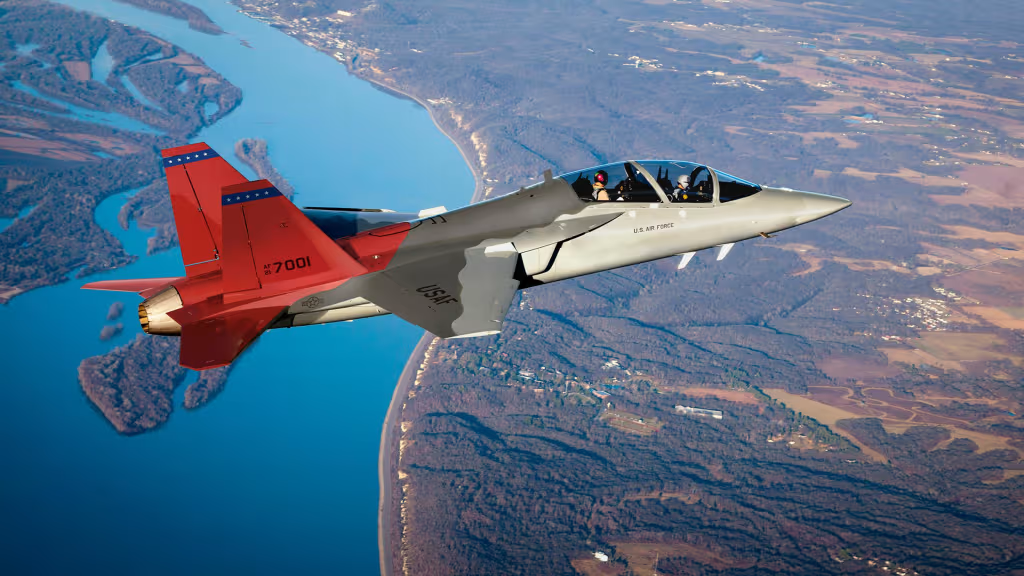
It seems that, despite the DIP’s publication, the Armed Forces are still waiting on decisions as to how the money that has been allocated will be spent. We had been hoping that the DIP would reveal which new jet trainer would be bought for the RAF to replace the Hawk T2 and the T1 for the Red Arrows.
£360m has been assigned, but no decision has yet been made on the programme. Rumours had been swirling that the RAF would also buy more Texan turboprop trainers, but this too has not been confirmed or denied.
The Red Arrows’ Hawk replacement now feels much closer after the recent MOD funding announcement.
These AI-generated concepts show a few possible futures: T-7A Red Hawk, M-346 Master or T-50 Golden Eagle.
Which aircraft would you like to see the Reds fly next? pic.twitter.com/ytDBKgZLSM
— European Airshows (@EuroAirshow) July 2, 2026
There was also no new information on the F-35B orders for the Fleet Air Arm and the RAF, in which more are expected, but few are confirmed. The future of the programme and the order of 138 over the lifetime of the jet, is still completely unknown. There is also no mention of further E-7 Wedgetail orders nor A-400M Atlas which the RAF needs to uplift their AEW&C and air transport capabilities, which are currently limited by low numbers.
Shockingly, there is almost no information about the future of British ballistic missile defences. £790m has been supplied for new homeland Integrated Air and Missile Defence systems but the majority is taken up by enhancements to existing infrastructure and radars.
No money is currently being spent on a ground based missile defence system capable of protecting key sites and cities like Lossiemouth and London from ballistic missile attack. The drone strike on Cyprus should have highlighted how vulnerable the UK is to even low end threats, with the country at risk of being dragged into conflicts in which the deployment of ballistic missiles is extremely common.
Only one line in the entire document highlights this with “Long range ground-based air and missile defence systems to protect the UK – including against ballistic missile threats.” An unfunded decision pushed back to 2030, with the country instead reliant on the Royal Navy’s destroyers, which is completely impractical given ship numbers and other defence priorities.

The DIP does include a line stating that the British Army will double its active number of Sky Sabre batteries, with over £350 million allocated to the task. Sky Sabre is by all means an excellent SAM system, with all its aggregate parts able to operate up to 15 km apart on the battlefield.
However, it only has a range of 120 km due to its use of the Common Anti-Air Modular Missile (CAMM), which means it cannot target ballistic missiles. Whilst CAMM is an excellent medium range air defence missile, it is prioritised for force protection and so it cannot protect the UK from the high end missile threat which is terrorising Ukraine on a daily basis.
More must be done on this front to strengthen the nation’s air defences in the manner that France and Germany are doing.
Conclusion
The DIP is unfortunately a mixed bag for the UK’s Armed Forces. There is an awful lot of good news that should give some programmes and defence officials a fair amount of breathing room to continue their work. GCAP appears to be secure with the RAF and the Royal Navy’s nuclear enterprise coming out as the clear winners of the DIP. Yet, the Royal Navy’s surface fleet appears to be at risk with a shot in the dark program that has an equal chance of success or failure. The Army too comes a cropper with little mention in the DIP beyond investment in drones and the continuation of Ajax, which is ever in doubt.
Whilst the RAF may become “Europe’s first 6th Generation Air Force” more must be done to ensure other avenues of defence are properly funded so that capability that is desperately needed is not cut ever further. Even more so, it is what is not said in the DIP that is even more worrying, with requirements and decisions delayed until the next funding plan under the next Prime Minister. This is most obvious with £5bn of the extra allocation to defence coming from no apparent source, meaning that the next Prime Minister is likely to have to make even more difficult decisions to find the money.
The UK government has released its much-delayed Defence Investment Plan. More cash is coming over the ten years covered, but exactly how much is mired in debate, as is whether it will be enough.
Read the full analysis by Douglas Barrie, Fenella McGerty (@FMcGerty), Ruben Stewart… pic.twitter.com/JRJiNphRWY
— IISS News (@IISS_org) July 2, 2026
This article is certainly not the definitive word on the DIP, and nor does it seek to be, with many more projects unable to be mentioned in such a space. Some of these will receive their own article as more of the DIP becomes realised over time. This article is instead a statement of concern that despite the bluster of this being the largest investment in the UK’s defence enterprise since the Cold War, it may not go far enough to deal with the threats that the UK actually faces. At such a time when the world is becoming more and more unstable it is vital that the UK keeps pace with the threat, so that the Armed Forces can protect the nation and its many allies around the world.
Only time will tell if the government is up to that particular task.







