



The USS Gerald R. Ford (CVN-78) aircraft carrier and Carrier Air Wing 8 recently returned from the Middle East, and Super Hornets show new signs in operations against Iran.
The U.S. Navy’s F/A-18E/F Super Hornet from Carrier Air Wing (CVW) 8 was one of the aircraft participating in the flyover for the America 250 celebration July 4, 2026, in New York. CVW-8 recently returned from the Middle East aboard the USS Gerald R. Ford (CVN-78) aircraft carrier.
New photos taken on July 4 by aerial photographer William Abrams (@whiskey_alpha_photo) show some of the aircraft receiving new markings after participating in combat operations against Iran. Several squadrons of single and two-seat Super Hornets took part in the flight.
“These photos were taken at NAS Oceana in Virginia Beach, Virginia, on July 4, 2026, during recovery following the America 250 celebration in New York,” Abrams said. “Because I was listening to ATC in advance, I knew recovery would begin soon and I was already in position when the aircraft started arriving.”
Indication of Battle Deployment
Display drawings indicating combat activities in which an aircraft has participated are a common tradition for U.S. fleets returning from deployments. These markings usually attract a lot of attention from aviation enthusiasts, especially if the nose art is applied to the aircraft.
However, it does give us a better understanding of how a particular aircraft was used. The A-10C Thunderbolt II and F-15E Strike Eagles are commonly known for displaying sophisticated nose art as well as a wide range of weapons used against a variety of targets.
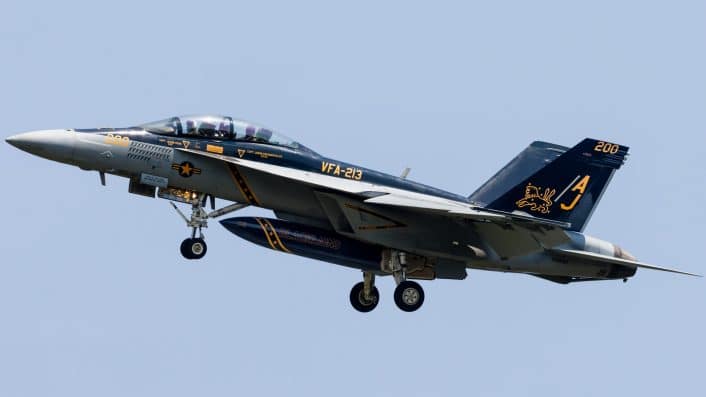
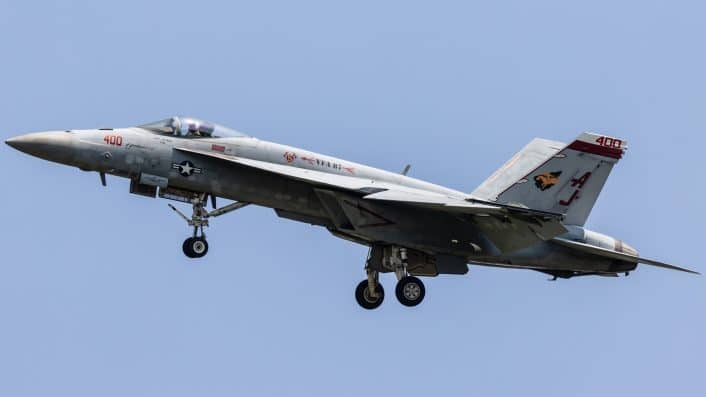
For Super Hornets, aircraft assigned to the Commander Air Group (CAG) have striking, colorful markings that distinguish them from the rest of the aircraft. Two CAG birds, an F/A-18F from Strike Fighter Squadron (VFA) 213 and an F/A-18E from Strike Fighter Squadron (VFA) 87, participated in the New York flight.
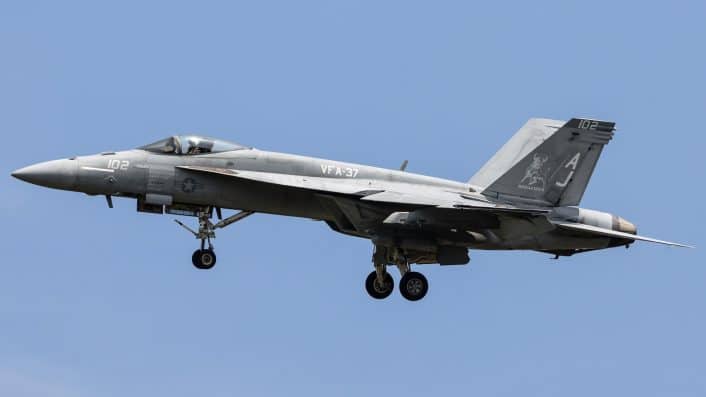
“The VFA-213 CAG jet immediately stood out for its nose art and mission markings. I wanted to capture a clean side profile to show off the aircraft,” said Abrams. “We were also able to photograph one additional VFA-213 Blacklions aircraft along with aircraft from VFA-31 Tomcatters, VFA-37 Ragin Bulls and VFA-87 Golden Warriors that returned during the same recovery period.”
super hornets
Photos sent to us by William Abrams show that the Super Hornets each used different numbers and types of weapons. For example, a CAG bird assigned to a gray F/A-18E and VFA-87 showed four AGM-154 JSOWs and 11 JDAM bombs, respectively.
Two jets from VFA-37 showed more activity, the first jet showing 4 JSOW and 42 JDAM, and the second jet showing 4 JSOW and 19 JDAM. JDAM bombs have been one of the most used weapons in air operations against Iran, with a variety of sizes used in both standard JDAM and laser JDAM configurations.
Perhaps the most confusing markings are those seen on the CAG birds of VFA-213. A total of 31 identical markings are visible on the jet, but not immediately identifiable.
The markings feature what appear to be Mk-80 bomb casings, identical in shape to those used in JDAM bombs. However, above the markings on each bomb is another shape that is not easily identifiable.
VFA-213 frequently appeared in official CENTCOM photographs released on the DVIDS network. The F/A-18F is often seen in clean configuration during training flights, as well as in the so-called “five-wet” configuration for aerial refueling and in a ground attack configuration using multiple JDAMs and laser JDAM bombs.
Many thanks to William Abrams for sending the photos. You can see more of his work on Instagram @whiskey_alpha_photo.







