



The U.S. Air Force has begun live-fire testing of its YFQ-44A cooperative combat aircraft, launching AIM-120 AMRAAM missiles over the Mojave Desert.
The U.S. Air Force announced that it has begun live-fire testing for its Cooperative Combat Aircraft (CCA) program, with the YFQ-44A firing the AIM-120 AMRAAM missile for the first time. The service said the weapon was fired at “a digital target in secluded airspace over the Mojave Desert.”
CCA Live Fire
This milestone follows an inert carriage evaluation conducted in early February of this year, which focused on collecting in-flight data to verify the aircraft’s handling. A follow-up evaluation verified data link integration between the aircraft and weapon systems prior to live fire.
This live-fire test brings us one step closer to providing CCA to the warfighter! pic.twitter.com/1jAsIiXzVa
— General Ken Wilsbach (@OfficialCSAF) July 15, 2026
The AIM-120 used in the test appears to be the real variant, as indicated by yellow and brown bands, indicating the presence of an explosive warhead and fuel respectively. The exact deformation is unclear due to image quality, but during captive transport the aircraft was noted to have a C deformation under the wings.
“This live-fire test is an important next step in the development of our collaborative fighter aircraft,” said Gen. Ken Wilsbach, Air Force Chief of Staff. “We are one step closer to delivering capabilities to the warfighter.”
New test video: YFQ-44A’s first missile launch.
The YFQ-44A launched an end-to-end attack beyond line-of-sight against a simulated target.
This test, run at @EdwardsAFB, represents an important step in turning CCA into an operational capability. pic.twitter.com/70cRIs6uXJ
— Anduril Industries (@anduriltech) July 15, 2026
The military reiterated that the CCA program will maintain human oversight, especially with regard to the use of lethal force.
“CCA will not use weapons autonomously,” the statement said. “The decision to launch a weapons system rests solely with the human operator who maintains command and control over the platform at all times.
The live-fire testing was conducted in collaboration with the 412th Test Wing Air Dominance Combined Test Unit, which worked to refine and validate the models needed for safe live-fire execution, the service explained. The start of the live-fire campaign follows recent production contracts for CCA Increment 1, which includes Anduril’s YFQ-44 and General Atomics Aeronautical Systems’ YFQ-42.
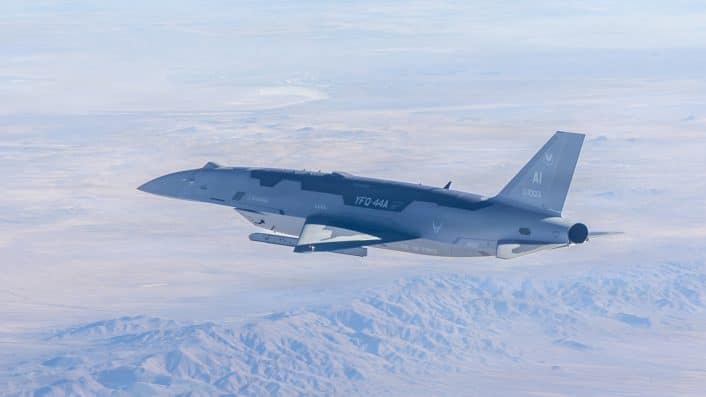
“Transitioning from an inert carriage to launching this weapon early in the year demonstrates program maturity, allowing us to validate our digital integration model with real-world data,” said Gen. Dale White, direct reporting portfolio manager for Critical Major Weapons Systems at the War Department. “This test provides operational validation that cooperative combat aircraft can automatically execute weapon use sequences within pilot-defined parameters, accelerating the delivery of capabilities to the warfighter.”
YFQ-44A
The YFQ-44A Fury is an Anduril Industries design for the U.S. Air Force’s Cooperative Combat Aircraft (CCA) program. Developed as a low-cost autonomous power multiplier, the YFQ-44A is designed to operate with crewed fighters such as the F-35 Lightning II, F-15EX Eagle II and future F-47, extending its range while taking on high-risk missions that can expose human pilots to harm.
Originally derived from Anduril’s Fury concept, the aircraft emphasizes rapid development, open systems architecture and modularity. The Air Force officially unveiled the mass-produced test vehicle, announcing the start of ground testing in May 2025.
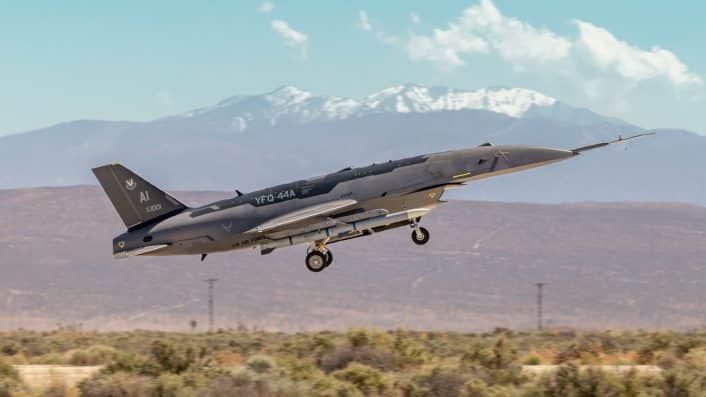
The YFQ-44A achieved its maiden flight on October 31, 2025, reaching the milestone “just 556 days after the start of development,” Anduril said. This is unusually fast for a military aircraft. According to the company, the aircraft flew semi-autonomously rather than remotely piloted, demonstrating the company’s software-centric approach to autonomous aviation.
CCA continued to expand testing throughout 2026, conducting a captive transport evaluation using an inert AIM-120 AMRAAM missile to verify weapon integration and safe storage separation prior to live-fire testing. It then began operational testing with the U.S. Air Force’s Experimental Operations Unit at Edwards Air Force Base, California, to begin developing tactics, techniques and procedures to integrate autonomous fighter aircraft into future air operations.
Recently, the U.S. Air Force awarded several contracts for the Collaborative Combat Aircraft program, including an Increment 1 aircraft production contract and autonomous mission software. The service explained that the award arrived months ahead of schedule because the two unmanned assets already met stringent mission requirements and were ready for full-scale manufacturing.
In particular, the CCA now drops the ‘Y’ designation denoting prototype, while retaining the designation of a UAV (indicated by the ‘Q’ vehicle type code) with its intended role as a fighter aircraft (indicated by the ‘F’ primary mission). The service plans to field approximately 1,000 combat-capable CCAs in multiple increments.







