



Russian Tu-95MS Bear bombers, accompanied by an Il-78M tanker and at least one Su-30SM2 fighter jet, performed rare flights carrying Kh-101 cruise missiles over the Barents and Norwegian Seas.
For the second time in a year, the Russian Tu-95MS Bear strategic bomber flew over the Barents Sea and Norwegian Sea carrying the Kh-101 air-launched cruise missile (ALCM). The Russian Ministry of Defense (RuMoD), which reported the flight in its daily update on April 30, 2026, said the four-aircraft package included two Tu-95s, at least one Su-30SM2 and an Ilyushin Il-78M tanker.
The Tu95-Kh101 loadout was previously reported after a flight over the same region in May 2025. RuMoD publicized both these flights with extensive visual and practical descriptions, as with other overflights around enemy airspace.
On the recent flight, only one unmarked Kh-101 appears to have been carried by the bomber. Russian military aviation analyst Guy Plopsky assessed that in both cases the missiles may have been inert/captive-carrying versions.
Russia added in a statement that the bombers “were also accompanied by foreign fighter jets.” However, the fighter jet, believed to be a NATO aircraft, was not captured in the footage released by RuMoD.
Neither NATO Air Command nor the Norwegian, Swedish, or Finnish air forces have released information about the intercept at the time of this writing. However, as reported by the French Joint Chiefs of Staff on 1 May, French Rafale fighter jets deployed to Šiauliai Air Base in Lithuania as part of NATO’s Baltic Air Policing (BAP) mission were involved in separate interceptions of two Russian Su-24MR fighter-bombers carrying OFAB and RBK series unguided drop bombs.
IL-78M aerial refueling tanker.
Su-30SM multipurpose fighter.
Tu-95MS strategic missile carrier equipped with “Kh-101 cruise missiles”. pic.twitter.com/Ghj6ROd6BC— Massimo Frantarelli (@MrFrantarelli) April 30, 2026
Tu-95 and Kh-101
An April 30 video released by RuMoD shows an aTu-95 taking off with a single Kh-101/102 mounted on a twin-rail AKU-5M ejector under the outermost hardpoint of the port (left) wing. The Tu-95 is equipped with four AKU-5Ms, which can accommodate a total of eight Kh-101/102s.
In-flight footage shows a Tu-95 being refueled by an Il-78M tanker and at least one Su-30SM2 being refueled by a fighter escort. Another Tu-95 can be seen on the starboard (right) side at a considerable distance in footage taken from inside the cockpit, but it is unclear whether this aircraft also carries the Kh-101.
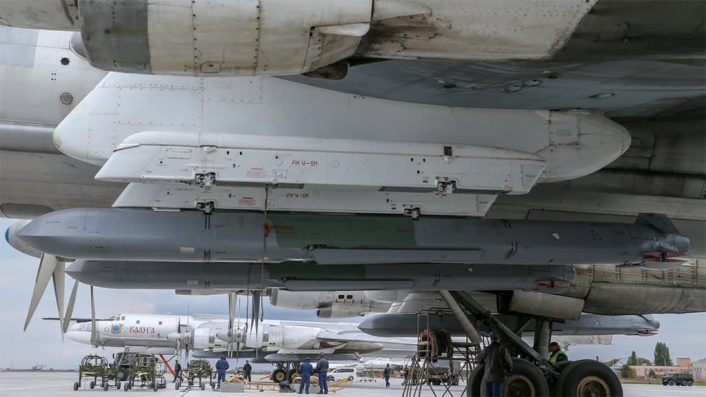
The RuMoD video also shows the Tu-95 taking off and returning during the day. The attached RuMoD statement said the “planned flight” over the Barents and Norwegian Seas lasted more than seven hours.
“The strategic bomber Tu-95MS of the Russian Aerospace Forces performed a planned flight in the airspace of the neutral waters of the Barents Sea and the Norwegian Sea. During the flight, the crew of the strategic bomber Tu-95MS practiced refueling in the air. The crew of the Su-30SM aircraft of the Aerospace Forces provided fighter escort. At certain stages of the route, the strategic bombers were accompanied by foreign fighters.”
The VKS Tu-95MS strategic missile carrier carried out a planned mission of more than seven hours in the Barents and Norwegian Seas. Several stills from the Russian Ministry of Defense video showing:
Above: Tu-95MS in flight taxiing to the runway. A single Kh-101 ALCM (or prisoner-carrying… pic.twitter.com/Nv8gkupAve
— Guy Plopsky (@GuyPlopsky) April 30, 2026
The statement followed a routine repeat of legal military flights in international airspace.
“Long-haul aircrews regularly perform flights in the neutral waters of the Arctic, North Atlantic, Pacific Ocean, Baltic Sea and Black Sea. All flights of aircraft of the Russian Aerospace Forces are carried out strictly in accordance with the rules for the use of international airspace.”
The accompanying Su-30SM2 carries wingtip electronic warfare pods, and at least one R-73 within visual range (WVR) AAM can also be seen on the port wing.
As mentioned in the introduction, the Tu-95 carried the Kh-101/102 in another instance during a flight over the same Norwegian and Barents Sea region, Plopsky noted in the RuMoD report of May 20, 2025. Here too, RuMoD mentioned and showed a video of two Tu-95MS bombers, one of which was again carrying a Kh-101 in a “planned flight over the Barents Sea.”
A still from a new 🇷🇺 MoD clip showing two Tu-95MS departing for a Barents Sea mission. A captive carry version of the Kh-101 ALCM or Kh-101/102 appears to have been attached to the AKU-5M ejector under the 2-station pylon of the outer port wing of the “Murmansk” (“24” Red/RF-94130). pic.twitter.com/t1b0p0TIsS
— Guy Plopsky (@GuyPlopsky) May 20, 2025
At the time, Russia confirmed that the fighter escort was the Russian Navy’s Su-33, and two were seen in in-flight video taken inside the Tu-95. The underside of one Su-33 is equipped with pure air-to-air equipment consisting of two R-27 medium-range AAMs and two R-73 short-range AAMs.
French Rafales intercept a Su-24MR.
France’s Joint Chiefs of Staff’s Plopsky identified one aircraft with Bort number and tail number “10” and RF-34002, respectively.
Both aircraft were equipped with weapons, the first carrying two RBK-500 series cluster bombs and the second Su-24 carrying four OFAB-250-270 high explosive fragmentation bombs. It is unclear whether this weapon is alive or inert.
French Air Force Space Force Rafale B multirole fighter and a pair of Russian naval aviation Su-24M attack aircraft.
B/N “10” White (RF-34002) is armed with two RBK-500 series cluster bombs, while the second Su-24M is armed with four OFAB-250-270 high explosive fragmentation bombs. https://t.co/PGSz4SDPCB pic.twitter.com/zxw6W4eGPa— Guy Plopsky (@GuyPlopsky) May 1, 2026
conclusion
The Tu-95, equipped with the Kh-101, Russia’s best air-launched land-strike missile known to have a range of up to 2,800 km, appears during provocative overflights by front-line aircraft such as the Tu-22M3 with the Kh-22/32 and the MiG-31 with the Kh-47M2 Kinzhal hypersonic missile over the Baltic Sea and the Sea of Japan, respectively.
Politically, this reflects ongoing tensions between the West and Japan, but from a military perspective, Russia could simply be carrying out prisoner-carrying tests of the latest variants of these missiles or simple training flights. Kh-101/102 versions with sub-variants with dual/serial warheads, decoy/penetrating auxiliary distribution, cluster warheads and various types of optical seekers for the final stage have already appeared in Ukraine.
🇷🇺🇪🇺Russian Tu-95 nuclear-capable bomber intercepted by NATO fighter jets over Norwegian Sea
The Russian Ministry of Defense announced on the 30th, “The Tu-95MS strategic missile-equipped bomber of the Russian Aerospace Force’s long-range aircraft performed the scheduled flight.” pic.twitter.com/DDmUOhnFKh
— Global Survive (@Globalsurv) May 1, 2026
As assessed by Plopsky, the choice of a theater of operations for carrying out transport tests of aircraft-borne weapons, assuming that they are captive-carried munitions, is also consistent with the goal of deterrence. Russia assesses that hostility with the West is likely to continue in the future.







