



Airbus and Kawasaki Heavy Industries have signed a memorandum of understanding (MOU) to collaborate on Eurodrone development concepts focused on anti-submarine warfare (ASW) and maritime patrol roles.
The two companies will now begin work to determine necessary modifications to the existing U950 Eurodrone design, including considering the sensor and payload packages needed for long-range ASW and other maritime missions. Conceptually tailored to Japan’s defense needs, Japan itself has not yet placed a firm order for such an aircraft, but has maintained official partner status in the broader Eurodrone program since November 2023.
#ILA24 presents a 1:1 model of #EuroDrone. This will ensure operational superiority over partner nations, especially in the context of Intelligence, Surveillance, Target Acquisition and Reconnaissance (ISTAR) missions. It will become a key axis of the future… pic.twitter.com/CNQIm5C8dV
— Airbus Defense (@AirbusDefence) June 6, 2024
Eurodrone is a twin-engine medium-altitude long-endurance (MALE) unmanned aerial vehicle (UAV) designed to perform a similar role to the U.S.-built MQ-9 Reaper. Compared to the Reaper, the Eurodrone is 5 to 6 meters larger in both length and wingspan, and its maximum takeoff weight is more than twice that of the MQ-9. Eurodrone’s first flight is currently scheduled for 2029.
Germany is currently the main customer with 21 orders, followed by Italy with 15 and France and Spain with 12 each. The four countries are collaborating on the development of the aircraft, with lead contractor Airbus and manufacturers Leonardo and Dassault. France has confirmed that it still intends to proceed with this type of procurement, despite criticism of the program and changes to its funding plans.
France remains committed to Eurodrone, but acquisition could be delayed, @AirbusDefence official says “There were and still are four countries in this program,” Jean-Brice Dumont said at the ILA Berlin Air Show. https://t.co/mWWiDslSyz pic.twitter.com/498xowd1n1
— Craig Hoyle (@FlightAcesHigh) June 17, 2026
With a planned endurance of up to 40 hours, Eurodrone is ideally suited for maritime long-range missions that augment crewed platforms by providing persistent ASW and Intelligence, Surveillance and Reconnaissance (ISR) coverage.
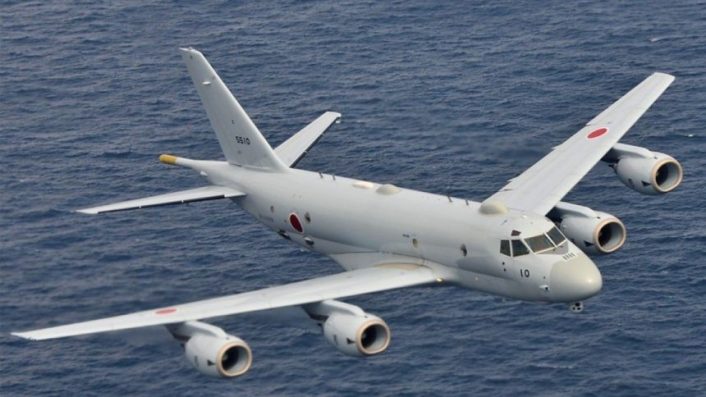
Japan, with its direct access to the vast Pacific Ocean and its proximity to China’s ever-expanding submarine force, is a key focus of these developments. Japan already operates dozens of Kawasaki P-1 and Lockheed P-3 Orion maritime patrol aircraft and has now begun using the RQ-4B Global Hawk for long-range ISR.

The Global Hawk is fully capable of providing elements of a maritime patrol capability, but lacks ASW capabilities or weapons carrying capabilities. Meanwhile, the envisioned maritime variant of the Eurodrone is planned to utilize sonobuoys and torpedoes, similar to the recently developed MQ-9.
Notably, Kawasaki’s press release notes that the MoU will also include exploration of how Eurodrones can collaborate operationally with the P-1 maritime patrol aircraft, hinting at manned-unmanned teaming (MUM-T) capabilities.
marine mission
The Eurodrone’s twin-engine configuration, a requirement stipulated by Germany for safety in urban areas, has been criticized for adding weight and complexity to the aircraft. However, for this use case, the improved reliability over platforms like the MQ-9 can be a huge advantage.
Airbus and Kawasaki Heavy Industries have signed a memorandum of understanding (MOU) on the conceptual development of a Japanese version of the Eurodrone. The idea focuses on deploying ASW platforms such as the MQ-9B. Eurodrones may be attractive due to their twin engines and high payload design. https://t.co/tQa9gxyB1A
— Alex Luck (@AlexLuck9) June 26, 2026
Although drones are considered more expendable than crewed aircraft, their cost of loss, especially when carrying additional ISR equipment and/or weapons, can still take a toll on the military’s overall capabilities. This is especially true if lost aircraft cannot be replaced in a timely manner, as the U.S. Air Force discovered after losing about 20 percent of its entire fleet during Operation Epic Fury. The MQ-9 has been described as ‘the most valuable player’ in the US war effort, despite being often assessed as being too vulnerable to modern high-intensity conflicts.
The U.S. Air Force MQ-9 Reaper drone was the “most valuable player” in Operation Epic Fury against Iran, Chief of Staff Gen. Ken Wilsbach said today. Wilsbach said the United States has carried out “quite a few attacks” against Iran using Reaper. “No other platform comes close…
— Chris Gordon (@ByChrisGordon) May 21, 2026
The complexity of ASW means that crewed aircraft will almost certainly be a key component for years to come, but having access to unmanned aerial vehicles to support ASW missions will reduce the workload of each ASW aircraft and allow it to scan a wider area for submarine threats. A similar evolution is taking place underwater and underwater, where expensive submarines and ASW frigates are now envisioned only as the tip of a broader window encompassing a variety of automation and remote control capabilities.


