



The Tiger MkIII effort envisions a complete mid-life upgrade (MLU) with new targeting and networking suites and draws lessons from current battlefield trends.
Airbus Helicopters has revealed details of the upcoming Mark III (MkIII) upgrade program for the Tiger attack helicopter fleet in service with the French and Spanish Armed Forces, scheduled for June 19, 2026. The company detailed a series of avionics, electronics and weapons suites integrated into the European rotary wing platform.
The program is operated in cooperation with the Joint Armed Forces Cooperation Organization (OCCA) of France and Spain. Airbus Helicopters has set a 2026 timetable for the MkIII’s first flight, following the introduction of a ground test bed (‘Helicopter Zero’) that will be used to test the new system.
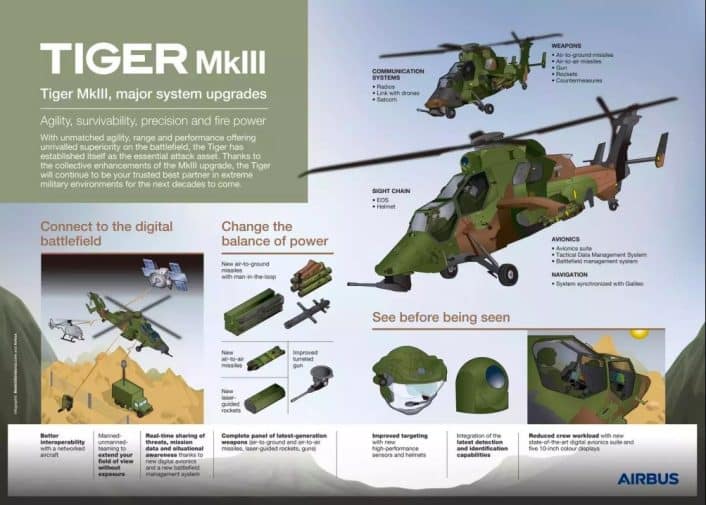
The MkIII is essentially a mid-life upgrade (MLU) program for France and Spain’s Tiger HAD-F and HAD-S MkII aircraft, which has been in the works since 2022. An early graphical representation of Airbus Helicopters showed upgrades that included improved digital touchscreens and ergonomic displays to ease pilot workload. Air-to-air and air-to-ground weapons. The latter features man-in-the-loop control for real-time target updates. New laser-guided rockets and turrets; Battlefield management and networking suite for connectivity to unmanned, ground and satellite assets; The new helmet features a visor-mounted display that rotates with an improved EO system for weapon signaling.
The Tiger Mark III combat helicopter is sharpening its claws for the digitized battlefield. Developed together with France and Spain, this modernization introduces next-generation avionics and weapons. Ground testing is underway with the goal of the first flight in 2026. https://t.co/5W9UrfKOfb pic.twitter.com/8G7Se2lhqt
— Airbus Heli (@AirbusHeli) June 19, 2026
Tiger MkIII
According to Airbus Helicopters, the Tiger MkIII was envisioned in 2022 in response to “new realities of the modern battlefield,” citing the use and consequences of attack helicopters in the Russia-Ukraine conflict. Marie Thomas, program manager at Airbus Helicopters, named the new system the Euroflir 510 optical sight, which offers improved aiming performance and can see “far further before we can see (…).” An improved touchscreen cockpit, a digital helmet and a completely overhauled cabling system that “accommodates all modern data streams and enables higher throughput and greater communications capacity.”
French Tiger HAD helicopters are equipped with the AGM-114K1A Hellfire II. pic.twitter.com/VR7HI5Q1CA
— 𝔗𝔥𝔢 𝕯𝔢𝔞𝔡 𝕯𝔦𝔰𝔱𝔯𝔦𝔠𝔱Δ 🇬🇪🇺🇦🇺🇲🇬🇷 (@TheDeadDistrict) May 2026 2 days
“Recently, the Tiger Mark III has reached several important milestones, including the induction into service of ‘Helicopter Zero’, a ground test bed designed to test new systems. The 2026 target is the first flight of the Tiger Mark III and is a major milestone for this project,” Thomas said in a press release. Meanwhile, engineering director Cindy Mercin said, “We plan to equip the Tiger Mark III with the means to interoperate with three-dimensional assets such as drones.”
The weapon system that OCCAR previously stated was part of the Tiger MkIII upgrade is the Missile Air-Sol Tactique Futur (MAST-F), which is currently in development and scheduled for delivery by 2028. MAST-F will replace the Hellfire II air-to-ground and anti-tank missiles currently carried by the Tiger.
The 1/4 Tiger Mark III program faces a critical phase in 2026. After the success of the ‘Zero Helicopter’ (ground test bed), the goal is now its first flight. This is not just a ‘modification’, but a fundamental change towards fighting in high-intensity environments. pic.twitter.com/GxqiJJR1bc
— J.Victor Pauli (@Victor35571262) June 19, 2026
The 1/4 Tiger Mark III program faces a critical phase in 2026. After the success of the ‘Zero Helicopter’ (ground test bed), the goal is now its first flight. This is not just a ‘modification’, but a fundamental change towards fighting in high-intensity environments. pic.twitter.com/GxqiJJR1bc
— J.Victor Pauli (@Victor35571262) June 19, 2026
“The Mark III program will enhance the Tiger’s performance and improve crew safety by allowing new avionics to reduce much of the pilot workload often required in intense combat zones, allowing unmanned systems to do it for them. Because we have expanded weapons systems, we can more easily penetrate specific combat zones without endangering the crew or mission,” explains Mercin. “By reducing cognitive load and increasing accuracy with new infrared sensors, the Tiger Mark III can help helicopters and crews avoid exposure to immediate danger when operating behind enemy lines.”
Tiger helicopter users and variants
The French Army deploys the Tiger HAP-F (Hélicoptère d’Appui et Protection/Support and Escort Helicopter – France or HAP-F). Spain instead deploys the Tiger HAP-E (Helicóptero de Apoyo y Protection – España/HAP-E).
The first French HAD-Fs were delivered in Mark I standard and were later converted and modified to Mark II configuration. The French military operates approximately 68 HAD-Fs, while Spain’s HAD-S helicopter fleet has 17 aircraft.
The Organization for Cooperation in Arms (OCCAR) announced delivery of the first HAD-F Mark II on October 24, 2024, from the Airbus Helicopters facility in Marignan, France. The HAD-F MkII sports upgrades such as a new laser-guided rocket, a new anti-jamming GPS and satellite navigation (SATNAV) system, and an Identification of Favorite (IFF) Mode 5 interrogator for interoperability.
In the same press release, OCCAR noted that the MkII would be followed by the Tiger MkIII MLU for the French and Spanish fleets. “This first approval marks the beginning of the modernization of the French Army’s 67 combat helicopters, which will continue the Mid-Life upgrade program to the MkIII for France and Spain,” OCCAR said.
Other users of the Tiger include France, Spain and Germany, as well as Australia, which uses the same SFIM Strix roof-mounted EO/IR turrets. Canberra is considering replacing about six of its fleet of 22 Tiger Armed Reconnaissance Helicopters (ARH) with 29 new AH-64E Apache attack helicopters while donating the former to Ukraine.
Apart from France and Spain, Germany is the other European country that plans to extend the retirement of its fleet of 54 Tiger UHT/KHTs to 2032 instead of 2038. The German Tiger is distinguished by its distinctive Osiris electro-optic turret atop the rotor head.
📍 Near East and Middle East | Review of resource commitments in the face of airborne threats 🇫🇷
🔥 Protection of French interests in the region and application of defense agreements
The 🎯 military 🇫🇷 maintains an active defensive posture through close cooperation… pic.twitter.com/jk8OZbLEPm
— French Army – Military Operations (@EtatMajorFR) April 10, 2026
On the 12th, the French Joint Command also released an official video showing a Tiger helicopter shooting down an Iranian Shahed-type one-way attack (OWA) drone with a 30mm chin-up cannon.
The French military released two images of an Iranian drone shot down by a French Tiger helicopter, along with images of a Tiger attack helicopter previously deployed in the UAE.
Via @armeedeTerre 🇫🇷🇦🇪 pic.twitter.com/iZyzPIzEf9— Tom Antonov (@Tom_Antonov) May 30, 2026
French defense media also quoted officials from MBDA, the French Army Light Aviation (ALAT), the Armed Forces Flight Test Center (DGA EV) Secretariat, and Chief of Defense Staff General Fabian Mandon testifying before the National Assembly about the Mistral 3 undergoing final qualification tests on Tiger helicopters. The French Tigers have so far been using the Mistral 2 Man-Portable Air Defense (MANPAD) system for air-to-air and anti-drone missions.







