



Daniel Bush,Washington Correspondentand
Pauline Cola
US President Donald Trump has threatened to impose tariffs on countries that do not go along with his ambitions to annex Greenland.
“We may impose tariffs on countries that do not cooperate with Greenland, an autonomous territory controlled by Denmark,” President Trump said at a White House meeting.
He did not specify which countries could face new tariffs or what powers he would exercise to use those import taxes to further his goals.
Other countries, including Denmark and Greenland, also opposed his plan, and many in the United States expressed skepticism about the takeover. As President Trump spoke, a bipartisan congressional delegation was visiting Greenland to show support for the territory.
The 11-member group included Republican lawmakers who expressed concerns about the president’s demand that the United States somehow acquire Greenland for national security reasons. They met with lawmakers as well as Danish Prime Minister Mette Frederiksen and Greenlandic Prime Minister Jens-Frederik Nielsen.
The group’s leader, Sen. Chris Coons, a Democrat, said their trip was intended to hear from local residents and bring their views to Washington “to lower the temperature.”
Trump said Greenland was vital to U.S. security and that Washington would get the island “the easy way” or the “hard way.” This is an obvious reference to purchasing an island or taking it by force.
“We may impose tariffs on countries that do not cooperate with Greenland because we need Greenland for our national security,” Trump said at a rural health conference held at the White House on Friday.
Greenland is sparsely populated but rich in resources and its location between North America and the Arctic makes it ideal for establishing an early warning system in the event of a missile attack and for monitoring ships in the area.
The United States already has more than 100 soldiers permanently stationed there. Pitupik Base is a missile surveillance base on the northwest tip of Greenland that has been operated by the United States since World War II.
Under an existing agreement with Denmark, the United States has the authority to send as many troops as it wants to Greenland.
But President Trump said the United States must “own” it to properly defend itself against possible attacks from Russia or China.
Denmark has warned that military action could spell the end of NATO, the transatlantic defense alliance in which the United States is its most influential partner.
NATO works on the principle that allies should come to each other’s aid in case of attack from outside. NATO has never faced the option of one member using force against another.
European allies came together to support Denmark.
They also said the Arctic region was equally important to them and its security should be a joint responsibility of NATO with the United States.
To this end, several countries, including France, Germany, Sweden, Norway, Finland, the Netherlands and the United Kingdom, have sent small numbers of troops to Greenland on so-called reconnaissance missions.
French President Emmanuel Macron said “land, air and sea assets” would soon be dispatched.

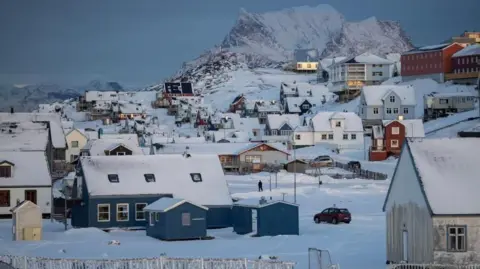 Reuters
The visit by the U.S. congressional delegation comes days after high-level talks in Washington failed to persuade Trump of his plans.
This includes senators and members of the U.S. House of Representatives who are passionate supporters of NATO.
Coons and the majority of the group are staunch Trump opponents in the Democratic Party, but include moderate Republican senators Thom Tillis and Lisa Murkowski.
Greenlandic lawmaker Aaja Chemnitz said meeting with US lawmakers made her “hopeful.” “We need friends. We need allies,” she told the BBC.
Asked if there was a big difference between the White House’s view and the positions of Greenland and Denmark, she said, “It’s a marathon, not a sprint.”
“The pressure from the US side is something we have seen since 2019. It would be naive to think it is all over now.”
“It’s changing almost every hour, so the more support we can get, the better,” she added.
Murkowski is one of the sponsors of a bipartisan bill to block attempts to annex Greenland.
Republican lawmakers have also filed competing bills supporting island annexation.
Jeff Landry, President Trump’s special envoy to Greenland, told Fox News on Friday that the United States should talk to Greenland’s leaders, not Denmark.
“I believe there is a deal that must be made once this is done,” he said.
“The President is serious. I think he has already reached a milestone.
“He told Denmark what he wanted, and now it’s a matter of getting Secretary of State Marco Rubio and Vice President JD Vance to make a deal.
“America has always been a welcoming country. We are not trying to conquer anyone, we are not trying to take over anyone’s country.
“We say, ‘Listen, we represent freedom. We represent economic power. We represent protection.'”
The foreign ministers of Denmark and Greenland met Vance and Rubio at the White House on Wednesday.
The US vice-president suggested finding a ‘middle ground’ that would satisfy Trump, Denmark and Greenland, according to a Danish official who spoke to the BBC on background to discuss the meeting.
The official said the possibility of a U.S. military takeover of Greenland was not raised during the White House meeting.
“We have not discussed with any senior official or minister the prospect of sending U.S. troops to Greenland,” the official said.
But a Danish official said Denmark was taking President Trump’s goal of seizing Greenland seriously.
“Our working hypothesis is that what he says on this matter is what he means,” the official said.







