




 getty images
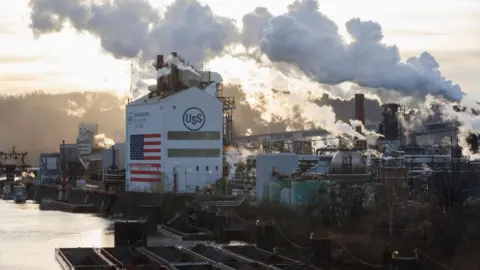
US President Joe Biden has officially blocked the acquisition of US Steel by a major Japanese company, saying foreign ownership could pose a risk to national security.
The controversial decision came a year later. Nippon Steel first announced a $14.9 billion (£12 billion) deal.It describes itself as a lifeline for its smaller, Pennsylvania-based rivals.
But the deal ran into almost immediate trouble as United Steelworkers union leaders vocally opposed the deal and political pressure mounted in key states during the 2024 presidential election.
Biden ultimately decided to scrap the deal, despite concerns from some aides that it could damage America’s relationship with key ally Japan.
Nippon Steel and U.S. Steel, which had previously threatened to sue the government if the deal did not go through, accused Biden on Friday of manipulating the review of the deal for political gain.
They said, “We will take appropriate measures to protect our legal rights.”
“We believe that President Biden has sacrificed the future of America’s steelworkers for his own political agenda,” the companies said in a statement. “This action is chilling for all companies based in U.S. allies who are considering making significant investments in the United States.” “It sends a damaging message,” he said. USA.”
Biden’s decision raises important questions about the path ahead for U.S. Steel, a 124-year-old company that was once a symbol of American industry but is now in much decline.
It had been looking for a buyer for several months before announcing a partnership with Nippon Steel, the world’s fourth-largest steelmaker.
In the months following the announcement, both companies pledged not to cut jobs and made other concessions to win support.
Just this week they offered to fund workforce training centers and reportedly gave the government the right to veto potential production cuts.
U.S. Steel also warned it may have to close the plant if new owners don’t invest, echoing the concerns of some workers and local politicians.
Other business groups expressed concern that rejecting the deal could scare off international investors at a time of rising U.S. protectionism.
However, these arguments failed to persuade Biden, who announced his opposition to the deal early last year.
The deal also drew criticism from President-elect Donald Trump and Vice President-elect J.D. Vance.
A U.S. government panel tasked with reviewing the deal for national security risks failed to reach an agreement by the end of December, leaving the decision to Biden, who must act within 15 days.
In Friday’s announcement, he said maintaining U.S. ownership was important to keep the U.S. steel industry and supply chain strong.
“As I have said many times, steel production and the steel workers who produce it are the backbone of our country,” he said.
“That’s because steel strengthens our country – our infrastructure, our automotive industry, our defense base. Without domestic steel production and domestic steel workers, our country is less strong and less secure.”
The United Steel Workers’ Union called the decision “the right move for our members and national security” and said, “Opposition was driven by concerns about the long-term survival of the steel industry.”
“I appreciate President Biden’s willingness to take bold steps to maintain a strong domestic steel industry and his lifelong commitment to American workers,” said President David McCall.
Shares of U.S. Steel were down about 5% in Friday morning trading.
But Pangea Policy’s Terry Haines said the move does not necessarily mean the end of the deal.
“One of the difficult aspects of this decision is that Japan is a very close ally of the United States,” he said. “The government frankly has a huge burden of proof to justify what they are doing today, which is detrimental to our bilateral relationship with Japan and is something that President Trump will want to avoid.”
Steven Nagy, a professor of political science and international studies at the International Christian University of Tokyo, said companies may decide to try again under President Trump. “Potentially, the new president could offer different terms so he can claim he got a better deal.” “He said. transaction.
He called Biden’s decision “political,” noting that the administration had promised a foreign policy “for the middle class” from the beginning.
“This is a direct response and continuation of Trump’s MAGA agenda to Make America Great Again,” he said.
“The Biden administration cannot appear weak to foreign companies, whether allies or enemies.”







