



Boeing conducted tests on the radar cross section of the MQ-28 Ghost Bat to verify its stealth performance.
Boeing announced that it conducted radar cross-section (RCS) testing on the MQ-28 Ghost Bat Cooperative Fighter (CCA) on June 1, 2026. The company said the test validated the aircraft’s stealth capabilities, which improved the Ghost Bat’s survivability.
The press release added that RCS testing was conducted on the MQ-28 to “provide customers with objective and repeatable data on survivability and detection risk.” RCS is an important engineering element of low-observable or stealth aircraft, as its smaller size makes it more difficult to detect the aircraft.
RCS refers to the amount of radar energy reflected back from the transmitter to the radar receiver. Specifically, it is defined as a virtual target area that reflects back to the radar the same power as a real target (in this case the MQ-28).
In addition to validating designs and models, the company said the testing will support procurement and certification and guide the selection of tactics and countermeasures. Boeing also said, “This milestone further demonstrates the platform’s maturity, survivability, and ability to deliver cost-effective, advanced capabilities for modern air combat operations.”
“The combination of high-performance platforms, stealth capabilities, advanced autonomy and artificial intelligence gives the Air Force an unprecedented ability to expand mission effectiveness and operational flexibility,” said Brad Thompson, director of Phantom Works Australia.
The RCS test was announced shortly after the MQ-28’s three flights over the Point Mugu Sea Range in the United States were revealed. It is unclear when this test was performed.
MQ-28 Ghost Bat – Boeing Air Power Teaming System
Designed by Boeing Defense Australia for the RAAF as a multi-role system capable of operating with crewed aircraft, the Ghost Bat was initially known as the Boeing Airpower Teaming System (ATS). Development began in 2013, and the prototype was first unveiled at the 2019 Australian Airshow, with its maiden flight taking place at the Woomera Range Complex in southern Australia on February 27, 2021.
The multipurpose unmanned platform has a 1.5 cubic meter nose that can accommodate interchangeable payloads for intelligence, surveillance and reconnaissance (ISR), airborne radar surveillance, EW/ELINT sensors and other attack munitions. The aircraft has been described as the next-generation Loyal Wingman, with 55 Australian companies involved in its development and, as of February 2024, receiving $600 million in funding.
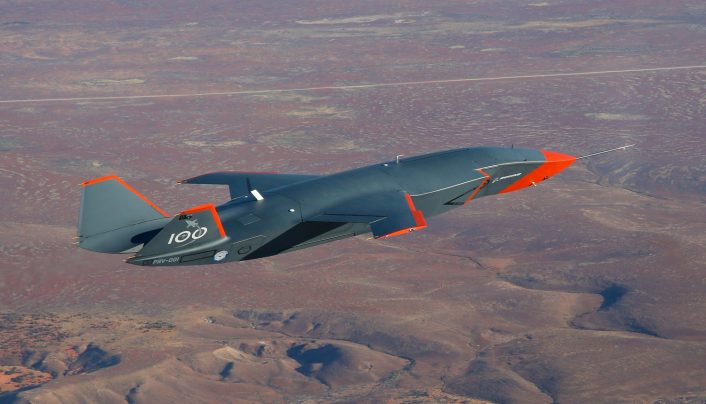
According to Boeing, the Ghost Bat “utilizes artificial intelligence (AI) to collaborate as a smart team with existing military aircraft to complement and expand its airborne mission.” The size of a compact, lightweight fighter jet with side air intakes, cranked kite wings and a slanted V-shaped tail, the MQ-28 can fly nearly 2,000 miles (3,200 km) and can “fly independently” through AI.
Boeing’s renderings showed the Ghost Bat flying with support and special mission aircraft such as the E-7A Wedgetail AEW&C aircraft and the F-15EX. According to Ferguson, “During a typical mission, launch and recovery operators (…) supervise the aircraft while it is in flight.”
Explaining the operational concept, Ferguson added, “It is then handed over to a crewed aircraft, such as an E-7A, F-35A, or F/A-18F, where the crew performs intelligence, surveillance, and reconnaissance missions.” Manned-unmanned teaming (MUM-T) does not necessarily have to be conducted in close formation, but can operate even when the aircraft are tens of kilometers or more apart, depending on mission requirements.
The stealth-oriented design has also been seen in the renders, which feature three nose sections with integrated Infrared Search and Track (IRST) sensors. Depending on their appearance, the other two could imply ISR and EW/ELINT roles, the latter being concerned with locating, jamming or overwhelming enemy ground radars.
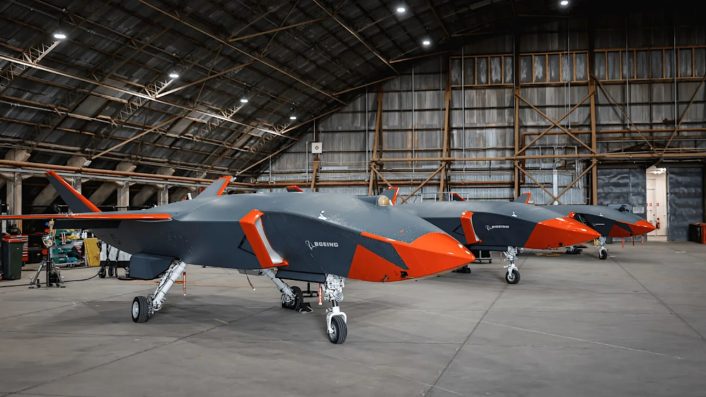
The MQ-28 can also serve as an escort for high-value support assets such as E-7A AEW&C aircraft or KC-30 tankers. However, it is not known whether unmanned aerial vehicles are considered vulnerable systems used to improve the survivability of manned platforms. After the mission is complete, “the aircraft will be returned to the launch and recovery operator to oversee the landing, deceleration and complete stopping of the vehicle,” Ferguson said.
Unmanned aerial vehicles have reached several important milestones in the past year. Among them was a June 2025 test that saw an E-7 Wedgetail control two MQ-28s on a mission against simulated aerial targets.
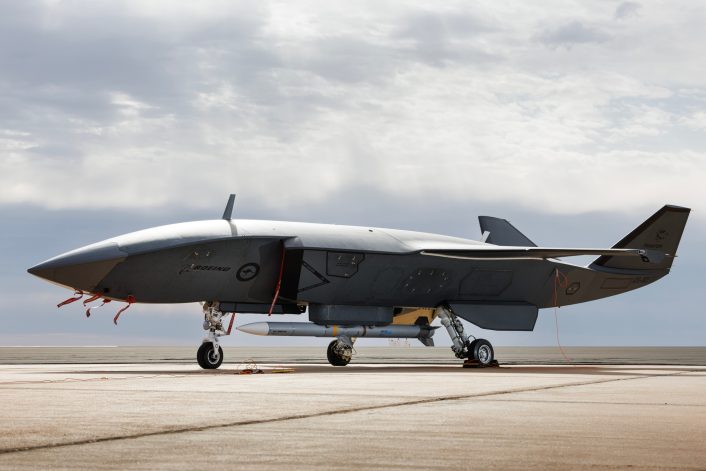
In December 2025, Boeing unveiled the first live-fire test of the MQ-28 equipped with the AIM-120 Advanced Medium-Range Air-to-Air Missile (AMRAAM). At the time, the aircraft teamed with the Royal Australian Air Force (RAAF)’s E-7 Wedgetail and F/A-18F Super Hornet.
The RAAF described it as “a demonstration of Cooperative Combat Aircraft (CCA) using air-to-air weapons against aerial targets in an operationally relevant scenario.” The Ghost Bat likely served as an offboard weapons release platform, leveraging sensors, detection, control and guidance data from the crewed platform.
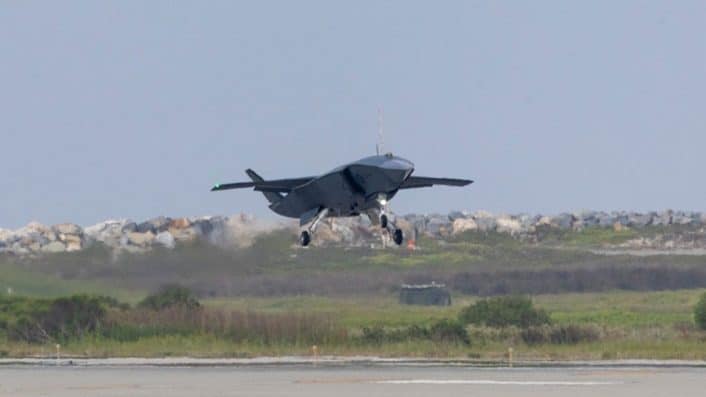
In May 2026, Boeing revealed that the MQ-28 Ghost Bat is currently flying what is defined as its first overseas flight in the United States. Previously, the aircraft only flew in Australia, where the MQ-28 was developed and built by Boeing Australia.
To date, the drone has completed three operational flight tests in the Point Mugu Sea Range off U.S. Naval Station Ventura County at Point Mugu, California. The company did not disclose when these flights were conducted.
However, it is already known that at least one MQ-28 was at NAS Ventura County, as the aircraft was clearly visible in a video released after its installation by U.S. Secretary of War Pete Hegseth in December 2025. However, since two different aircraft can be seen in the videos from December 2025 and May 2026, it is possible that two aircraft are there now.







