



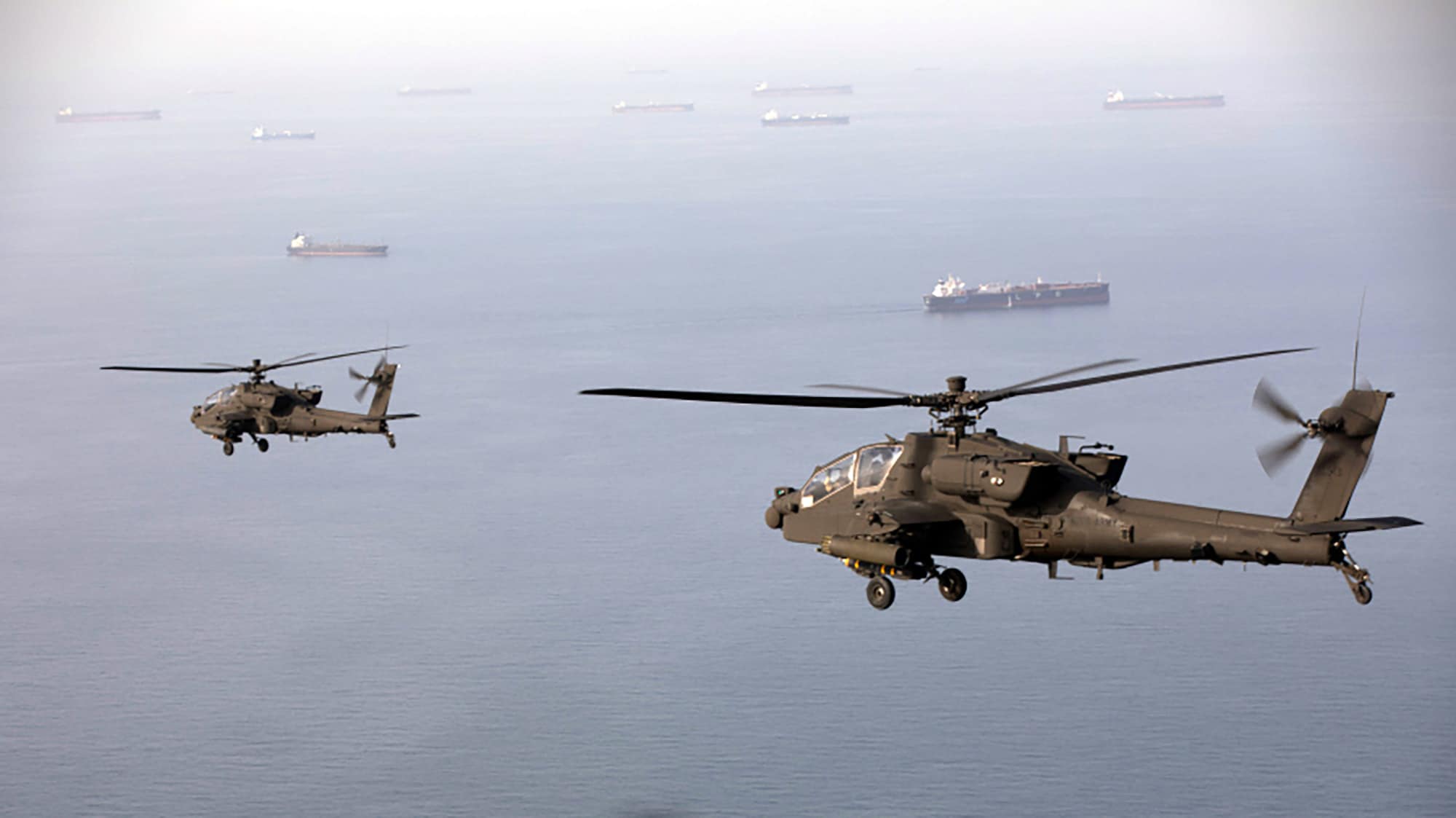
US CENTCOM has released intriguing photos of AH-64 gunships patrolling the strait as Iran once again moves to restrict traffic through the narrow waterway.
Saturday, April 18, 2026 Iranian Revolutionary Guard Corps (IRGC) gunfire reportedly opened fire on an oil tanker transiting the Strait of Hormuz on Saturday, according to an advisory issued by the UK Maritime Trade Operations (UKMTO).
The alert states that the organization was notified directly by the captain of a vessel who reported two IRGC gunboats approaching about 20 nautical miles off the coast of Oman. No radio warnings were reportedly issued before the tanker, whose identity was not disclosed, was attacked.
UKMTO Alert 037-26 – Attack Report Date: 18 Apr 2026 Report Time: 0920UTC Issue Date: 18 Apr 2026 Source: Master UKMTO has received reports of an incident 20NM NE of OMAN. The tanker’s owner reported that two IRGC gunboats approached, but no VHF strikes were fired at the tanker. The tanker and crew were reported safe. Authorities are investigating.
During today’s Iranian attack on an Indian oil tanker in the Strait of Hormuz, the vessel was initially headed for departure but appears to have been rebuffed by the IRGC. The ship is heading inbound towards the Gulf again, but turns off the AIS and runs… pic.twitter.com/EK5pQaJvwm
— Martin Kelly (@_MartinKelly_) April 18, 2026
The episode comes as Tehran reimposed strict restrictions on shipping through the strait after US President Donald Trump said on Friday April 17, 2026, that the US blockade on ships using Iranian ports would continue. According to CENTCOM, 23 vessels have been forced to turn back since the blockade was implemented.
The littoral combat ship USS Canberra (LCS 30) is patrolling the Arabian Sea during the U.S. blockade. Since the blockade began, 23 ships have followed U.S. military orders to return. US military enters ships or implements maritime blockade… pic.twitter.com/PMIBOoeJXS
— U.S. Central Command (@CENTCOM) April 18, 2026
The IRGC Naval Command’s official
Whenever the United States violates its promises, there is an appropriate response.
As long as shipping movement from and to Iran is threatened, the situation in the Strait of Hormuz will remain as before. god’s will— IRGC Naval Command (@niroo_daryayi) April 18, 2026
The statement capped a chaotic 24 hours in which Tehran said the Strait of Hormuz had reopened and then reimposed restrictions effectively blocking it again.
As news of attacks on ships in the strait began to spread (two Indian ships turned back after being attacked by IRGC naval vessels in the strait), US Central Command released interesting photos of US Army AH-64 Apache helicopters patrolling the waterway.
An AH-64 Apache flies over the Strait of Hormuz during patrol April 17. U.S. Army Soldiers are flying in and out of the Channel, providing a visible presence in support of freedom of navigation. pic.twitter.com/6K6cuCoqq2
— U.S. Central Command (@CENTCOM) April 18, 2026
At a Pentagon press briefing on March 19, 2026, Chairman of the Joint Chiefs of Staff Gen. Dan Cain announced that U.S. Air Force A-10 Thunderbolt II jets in support of Operation Epic Fury have begun operations on the southern flank targeting fast attack aircraft in the Strait of Hormuz. He also said AH-64 Apache gunships were hunting one-way attack drones in the same area.
Along with fast jets, the AH-64 is well-suited to maritime patrol missions as a platform combining persistence, precision sensors and a flexible weapons mix that allows gunship helicopters to counter fast ships and OWA drones that can be launched against tankers and ships in crowded coastal environments. As shown in a recent U.S. Army anti-UAS demonstration, the AH-64E is capable of detecting, tracking, and defeating drones with a variety of weapons, including 30mm M230 chainguns, APKWS-guided 70mm rockets, HELLFIRE variants, and JAGMs, providing aircrews with scalable options based on range, target size, and collateral risk considerations.
The sensor side of the helicopter features a combination of electro-optical and infrared sighting devices and a mast-mounted AN/APG-78 Longbow radar, designed to quickly detect, classify and prioritize large numbers of contacts. In the Strait of Hormuz, where threats may include small one-way attack drones, high-speed attack aircraft, and other transient and difficult-to-classify targets, this combination makes the Apache a reliable hunter-killer platform. Build situational awareness, share data across networks, and engage everything from low, slow aerial threats to small hostile boats with direct fire, guided rockets, or heavier missiles, depending on the tactical situation.







