



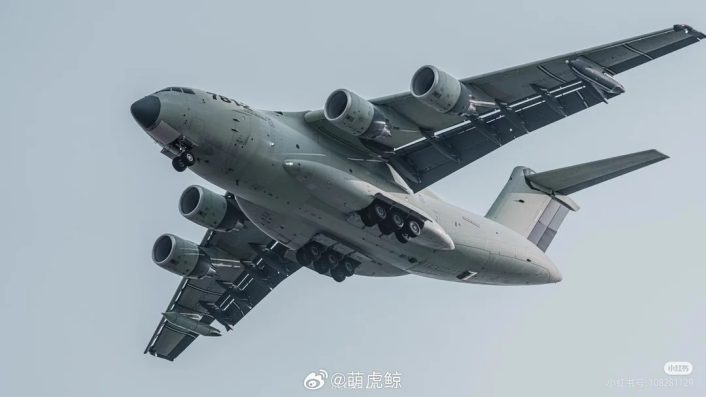
From May 24 to 26, China deployed approximately 60 military aircraft, helicopters, and drones into Taiwan’s ADIZ, including a Y-20 tanker that refueled J-16 fighter jets.
The People’s Liberation Army Air Force (PLAAF) YY-20A/YU-20A aerial refueling unit was one of 21 aircraft tracked and intercepted by Taiwan’s Republic of China Air Force (RoCAF) on May 25, 2026. Taiwan’s Ministry of National Defense (MND) identified the other aircraft as J-16 and J-10 fighter jets and a KJ-500 airborne early warning and control (AEW&C) aircraft. They were acting in coordination with PLA naval vessels.
RoC’s military news agency released an infrared capture of a targeting pod showing YY-20As identified as two J-16 fighters. Aircraft were flying on either side of the tanker, and the faint outline of a refueling hose connected to a jet at port (right) was visible.
The image does not show the interface normally seen on a multifunction display (MFD) and appears to have been edited. The interface may have helped identify the aircraft and target pods that captured infrared images of the three aircraft.
The Ministry of National Defense announced that it sequentially detected 21 sorties including main and auxiliary fighter aircraft and unmanned aerial vehicles of the Chinese Communist Party, including the J-10, J-16, and KJ-500, starting at 15:12 yesterday (25th). Among them, 16 sorties crossed the central line and its extension lines and entered our northern, central, southwestern, and eastern airspace. Under the name of the “Joint Combat Readiness Patrol,” they cooperated with communist ships to harass the seas, airspace and waters around us.
📷:Ministry of Defense#DefenseDefense #台strait pic.twitter.com/nXS0br7Tmt
—Military News Agency, ROC (Taiwan)🇹🇼 (@mna_roc) May 25, 2026
However, looking at the October 2024 incident in which RoCAF F-16s captured the first PLA Navy aircraft carrier-borne J-15 fighter jets in a sniper targeting pod, it is likely that the same assets were used here as well. Taipei Times It was also reported that the RoC aircraft that followed the trio was an F-16, but the military did not comment on this.
Total 21 types #PLA From 15:12 today, aircraft of various types (including J-10, J-16, KJ-500, etc.) were detected. Of the 21 sorties, 16 crossed the center line. #taiwan Enter the northern, central, southwestern, and eastern ADIZs through the strait and carry out high seas…
— Ministry of National Defense, ROC (Taiwan) 🇹🇼 (@MoNDefense) May 25, 2026
The Y-20 has recently achieved several milestones with the launch of the Y-20B variant powered by domestically manufactured WS-20 turbofans. This variant made its first overseas deployment in late April 2026, when it flew to South Korea to retrieve the remains of Chinese soldiers killed in the Korean War.
At approximately 13:00 on April 20, a PLAAF Y-20B transport aircraft took off from Zhejiang, central China, toward Korea.
His classmate is in charge of the mission of returning the body of the 13th anti-American resistance fighter Jo. Scheduled to return home on the 22nd.This will be the Y-20B’s first external mission. https://t.co/bvGCWTOFVM pic.twitter.com/ak1AchX4p4
— Sugar wsnbn (@sugar_wsnbn) April 20, 2026
ADIZ flights
Typically, Taiwan’s Ministry of National Defense’s daily reports on China’s routine ADIZ intrusions cover a 24-hour period, ending at 6 a.m. on the day they are published. This time, the flight of 21 Chinese aircraft, including the Y-20, was reported within a few hours rather than waiting for the next day.
The statement is translated as follows:
“From 15:12 today, a total of 21 sorties of PLA aircraft of various types, including J-10, J-16, and KJ-500, were detected. Of the 21 sorties, 16 crossed the center line of the Taiwan Strait and entered the northern, central, southwestern, and eastern ADIZ to conduct joint air-sea training with other PLAN ships. ROC forces monitored the situation and responded accordingly.”
As of 6 AM today (UTC+8), nine PLA aircraft sorties, seven PLAN ships, and one official vessel have been detected operating around Taiwan. Eight of the nine sorties entered the southwestern and eastern Taiwan ADIZ. #ROCArmedForces We monitored and responded to the situation. pic.twitter.com/cB0lBDiHRU
— Ministry of National Defense, ROC (Taiwan) 🇹🇼 (@MoNDefense) May 25, 2026
The Ministry of Defense also released a photo showing a Y-20 refueling two J-16s, as well as a photo of a PLAN Type 052D class destroyer sailing outside Taiwanese waters. In a report of a violation of the Air Defense Identification Zone (ADIZ), which tracked Chinese aircraft until 6 a.m. on May 25, the Ministry of Defense monitored the sortie of nine Chinese aircraft, eight of which crossed the virtual ‘middle line’.
Seven PLAN ships were also observed, with all naval and air assets surrounding Taiwan’s southwestern and eastern air and maritime borders. No further details were provided.

In response, the statement said, “The Republic of China Armed Forces (…) utilized combat air patrol (CAP) aircraft, naval vessels, and coastal missile systems in response to the detected activity.” The Ministry of National Defense did not reveal the names of the aircraft, but named and counted them as two unmanned aerial vehicles, seven fighters, bombers, and support aircraft, and one helicopter.
As of 6 a.m. on May 26, the Ministry of National Defense reported 29 Chinese aircraft and 7 PLAN ships, 24 of which crossed the median line and entered Taiwan’s northern, central, southwestern, and eastern ADIZs. The Chinese aircraft package consisted of fighter jets, helicopters, UAVs and support aircraft, all flying in various patterns around the island.
As of 6 AM today (UTC+8), 29 PLA aircraft sorties, 7 PLAN ships, and 1 official vessel have been detected operating around Taiwan. Of the 29 sorties, 24 crossed the central line and entered the northern, central, southwestern, and eastern Taiwan ADIZ. #ROCArmedForces Monitored… pic.twitter.com/ms5KTvicQq
— Ministry of National Defense, ROC (Taiwan) 🇹🇼 (@MoNDefense) May 26, 2026
It is important to note that the Air Defense Identification Zone (ADIZ) is not sovereign airspace, but rather a conceptual extension of the air boundary. This is used to provide countries with sufficient time and advance information to respond to incoming aircraft before they enter internationally recognized national airspace.
Diplomacy Overview
Additionally, China’s recent Taiwan ADIZ flyover comes after the Trump-Xi summit in Beijing, where the latter warned the United States that continued support for Taiwan would spark conflict between the two superpowers. This was immediately followed by a more extensive summit between Russian President Vladimir Putin and Xi Jinping.
Analysts broadly interpreted this as a signal of mutual suspicion between Russia and China toward the United States. At the same time, Moscow and China assess that, regardless of the White House’s dispensation, the United States will continue to use Ukraine and Taiwan in some way in its strategic competition with the two countries in the future.

Interestingly, the US-China equation is also seen as ensuring ‘strategic stability’, which China consistently refers to. In fact, it was reported that regular flights to Taiwan’s Air Defense Identification Zone (ADIZ) were temporarily suspended from February 27 to March 5, the date of the start of the war with Iran, and then resumed on March 7.
China has indicated that it will not take advantage of America’s sudden preemption elsewhere, which could be seen as an attempt to open a second front in cooperation with Iran. At the same time, the resumption of ADIZ violations communicated that Taiwan is a non-negotiable target for China, regardless of the state of its relationship with the United States.


