



Toda OpeyemiBBC Africa, Benin City

 AFP/Getty Images
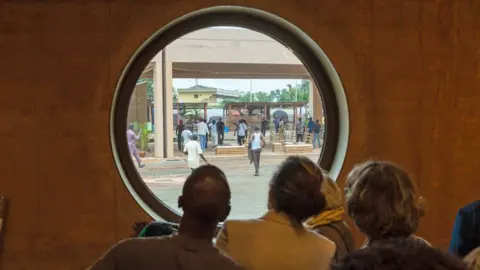
Nigeria’s stunning new Museum of West African Art (Mowaa) has found itself in the crosshairs of local power politics the week it was due to open its doors to the public for the first time but failed.
The 6-hectare (15-acre) campus is located in the heart of Benin City, the capital of southern Edo State, and includes archaeological digs and buildings designed by renowned British-Ghanaian architect Sir David Adjaye, best known for the National Museum of African American History and Culture, which opened in Washington in 2016.
It took five years to create and is intended to celebrate both the past and present of the creativity of a region famous for its Benin bronzes, art objects looted from the city’s royal palaces by British troops in the 19th century.
It was impressive. And ahead of its planned opening, Mowaa is buzzing with staff determined to prove it is a venue that can compete with established museums and galleries in the West.
Inside, caretakers carefully unwrapped the artwork from its protective packaging, inspected and meticulously recorded each piece before placing them on the walls and plinths.
Technicians fine-tuned the climate control system. In the materials science laboratory, officers calibrated equipment to preserve centuries-old artifacts.
The project was the brainchild of businessman Phillip Ihenacho, who is currently the Managing Director of Mowaa.
“I want us to have a significant economic impact on the communities around here,” he told the BBC, adding that he wanted to make Benin City a “cultural destination.”
Mowaa, a Nigerian not-for-profit organization, creates more than 30,000 jobs directly and indirectly and contributes more than $80 million (£60 million) annually to the local creative economy through partnerships and programming.
It took $25 million (£19 million) to get here. The money was raised from a variety of donors, including the French and German governments, the British Museum and the Edo State Government.
But now the local government has pulled the rug out from under them, canceling use of the land on which the museum was built.
An Edo government spokesperson told the BBC that this was because in the original filing it called itself the Edo Museum of West African Art and later dropped “Edo” from its name.
The announcement follows protests on Sunday where people stormed the campus demanding it be called the Royal Museum of Benin.
A violent group insulted foreign guests ahead of the museum’s opening and forced them to leave in a hurry under police escort.
President Bola Tinubu stepped in to defuse tensions and set up a high-level committee to do some damage control.
But how did this become so politicized and a PR disaster?
Much of it comes down to internal competition at the local state level, as the museum’s main benefactor was former Edo State Governor Godwin Obaseki (whose term expired last year).
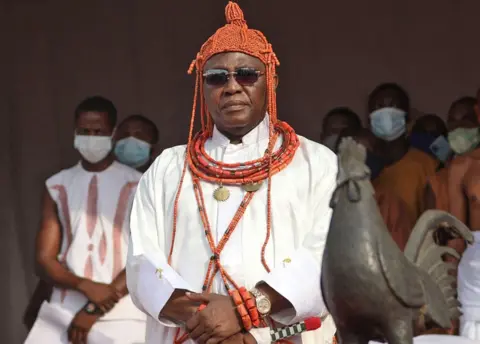
And the new governor’s administration, a close ally of the local traditional ruler known as the Oba, appears to want a bigger stake in the project. For example, protesters on Sunday demanded that the museum be brought under the control of Oba Ewuare II.
It focuses on the controversial issue of the Benin Bronze, one of Africa’s most famous cultural objects.
Because when the museum eventually opens, these bronzes will be conspicuously absent.
These are brass, ivory and wood carvings that once adorned the royal palace of the Kingdom of Benin until British troops plundered it during a punitive expedition in 1897.
Today, thousands of them are scattered across museums in Europe and North America, including the British Museum, the Humboldt Forum in Berlin, and the Metropolitan Museum of Art.
Their return became one of the most controversial debates in the world of art. About 150 people have now returned home, with more expected to follow.
When plans to build the Benin City Museum were first announced in 2019, leading figures in Nigeria’s art community hoped it would be their home in a state-of-the-art complex where they could showcase themselves to the world.
But the waters got muddied two years ago when the federal government announced that the Oba would be the rightful owner and custodian of all returned bronze. And the palace pushed for a royal museum against the wishes of former Governor Obaseki.
 AFP/Getty Images
This placed Mowaa in a delicate position. That meant asserting a clear position on reparations, while maintaining a diplomatic stance on stewardship and emphasizing a broader vision, dropping “Edo” from the name.
“One of the frustrations I’ve always felt is that we said from the beginning that we would focus on being modern and contemporary,” Ihenacho said.
“But because of the Western story about the return of the Benin bronzes, everyone kept referring to us as the museum they would go to. The problem is that we are not the owners of the bronzes and we have no legal title to them.”
His goal is to build a haven for contemporary African creativity, including film, photography, music, dance and fashion, as well as the visual arts.
“Yes, we want to focus on the historical, but the goal is to inspire the modern,” he said.
“We have become a museum focused on creating an ecosystem to support creatives in West Africa.”
From young Nigerian artists moving from the United States to work as conservators, to recent graduates completing a mandatory one-year national youth service program, to PhD candidates from Ghana conducting research, Mowaa has already become a hub for regional collaboration.
Eweka Success, 23, who graduated from the Department of Sculpture at the University of Benin and toured Mowaa, welcomed this opportunity.
He pointed out that while many residents in the city “don’t care” about the reparations conversation, the museum still has something of value to offer.
“Many of us have never seen the original, but there we can study the design, technology and history in more detail,” he told the BBC.
Cultural expert Oluwatoyin Sogbesan agrees that the conversation is becoming increasingly elitist.
“Everyday people are concerned about making a living, working and providing for their families. Many people don’t even know about bronze,” she told the BBC.
For her, restoration goes beyond just returning artifacts, it must also restore memory and language.
“We need to decolonize the term ‘Benin Bronze’ itself,” she explained.
“Please call it by its original Edo name, ‘Emwin Arre’ (meaning ‘cultural object’). This is what the people who created this product would have called it.”
This fits in well with the museum’s first exhibition, Homecoming, which will be open to the public.
 AFP/Getty Images
Works by renowned artists such as Yinka Shonibare, Toyin Ojih Odutola, Precious Okoyomon, and Tunji Adeniyi-Jones are on display. Many of them live in the diaspora and are rarely on display in Nigeria.
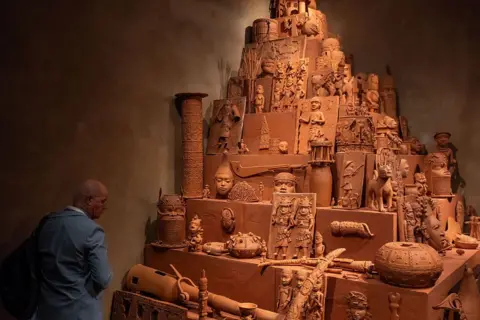
The Monument to the Restoration of Mind and Soul in Shonibare takes pride of place in a pyramid-shaped unit featuring more than 150 clay replicas of Benin bronzes.
“Creating a monument like this acknowledges the trauma caused by the plunder of spiritual relics,” he told the BBC. “It’s a deep emotional engagement with the trauma of the invasion.”
He deliberately chose clay as a metaphor for his connection to the land of Benin itself.
“In modern society, we seem to be becoming increasingly distant from nature, while our ancestors had a deep connection and respect for nature.”
While the pyramids evoke the ancient wonders of Africa, their replicas speak of absence and memory.
“The work is conceptual. It’s about the meaning of absence, the spiritual meaning of bronze,” Shonibare explained. “In some ways this work is cathartic. It’s almost mournful.”
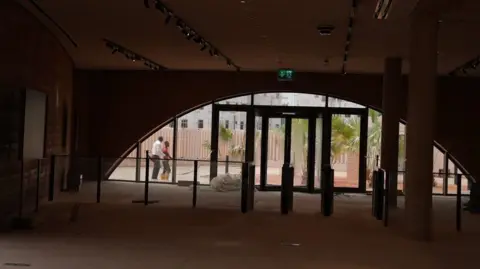
Also of note is Ndidi Dike’s 2016 mixed media piece National Grid. The work reflects both biographical and political power.
Nigerians experience power outages so frequently that they have become a part of daily life. This is a metaphor Dike uses to question widespread failures in governance and infrastructure in the country.
This is something that will resonate so deeply with those working at Mowaa this week.
You may be encouraged by the words of the Minister of Culture, Sports and Tourism, who chairs the presidential committee that is trying to resolve the conflict.
“Cultural institutions are pillars of our national identity and must be protected through a collaborative approach that respects both traditional custodial roles and modern institutional structures,” said Hannatu Musawa.
There are concerns that the lawsuit could undermine ongoing efforts to recover stolen art from Africa, and Western museums feel their concerns about the preservation of returned works are justified.
But many of those working within Mowaa’s walls are determined to show that their creativity can redefine what a modern African museum can be, with or without historical artifacts.
 Getty Images/BBC







