



The X-65 Active Flow Control demonstrator is currently scheduled for first flight in 2027, with the fuselage mated to the wings continuing to evolve.
Assembly of the Active Flow Control (AFC)-enabled 7,000-pound X-65 unmanned X-Plane demonstrator currently being manufactured by Aurora Flight Sciences (AFS) for the Defense Advanced Research Projects Agency (DARPA) has taken a step forward. Aurora reported on June 23, 2026 that the aircraft has finally received its distinctive triangular wings, as seen in the photo attached to the social media post.
As part of DARPA’s Innovative Aircraft Control with New Effectors (CRANE) program, the experimental demonstrator, which has been underway since 2020 and is currently in Phase 3, replaces traditional control surfaces such as ailerons, elevators and rudders with pipes and valves that release jets of pressurized air.
This unique system is expected to reduce the aircraft’s weight, improve aerodynamic efficiency and reduce mechanical complexity. The results of the demonstrator flight campaign, planned for 2027, will validate the aeronautical concept and then lead to AFC-specific systems being integrated into larger aircraft.
A previous set of images released by Aurora on February 24 and April 2 showed the completed X-65 fuselage after manufacturing at the company’s West Virginia facility and delivery of empty airframes, which closely matched concept representations released so far. The new images reveal many new details about the wing’s AFC-related features.
The next big milestone for the X-65: the wings have arrived! Triangular vanes manufactured at our WV facility allow for active flow control testing over multiple sweeps. Integration is underway at the VA as the @DARPA CRANE program moves forward with its first flight. pic.twitter.com/w6jhT7ptzI
— Aurora Flight Science (@AuroraFlightSci) June 23, 2026
new photos
The X-65 airframe can be seen with most of the panels removed, showing that the necessary wiring and hardware has been installed. This is consistent with Aurora Flight Sciences’ previous statement that it will soon integrate AFC-related components and electronics into the fuselage.
The starboard wing’s root is prominently installed, and the port wing is nearly complete, missing only the low-swept angle external components, as seen in the concept representation. A slanted tail is also missing, these surfaces are currently in production and will be installed over the next few months.
#ICYMI X-65 fuselage has arrived! Our team is currently integrating electrical, propulsion and AFC systems into the fuselage in Virginia, while wing and tail manufacturing is advancing in West Virginia. Stay tuned for updates as we progress toward first flight planned for 2027. pic.twitter.com/uZ4FL0sxRR
— Aurora Flight Science (@AuroraFlightSci) April 2, 2026
Aurora previously described the X-65 demonstrator as “designed specifically to test and demonstrate active flow control with a 30-foot wingspan and 7,000-pound gross weight.” The aircraft’s speed is expected to be Mach 0.7.
“The AFC system supplies pressurized air to 14 AFC effectors embedded in all flight surfaces,” the company added. Screenshots from the graphic video show AFC effector nozzles on the trailing edge of the wing and the raked tail.
One feature that can be seen in both images and representations showing cutaway representations is the ‘air distribution system’ that typically runs across the spars where the wing joints are located.
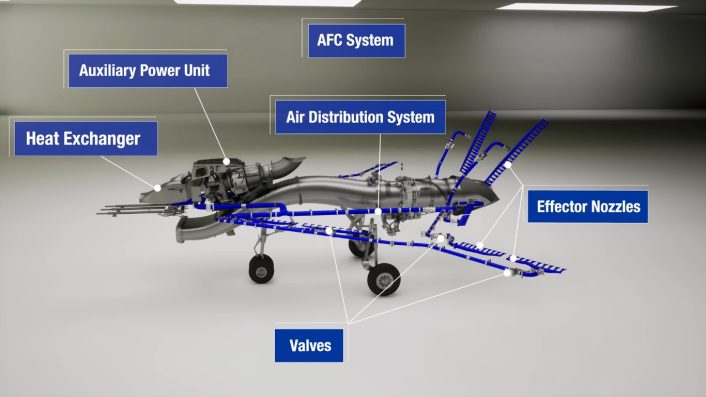
In a previous report, we observed that three flight data probes (pitot tubes) were also common in all renderings. A February image of the front of the fuselage shows three holes in the chine line, which may be ports for this probe.
As we also reported, according to AFS’s 2024 concept video, the larger opening in the front nose section hosts the heat exchanger that feeds the front-mounted auxiliary power unit (APU), while the exhaust is located squarely in the spine.
In mid-January, Aurora completed the X-65 fuselage at its manufacturing facility in West Virginia. In collaboration with @DARPA, we are building the X-65 to demonstrate active flow control. Follow progress toward first flight, currently planned for 2027. pic.twitter.com/V10cldS0Bg
— Aurora Flight Science (@AuroraFlightSci) February 24, 2026
Aerodynamics and manufacturing capabilities
Aurora Flight Sciences previously noted that the As can be seen in the video released by the company earlier, the AFC effector nozzles are located at the front and rear, and the slanted wing parts are activated in various combinations to express various wing sweeps.
Aircraft with conventional control surfaces require different types of mechanical or fly-by-wire flight controls, each with its own linkages and actuators. AFC effector nozzles replace these components but still operate on the same mechanical principles, producing roll, pitch, and yaw moments to change the aircraft’s attitude.
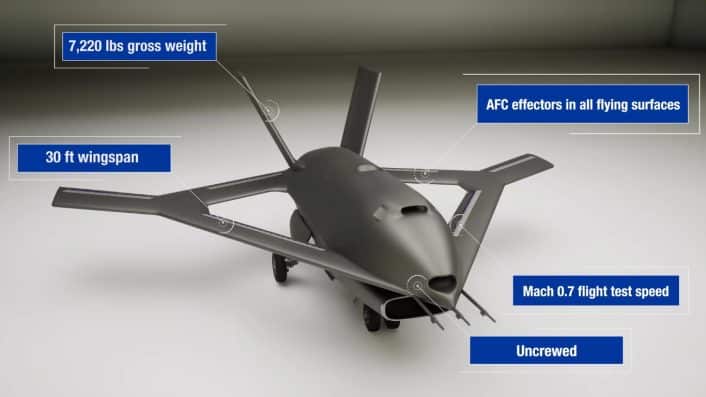
Therefore, AFC will advance flight control systems to technologies that do not require moving surfaces. DARPA stated on January 17, 2023 that the transition from Phase 2 to the follow-on phase and the selection of AFS among all competitors was based on “innovations across aircraft configurations, autonomous systems, propulsion technologies, and manufacturing processes.”
Aurora and DARPA have not announced the powerplant selected to fly the X-65. The engine will likely also support the air supply required for the AFC.







