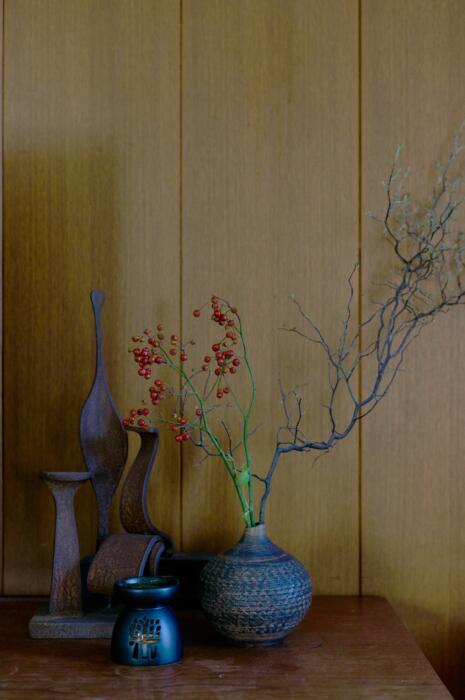
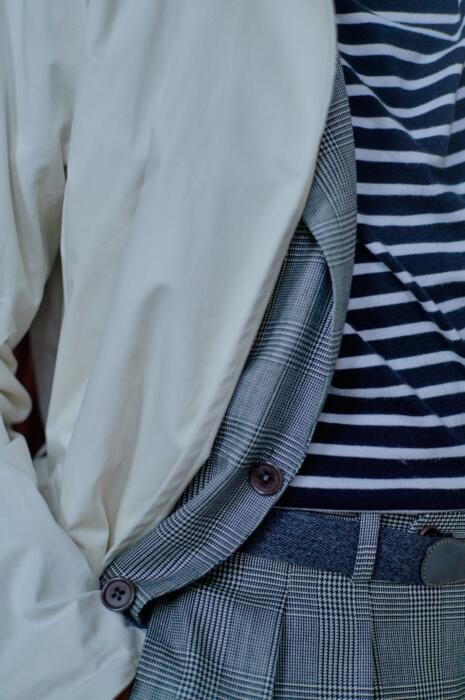
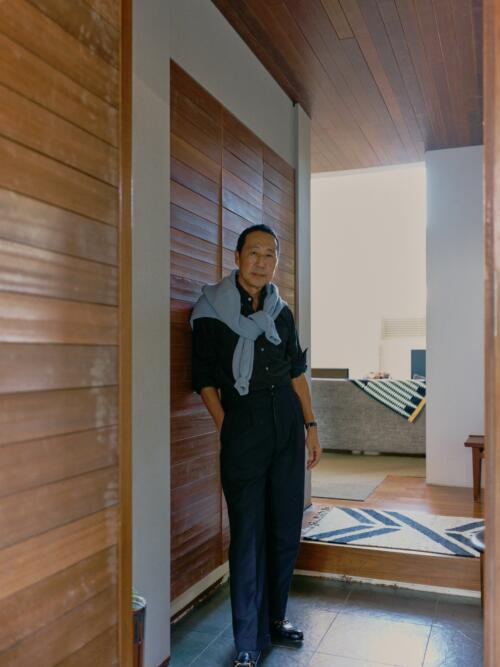
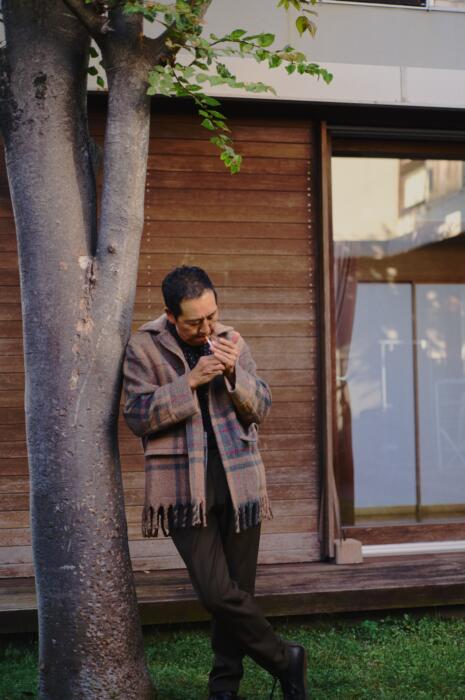
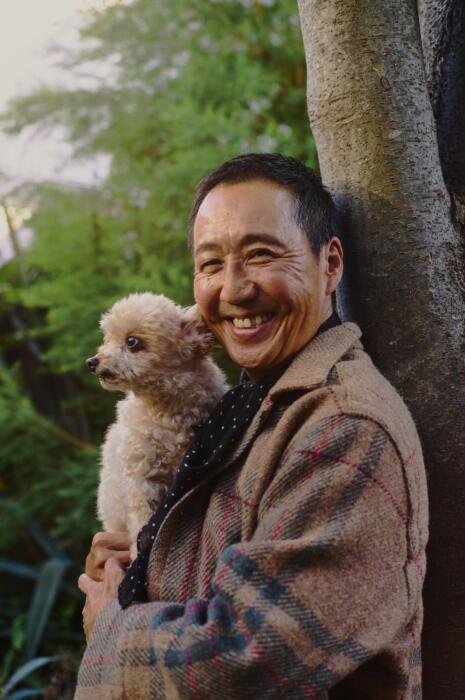
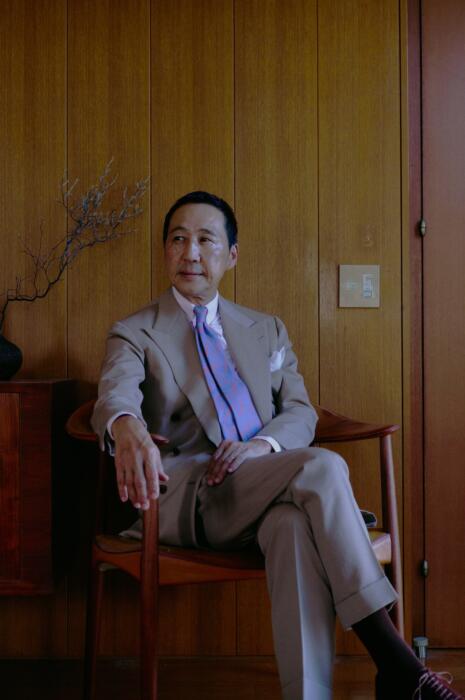
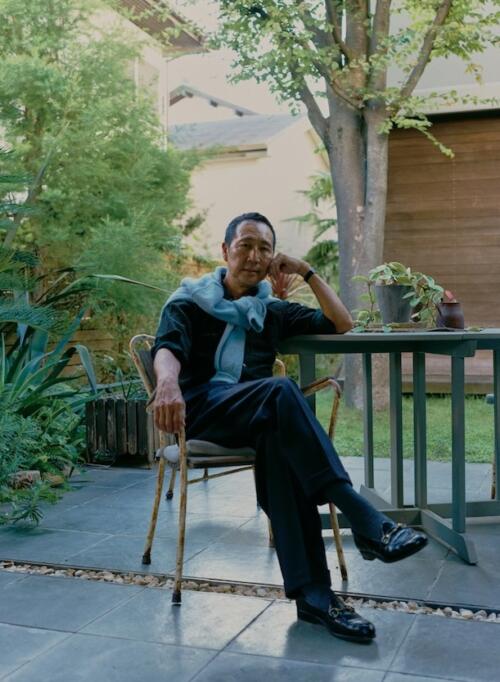
Note: The images shown are mostly from Kamoshita’s house in Tokyo, where we sent a photographer, to illustrate his style and wardrobe. The interview took place on a separate occasion, in Milan.
When we arrived, Kamoshita-san and Hasegawa-san were already there. Or to be more precise, they were across the street, peering through the window of Officina Antiquaria. “It’s my favourite furniture shop,” Kamoshita said. “Vintage, mid-century.” Through the window we could all see – as we peered together now – some low tables, a set of cabinets, a rather elegant leather recliner. Nice stuff.
Kamoshita had picked the restaurant, so it shouldn’t be surprising that it was close to a favourite store, as well as, in fact, round the corner from his hotel. He’s been coming to Milan for a long time. The first time was buying European brands for Japanese department store Beams in the nineties – and there is naturally a set of favourites.
Oh, also it was 37 degrees. Milan had been throbbing with heat that day, and so we did little more than glance in the window before scuttling across the street to the restaurant. Inside Kamoshita suggested beer – just a little glass, ice cold – before we looked at the menu. Everyone enthusiastically agreed and after receiving that, as well as equally cold mineral water, we could relax.
Kamoshita and colour
We means four. Myself and Lucas Nicholson from Permanent Style, Kamoshita and Yoshimi Hasegawa sitting across from us. Hasegawa was there to translate: Kamoshita’s English is good, but like many Japanese I’ve interviewed, he prefers to speak through a translator. It rules out any possible mistake, and provides more thinking (or eating) time.
Indeed, Kamoshita would give rather long, thoughtful responses to each question during our dinner, as if he had used that extra time to reflect. For example – I’ve always admired Kamoshita’s sense of colour, and remembered that he studied interior decoration at university – were the two possibly connected?
“No, I don’t think so,” said Kamoshita, or rather Hasegawa. Fortunately, we’d heard Kamoshita’s long reply in Japanese, so we knew there was more to come. It wasn’t a stupid question.
“We studied the history of decoration and of architecture, so it was not that relevant. But, I loved art and I loved artists, that was why I studied it at university, and that has always been an influence. Particularly colour, particularly artists like David Hockney. The way he combined colours – you could see it in the paintings and then in what he wore.”
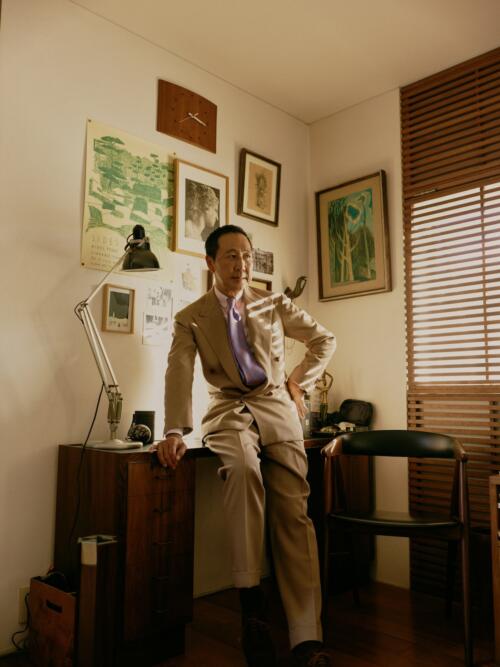
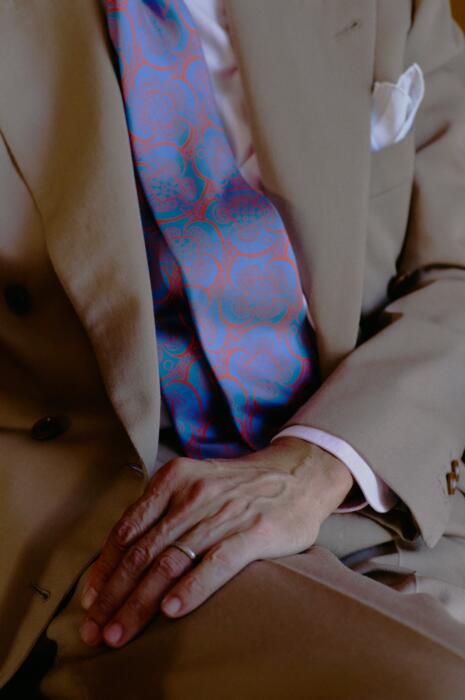
Kamoshita, by the way, is wearing a tan-gabardine suit, with a mustard-striped shirt and a jazzy Charvet tie of red, cream and purple. No one meeting him would be in any doubt that he likes a splash of colour.
But, I asked, doesn’t this make it hard to work in classic menswear, given it’s so dominated by sober tailoring, by black and blue and white?
“Yes, there has always been a tension there,” Kamoshita replied. “But, I appreciate the traditions of menswear and why they exist. I appreciate the elegance of sober dressing and everyone dressing in a similar way. I appreciate the respect that comes with dressing for a particular occasion.
Then, after a pause: “At the same time I think there is a responsibility for me to express myself. Once you know how to, I think there is just as much responsibility there to yourself as a person.”
Menswear moves with re-interpretation
I was interested whether some of that passion of colour came from Kamoshita’s love of Italian style? After all, Italian tailoring was a huge trend in Japan in the late nineties and early noughties, when he was building up United Arrows.
“No, not particularly. A lot of people talk about colour in relation to Italian style, but I think you see it everywhere – in American Ivy style, in British style. When I was growing up American casual style was the big trend, and they have their own strong colours. Then it was French style, then Italian, and always in the background a British influence.
“Of these, the most influential for me was the French, particularly their take on Ivy style. Shops like Hemisphere, Old England and Arnys. All of them were beautiful men’s shops in Paris, all of them are now sadly gone.
This, I suggest, illustrates one of the great drivers of men’s style in the past 50 years, and one often underestimated: interpreting and re-interpreting traditions. Classic menswear can seem fairly static, but often it’s the interpretation of one culture by another that keeps it relevant. Like Hemisphere being a French person’s take on American clothing, which then got re-interpreted when it came to Japan.
“Yes, and it’s interesting being a Japanese person, because we are always last in this chain. We don’t have our own menswear, so from the beginning we had to learn from others – from the Americans, from the French. This is what makes us great students of other traditions, of other cultures. We want to understand everything.
What is Japanese style?
Then after a pause again, that incisive additional thought: “And under all of it, I think we want to understand what is the best combination – what is the best style – for Japanese people. Today, I think we have found it, I think Japanese people have reached that point.”
OK, so obvious question next – what is that style? Kamoshita has one of those faces that can turn from serious to smiling in an instant. He is either pondering or grinning broadly. Without wishing to be patronising, I find it very endearing.
At my question he shrugs, his face breaks open, and he laughs. It’s infectious – we all start laughing.
“It is very difficult, very difficult to say.” I can see why. Ask a British person to describe British style and he might mention a few specific things – suits, ties, maybe cricket or tennis – but he can rarely define it satisfactorily. A lot of it is subconscious; it often takes an outsider to see it clearly.
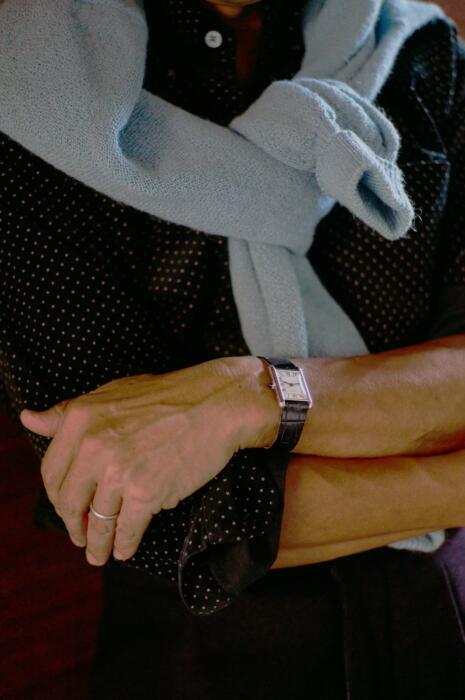
“Perhaps you see it best in the clothes themselves. For example, this suit I am wearing is by a rising star of Japanese tailoring. But the style of it is a combination of English and Italian style, through a Japanese eye,” Kamoshita says.
“I never thought it would be possible to establish a Japanese style, particularly when it comes to colour. But people say I have a particular take on colour, so perhaps this Japanese style is being expressed by what I wear, what I design – it is those on the outside that have the perspective to see that best and describe it.”
I guess that’s people like me. As I mentioned, I have always found it inspiring how Kamoshita uses colour, and if I had to describe it I’d say it has all the energy of Italian dress, with a control and precision that’s very Japanese.
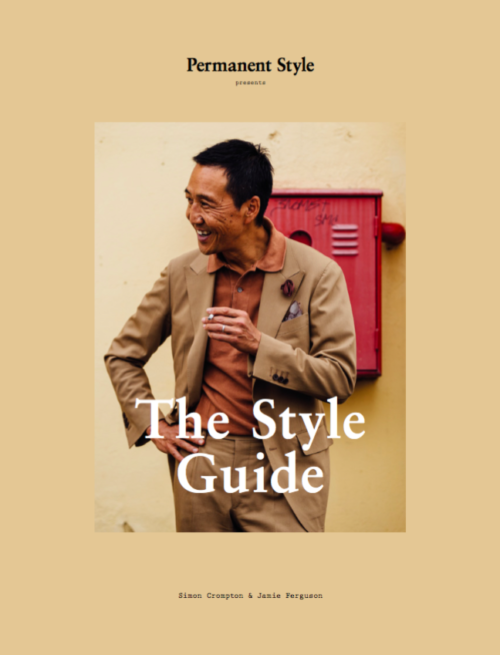
Kamoshita has appeared on the cover of one of our publications before, for example – The Style Guide in 2018 (below). In that image he wears a tan suit with a burnt orange polo shirt, similarly coloured boutonniere and brown/white handkerchief. It’s colourful, but also restrained.
A lot of Italians I know would combine those warm colours with a pop of yellow or of green, but the earthy tones he goes for are much more satisfying. Even the shirt and tie he’s wearing today are within a similar tonal bracket.
What’s the next new colour?
“The way we wear clothes is very influenced by what we see around us,” Kamoshita continues. “Our environment, the buildings, the weather – and of course the people.
“In my case, I’ve always wanted to be different from what others are wearing. It’s still very Japanese probably, but because everyone I saw was wearing navy and grey, I wanted to wear brown. Now many years later, brown is popular too, so I have to find something else!” This remark is followed, predictably and delightfully, by a giggle.
“I’m not sure what is the new thing for me – perhaps beige. I can’t wear a purple suit and there aren’t many other options.” Perhaps white, I suggest – he could become the Japanese Tom Wolfe? “I’m not so sure, a white linen suit is beautiful but I think it works better on a white person with blond hair – Asians can’t compete with that,” he says.
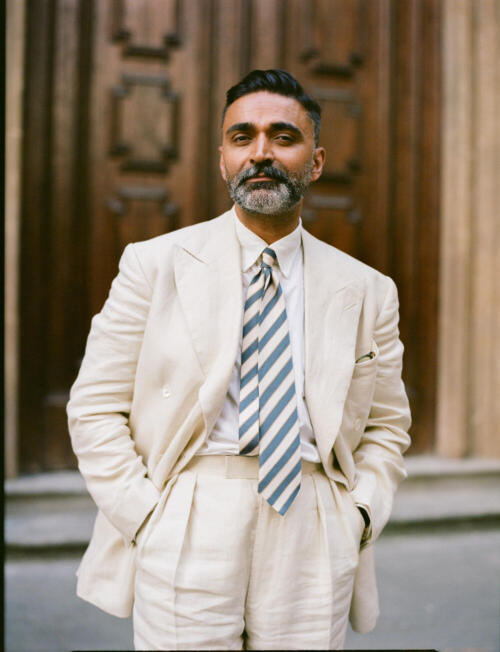
Associations play a role as well of course. Permanent Style contributor Manish Puri was showing off a cream double-breasted linen suit earlier that day (below) – but it looked rather different on him, being of Indian ancestry, than it would on the very white and English Lucas or myself. Kamoshita nods sagely, just as the main course arrives.
Why do PS readers worry so much?
The restaurant, Antica Trattoria Della Pesa, is one of the oldest restaurants in Milan and deliberately continues a long tradition of Lombardian cuisine: ossobuco, often with risotto, hot zabaglione for dessert. It has also scrupulously kept its old furnishings.
There is a lull in the conversation for a good 10 minutes while everyone tucks in. Mention is made of the recent elections, but nothing else. Proper menswear talk is reserved for the end of the course.
I begin by raising a point about that urge to dress differently from others: is that a hindrance when you’re designing clothes for other people to buy and wear? “Fortunately no, I don’t think so. I design what I like and want to wear, and it has always worked,” he says.
“However, it does vary with the size of the brand you are working for. If it is my old collection, Camoshita, then it can be more just what I like – but if it’s a bigger brand, you need to have the broader customer in mind.”
This is interesting, because I feel Permanent Style readers all exist somewhere along this spectrum – from those that want to dress quite simply and conservatively, to those that are keen to express themselves.
This point brings a question from Kamoshita back at us: “Why do Permanent Style readers ask about what they should wear so much?” he asks. “Why do they worry about it rather than just doing what they want?”
It takes me a while to formulate an answer. I wish I had a translator to give me some thinking time. In the end I say: because, I think, a lot of men want to dress well but they don’t have the understanding of clothes to do it. They don’t have the cultural inheritance of fathers or brothers or friends who dressed in an elegant way, and they haven’t spent much independent time thinking or researching it.
Clothes are what you eat
“But I think most people know what they want to wear – they just don’t have the confidence to do it,” argues Kamoshita, serious now. “It’s instinctive, they know what they like. Just like eating – you eat food, you know what you like to eat.”
I like the metaphor, but I think clothes are different in at least one way – they are social, cultural. They communicate something about you to everyone around you, so they’re more complex. Most of the time people don’t see what you eat.
Lucas chips in here to extend the analogy: you can’t always eat what you want, like McDonald’s every day, because it would make you unhealthy. In the same way, you can’t wear exactly what you want because you live in a society, where different clothes communicate different things.
(It occurs to me, as the conversation switches interlocutors, that that’s maybe why so many people turn up to McDonald’s in sweatpants.)
“And just like healthy eating, dressing well requires a certain level of education,” says Hasegawa.
“I agree,” nods Kamoshita. “Ever since I was a young boy I was interested in clothes and wanted to know about them. I couldn’t understand people who didn’t care. I think today I have the same problem: I find it difficult to understand that some people may not know how to wear clothes because they’ve never thought about them – rather than it being a definite decision to dress that way.”
It’s also much easier to learn when you’re a teenager, I say. You’re learning everything else, so you absorb it all very readily, and there are no expectations. When you’re a 40-year-old it’s a lot harder to learn and also to experiment, to find your style.
“Yes – I always say that if you never try you never learn. You need to try lots of different things. Same with food,” says Kamoshita.
This is true. The big problem is that good clothes are expensive – trying a lot of them takes a lot of money.
“And, it’s a reason bespoke is not for everyone,” he says. “Not only is it the most expensive thing to experiment with, but it requires a certain level of knowledge and experience because you’re buying something you can’t even see – you have to imagine it.”
Hasegawa chips in again, going back to the point about how much money people spend on clothes: “It’s interesting to compare Europe with Japan, because in Japan people spend a lot more money on clothing. They may have a tiny flat and they won’t own a car, but they do spend a lot on clothes.
“So they might earn £30,000 a year, but they’re still happy to buy Yohei Fukua bespoke shoes (which cost over £3,000). Perhaps that’s one reason the standard of dress is higher – they’re buying more, and so experimenting more.”
Are there other reasons for that different attitude to spending money, I ask?
“One reason I think is that there hasn’t been any kind of class system in Japan, so people buy things more to show their status. And it’s cheaper to do that with a suit than it is with a car.”
At this point everyone sits back, as if we’ve solved something knotty and profound. I’m not sure we have, but it certainly made the meal go quickly. At the waiter’s suggestion, we retire outside for dessert.

It’s always shoes
It’s still steaming hot outside, at 10pm. Still, with a cold glass of wine and a little wind coming up the street, it’s a lot more pleasant than it was during the day. I kick off with a favourite and regular question: what was the most expensive piece of clothing Kamoshita remembers buying when he was young?
“I always like golf,” he says, “I’ve played regularly ever since my twenties. Back then, Jack Nicklaus was my icon, both for his golf and for what I wore. He had some real style. Well, I wanted the same club as him but also the same shoes, from Johnston & Murphy. I remember buying those shoes and they cost me more than my month’s salary. That’s stayed with me!”
It’s interesting, I think shoes are the answer to that question about three quarters of the time. There’s something about them that appeal uniquely to men – like they’re an object that can be fetishised, in a way that a suit isn’t. “For me, they’re a complete product,” says Kamoshita. “A bag is like that too – it exists on its own, without the need for a shirt, tie, even a person wearing it.”
And what does he wear to play golf today? “Ah, no costume, no knickerbocker!” he says. Slightly disappointing – if anyone could pull off that look, with a Fair Isle vest and a pair of saddle shoes, he could.
Frankly, after this, the conversation turns to food and reminiscing. The dessert menu prompts a debate as to the origin of île flottante – many foreigners assume custard-based desserts like this are English, even though English people have rarely heard of them. And then there is talk of the heat – what is the highest heat and humidity people have had to live through? Nice chat, but probably not worth reporting in a feature on menswear.
Trousers over time
There is a last question that prompts an interesting answer. As grappa arrives, we ask Kamoshita what he has on his wishlist, in terms of menswear purchases. Turns out, it’s a whole new set of trousers.
“It’s hard, because I have a lot of suits and trousers, but fashions have slowly changed over the years,” he says. “Most of my suits are 18cm at the hem, but now trousers are 20cm, even 22cm. I’d like to change them but that’s often more than is possible. And you can’t get the same cloth any more.”
He has managed to maintain the same body size over the years, so the jackets are OK. (We tell him this is very impressive – it draws a trademark laugh, which is always satisfying.) But the silhouette with the slim trousers looks wrong today.
We have a few suggestions – turning them into flares with a nice paisley insert; adding Adidas stripes all the way down the leg. Admittedly these are not serious – the grappa may be starting to take its toll.
The subject is saved by Lucas, who makes the practical suggestion of wearing separates instead. Kamoshita nods, and takes out his phone. We’re shown a picture of him wearing an old suit jacket with wide Bernard Zins trousers – naturally, he makes it work.
Lucas also suggests that the trend will come round again. “Mmm, maybe after 20 years,” projects Kamoshita. “And by that time I’ll be dead!”
The photo had been taken outside Kamoshita’s home, and that is one reason the location was chosen for the photos accompanying this piece. It looked so stylish but also, of course, an extension of Kamoshita-san and his personality.
The evening as a whole has felt like a wonderful insight into that. Not so much about his career, with all its twists and turns, but about a man reflecting on his relationship with clothes and how he sees things today.
“If there is one thing I would like to do in the next few years, it is help Japanese craftspeople – particularly tailors,” concludes Kamoshita, returning to the theme of establishing a Japanese style. “There is such talent there, but not always the confidence or awareness to create an identity. I feel a responsibility to do this any way I can.”
All I can say is, lucky tailors.
Footnote: Biography
Yasuto Kamoshita has been one of the most influential figures in Japanese menswear for many years. Born in 1957, he joined the department store Beams after graduating from Tama Art University, moving from a salesperson to a buyer over the years. In 1989, he made waves by being part of the team that broke away from Beams to set up a new store, United Arrows.
Originally intended to be its own luxury Japanese brand, United Arrows eventually became a multibrand store too, albeit the biggest in the country. Kamoshita was a buyer from the start, focusing on Europe – for many years he hadn’t visited the US, despite his fondness for their style.
In 2007 he launched his own line within United Arrows, Camoshita (the ‘K’ being swapped for a ‘C’ to sound more Italian, less Japanese). Today he continues to run his own brand as well as being a director for other brands, including Paul Stuart in Japan for example, which has a separate collection to the United States.
Throughout it all Kamoshita has been recognised for his easygoing, Ivy-influenced style and mastery of colour, which have made him a style icon quite apart from his role in the direction of these stores and his personal designs.
This article was the cover story of the Spring/Summer ‘25 issue of PS magazine