



alex de waalAfrican analyst

 Reuters
Two and a half years of war have left Sudan in ruins. Six peace initiatives have failed. None of them can pressure or persuade local powers to push for compromise.
Many Sudanese ask whether the world cares whether they live or die.
Could things change with direct intervention from the Oval Office?
As US President Donald Trump himself acknowledged, the conflict was something he “didn’t plan on getting into.” I thought it was just crazy and out of control.
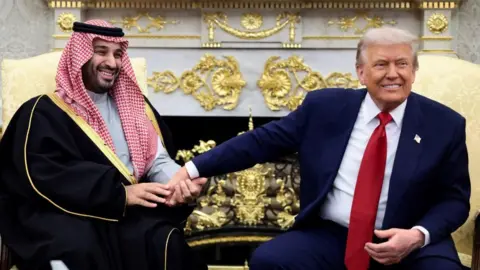
But that was before the White House met with Saudi Arabia’s Crown Prince Mohammed bin Salman 10 days ago. He explained to the President what was happening and asked him to intervene.
President Trump later said, “We are going to start working on Sudan.”
He later posted on social media that “tremendous atrocities are taking place in Sudan. Sudan has become the most violent place on earth” and pledged to work with Egypt, Saudi Arabia and the United Arab Emirates to end the violence.
In fact, the United States has already joined the negotiations, but perhaps Trump’s personal influence over leaders of allies accused of supporting one side or the other in Sudan could make a difference.
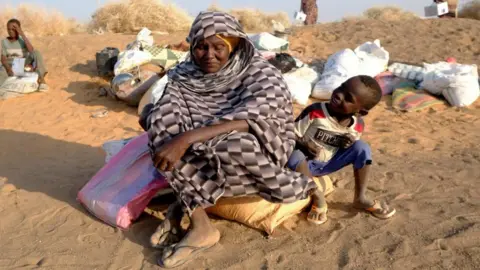
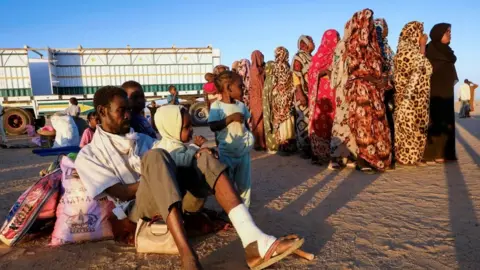
With nearly 12 million people forced from their homes and famine conditions continuing in parts of the country, Sudanese are desperate for anything, anything, to break the deadlock.
Trump’s comments on the situation come just days after the Civil War reached a new low in horror in late October.
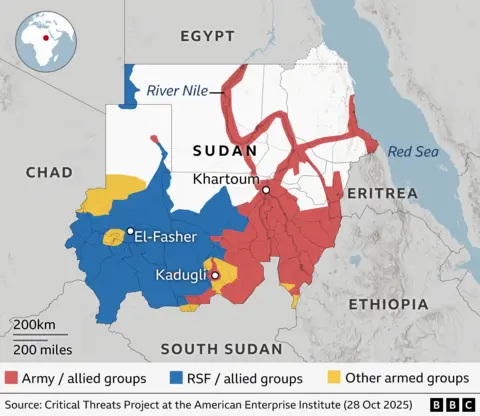
After a 500-day siege, the paramilitary Rapid Support Forces (RSF) captured the city of El Fasher, the army’s last stronghold in the westernmost region of Darfur.
 Reuters
RSF fighters swept through the city, killing, raping and pillaging. The number of people killed in this ethnically targeted massacre is estimated at more than 5,000.
A ‘trophy video’ filmed on a cell phone showing the killers harassing, torturing, and killing the victim was distributed on social media.
The posture of the war leaders following the killings followed a long-standing pattern.
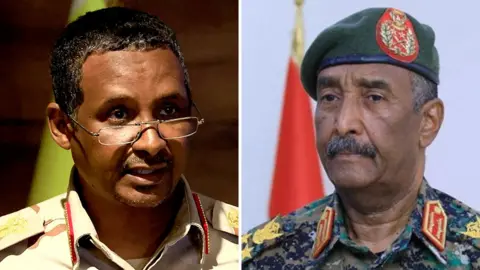
After capturing El-Fasher, RSF chief General Mohamed Hamdan Dagalo, known as “Hemedti”, announced that a ceasefire was ready. He wanted to clean up a reputation tarnished by genocide.
But Sudan’s generals, stricken by battlefield humiliation, were not ready to compromise.
Army Chief of Staff Abdel Fattah al-Burhan, leader of the UN-recognized government, rejected the ceasefire and pledged to continue fighting.
Burhan, especially the Islamists in his camp, are currently in a fighting mood and portray the RSF as a terrorist insurgency that must be defeated once and for all.
Hemedti publicly proposes a compromise. But his army’s atrocities tell a different story, and few people in the cities they sacked would consider living under their rule.
When they have just suffered defeat, military commanders constantly promise to repay their losses and restore their pride. And when they win, they claim they can get the job done.
 Reuters
During four decades of war in southern Sudan, Darfur and elsewhere, this mentality meant Sudanese leaders dismissed the formula for peace proposed by mediators.
Now, as the country faces virtual division, this is the pattern Trump must break.
Regional states support different sides in the war.
Egypt and Turkey have stepped up arms supplies to the Sudanese military. Saudi Arabia is also leaning towards the military.
The UAE has reportedly armed the RSF and is increasing its supplies, according to several reports from investigative journalists and intelligence agencies. The UAE has always denied this.
The first step toward peace is for major regional countries to stop adding fuel to the fire and instead use their influence for peace.
For the past six months, U.S. Secretary of State Marco Rubio and his senior adviser on Africa, Massad Boulos, have been developing a plan.
They established a “Quad” that would include the United States, Egypt, Saudi Arabia and the United Arab Emirates and drafted a plan with three key elements:
- truce
- Access to humanitarian assistance
- Negotiations to form a civilian-led government.
The Quad confirmed its plans in September and met with Washington again last month. However, the gap between the Sudanese warring parties could not be completely bridged and the RSF attacked El-Fasher.
Taken at face value, Bin Salman’s appeal to Trump places much more weight on the Quad plan.
The US president is the only one who can intervene with UAE President Sheikh Mohammed bin Zayed Al Nahyan and persuade him to change course.
The problem is that Saudi Arabia and the UAE are engaged in fierce competition for influence not only in Sudan but also throughout the Arab world, including Yemen and Syria.
It is a battle over who will take control of the Arabian Peninsula.
The two have policy differences, particularly over how to deal with the Muslim Brotherhood. Saudi Arabia can tolerate Islamists if they do not play a leading role, while the UAE considers the Muslim Brotherhood a terrorist organization.
Because Burhan’s coalition includes powerful and wealthy Islamists during former President Omar al-Bashir’s three-decade rule from 1989 to 2019, the UAE has sided against them.
Trump should also get Saudi Arabia and the UAE to place Sudan higher on their priorities.
For both countries, Sudan is under the problems of Gaza, Syria, finance and commerce.
Despite his personal appeal to the US president, it is unclear whether bin Salman has offered to put aside his differences with the Emirati leader to make peace in Sudan.
And Burhan appears to be interpreting the prince’s intervention in Washington as ignoring the Quad plan rather than strengthening it. Because this could mean excluding the UAE.
He would like to see a greater role for Saudi Arabia in mediation, but the UAE has refused to do so. This is a green light to strengthen the war, not end it.
 Reuters
To be truly effective, Trump would need to put enormous pressure on the UAE to end its reported support for RSF.
But with bigger issues at stake, the UAE is a champion of the Abraham Accords and a key investment partner. The Trump White House is unlikely to take sides against Abu Dhabi in the war in Sudan.
There has never been a single public rebuke of the UAE, and there is no prospect of measures used in other disputes, such as economic sanctions.
For now, the United States is relying on quiet diplomacy to persuade the United Arab Emirates to use its influence over Sudan’s guardians. This requires diplomatic finesse.
The long-suffering Sudanese people are hoping that the Trump White House will have the skills and patience for peace.
Even if the Quad wins a ceasefire, it is only the beginning.
With aid budgets cut, the $3bn (£2.3bn) urgently needed for humanitarian aid will be difficult to find. Any ceasefire will be fragile without a massively stepped-up support effort.
And that is just the beginning of Sudan’s long and arduous journey toward peace.
Sudanese are polarized and bitter, and most of them do not trust any general.
Civilians who took to the streets to suppress Bashir seven years ago are still demanding democracy and justice.
And many fear that if Arab countries lead the peace process, Sudan’s destination will be an Arab client state.
Alex de Waal is the Executive Director of the World Peace Foundation at Tufts University’s Fletcher School of Law and Diplomacy.
 Getty Images/BBC







