



In a significant milestone toward first flight later this year, Shield AI and GE Aerospace have integrated the X-BAT with the AVEN thrust vectoring system tested on the F-16 in the 1990s.
Shield AI’s fighter-grade The company announced that it had selected the F110 in November 2025.
Shield AI said the two companies “successfully completed integration, operational and engine-out testing” of the AVEN. The special AVEN nozzle is suited to the X-BAT’s unique launch and operation, providing “adequate thrust vectoring capabilities for vertical flight, launch and landing,” the company said.
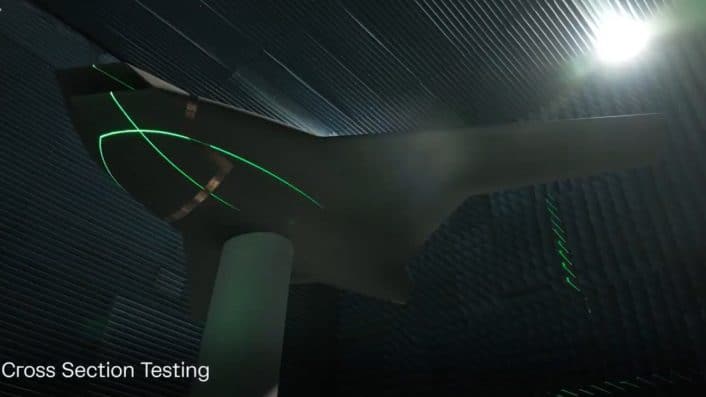
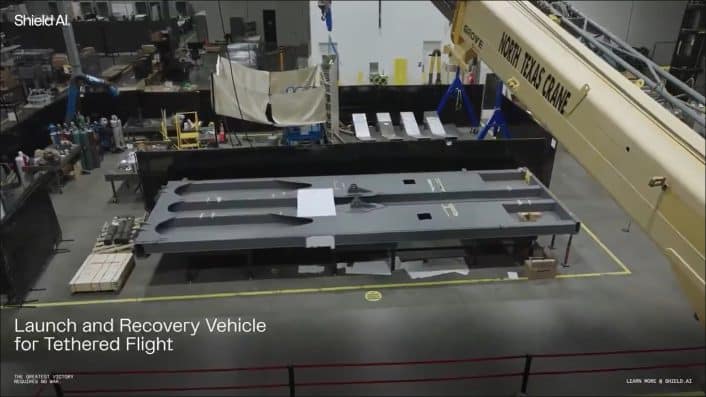
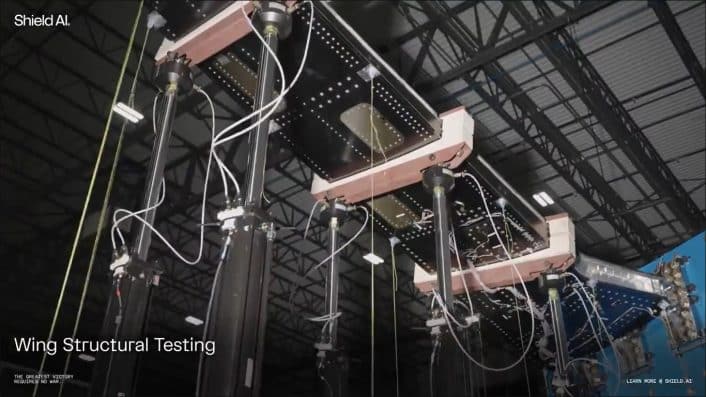
A video released by the company on July 15 shows the F110 undergoing ‘hot fire testing’ in a wind tunnel facility, and three such power plants are visible. The video also showed a full-scale model of the aircraft undergoing radar cross-section testing in an anechoic chamber, wind tunnel testing, structural stress testing of the wings, and most importantly, a unique launch and recovery vehicle for tethered flight.
There is no runway, no problem.
Shield AI and @GE_Aerospace have just completed engine-out testing of the Axisymmetric Vectoring Exhaust Nozzle (AVEN) for the X-BAT, completing the critical path to vertical flight.
Engineers from both companies designed AVEN for GE Aerospace… pic.twitter.com/OxV3y3sRKB
— Shield AI (@shieldaitech) July 20, 2026
In previous reports, we observed that there are few details about this unidentified docking mechanism. The three deep slots visible in the LRVTF, corresponding to the underside of the X-BAT, give an idea of the unique system being developed for runway-independent operation.
The X-BAT is one of the autonomous unmanned combat aircraft expected to be fielded in Incremental Phase 2 of the U.S. Air Force’s Cooperative Combat Aircraft (CCA) program, along with Lockheed Martin’s Vectis advanced fully stealth UCAV. Shield AI previously said it planned to begin production in 2029, with the X-BAT’s first vertical takeoff test in 2026, full system flight testing and operational validation in 2028.
X-BAT is in progress. pic.twitter.com/LhLGT80Fjm
— Shield AI (@shieldaitech) July 15, 2026
AVEN nozzle integrated with F110
The latest video released by Shield AI shows a variable-geometry nozzle that performs various expansions, contractions, and shape changes. This is a function that must be performed during various phases of X-BAT flight, including VTOL operations. “Engineers from both companies integrated AVEN into the F110-GE-129E engine and then completed functional checks and engine lights-out to verify system performance at GE Aerospace’s test operations site in Peebles, Ohio,” the companies said.
“This is the first fully integrated test campaign since the 1990s, integrating AVEN’s hardware, controls and engine systems to execute coordinated nozzle movement sequences using defined test protocols,” Shield AI added. The company further defined it as “an important milestone in the program’s path toward vertical flight.”
We’re fired!
X-BAT has completed its first engine fire, illuminating @GE_Aerospace’s F110 and taking a significant step in its development program.
Autonomy for the world. The greatest victories do not require war. pic.twitter.com/kMaJu1PjW3
— Shield AI (@shieldaitech) March 18, 2026
The F110-GE-129 powers the Block 50 and later F-16, F-15E Strike Eagle, F-15K Slam Eagle, F-15SA, F-15QA, and F-15EX. The engine is capable of Full Authority Digital Engine Control (FADEC) and has an intermediate thrust of 76.3 kN and a full afterburner thrust of 131.2 kN.
The F110 was developed in the mid-1980s in response to the Air Force’s need for a 129kN engine that maintained the durability, maintainability, and reliability of the F100-PW-220 and F110-GE-100 powerplants. Pratt & Whitney and GE produced the F100-PW-229 and F110-GE-129, respectively.

AVEN, F110 and X-BAT
AVEN nozzles were originally installed on the experimental F-16 Multi-Axis Thrust Vectoring (MATV) aircraft, later designated the NF-16D VISTA (Variable Cabin Simulator Test Aircraft). It later became the
X-BAT does not follow the wind.
The team is pushing X-BAT through thousands of wind tunnel test conditions to evaluate its performance as the environment changes. The goal: A prototype designed for greater reliability, resilience, and mission success than ever before… pic.twitter.com/QNd5To2KQc
— Shield AI (@shieldaitech) June 10, 2026
Armor Harris, senior vice president of aircraft engineering at Shield AI, explained why propulsion type is key to the X-BAT’s ability to be completely independent of VTOLs, runways, and air bases. “AVEN enables vertical flight on a platform of this size and performance. We are applying it differently than we have ever used before. Vertical flight requires rapid gimbaling to maintain attitude control, a requirement that the original program was never able to meet,” said Harris.
The Earth is our runway.
Building the world’s first AI-controlled VTOL fighter requires VTOL setup correctly. Initial entrance testing will ensure the X-BAT has the thrust and stability needed to launch and land anywhere, anytime.
Autonomy for the world. The greatest victories require nothing… pic.twitter.com/IIuxOI2Aci
— Shield AI (@shieldaitech) March 23, 2026
“By taking hardware with a proven track record in flight and tailoring it to that mission, we’ve been able to advance development at an incredible pace rather than starting from scratch. The next step is to iterate on our propulsion approach to make future versions faster, lighter and more capable,” Harris added.
On the NF-16D VISTA, the AVEN nozzle accumulated 73 hours of ground testing and 135 hours of flight time over 95 flights during the 1990s. Now AVEN has been modified and is “undergoing ground testing in preparation for flight testing with the X-BAT prototype.”
X-BAT
Powered by Shield AI’s proprietary Hivemind AI autonomous flight software, the Operating from existing civilian merchant ships, surface warships, amphibious assault ships, aircraft carriers and remote islands, the X-BAT “can be flown independently or as part of a power package with crewed aircraft.”
The drone can carry up to 2,000 pounds of weapons payload in each internal weapons bay, making it similar in size to an F-35. The 80 kilowatts of power the device generates can power electronic warfare and intelligence, surveillance and reconnaissance payloads, and active and passive radar modes.
A new X-BAT design has just been released.
X-BAT took center stage at the @AFA_Air_Space Warfare Symposium to unveil a new, sleek wing for better aerodynamic performance. We brought a 45% scale model of the world’s first AI-piloted VTOL fighter jet to provide customers and the industry with a clear look. pic.twitter.com/nDFhO3mmCa
— Shield AI (@shieldaitech) March 4, 2026
Shield AI says the combat radius is expected to be 1,000 miles. The drone has also been shown to be capable of operating the AGM-158, Joint Air-to-Surface Missile (JASSM) or Long-Range Anti-Ship Missile (LRASM) and the AGM-154 Joint Standoff Weapon (JSOW).


