



The Chinese national, who is currently studying an aeronautical engineering degree in Scotland, was arrested by the FBI at JFK airport before returning to Europe.
Tianrui Liang, 21, visited Offutt Air Force Base, Nebraska, to spot and photograph U.S. Air Force aircraft such as the E-4B Nightwatch and all RC-135 variants. He had previously visited Ellsworth Air Force Base in South Dakota to spot B-1B Lancer bombers.
The Scotsman reported that Liang used information gathered from plane spotting websites to determine his location to get the best views and photo opportunities on the base. These websites are commonly used by enthusiasts to understand where they can be discovered without getting in trouble with authorities or private landowners, but it’s unclear exactly where Liang chose to discover.
Chinese student at Scottish university charged with filming US military aircraft https://t.co/LkRlPO8RH8
— The Scotsman (@TheScotsman) April 19, 2026
Liang first flew to Vancouver, Canada, to meet a friend studying at university in New York. The two began traveling to the United States, via Seattle and on to Montana. Afterwards, the friend boarded a flight to New York, and Liang reportedly continued traveling alone.
Liang was arrested by the Federal Bureau of Investigation (FBI) under Title 18, United States Code, Section 795 as he arrived at New York’s John F. Kennedy Airport and was preparing to return to Glasgow via Frankfurt. The law is similar to a rarely enforced law on the statute books of several countries, including the UK, and states: Do not use naval facilities or equipment without first obtaining permission from the commander.
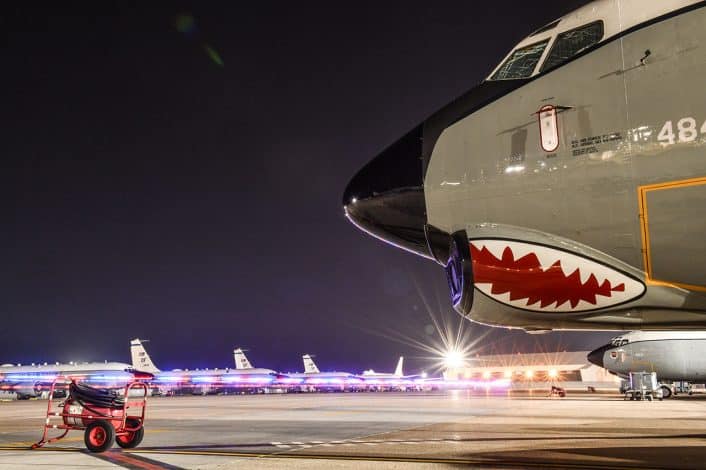
These types of laws are not uncommon around the world, and aviation enthusiasts are generally not bothered by them. In fact, many security agencies have long viewed aviation enthusiasts as a useful additional layer of security protection who can relay information about suspicious activity to the appropriate authorities. Some airfields also maintain a membership system for regular airplane spotters that allows members to contact the base more formally and directly to report such incidents.
Certainly, with the observer’s guides available and the numerous photos taken from the base, many enthusiasts have been able to engage in the hobby at Offutt without issue.
In this case, it appears that the combination of Liang’s Chinese nationality (our cursory research found significant evidence to support that he was a bona fide airplane spotter), heightened sensitivity during the Iran conflict, and a purportedly more hostile environment for foreign enthusiasts under the Trump administration led this individual to run afoul of the law. Offutt AFB is not only home to a variety of enthusiast-favorite aircraft types, but it is also the headquarters of U.S. Strategic Command (STRATCOM), which adds an additional element to security concerns.
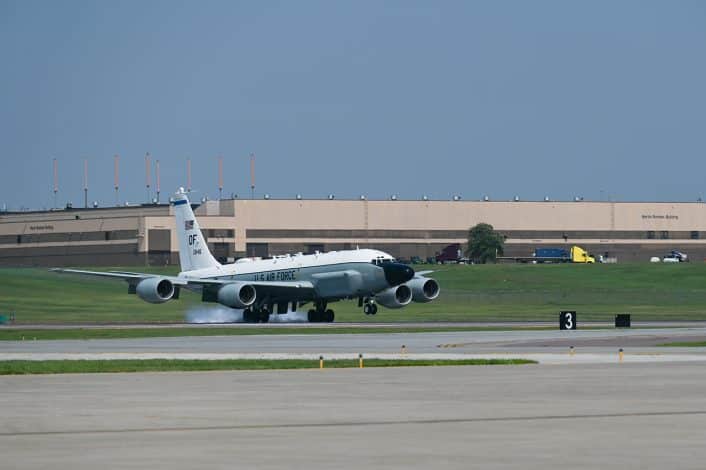
Liang, who is probably most familiar with Britain’s more tolerant environment, may also have attracted more attention by choosing a location not commonly used by local enthusiasts. The witness reported that Liang photographed the aircraft ‘on the runway’, which does not match Spotterguide.net’s recommended location.
The student surrendered his passport, appeared in court on April 8, and was released on bail. This is because the judge in charge of the case rejected the U.S. government’s request for detention until trial. But under a new court order on April 9, Liang, who was deemed a ‘flight risk’, was remanded in custody and it is assumed he remains.
Plainspotter’s problem
Although little appears to have changed for American citizens, there have been numerous reports from foreign aviation enthusiasts visiting the United States since the current administration took office, suggesting that authorities are taking a much more sensitive stance toward the detection of airplanes at U.S. military facilities.
Monitors from allied countries, including the United Kingdom and the Netherlands, who travel under the Electronic System for Travel Authorization (ESTA) visa waiver program, have also spoken online and in person about how they regularly had their details recorded by security forces while at detection sites or were interrogated when they left the U.S. and returned to their home countries.
This isn’t the first time this has happened. This also happened in Türkiye a few years ago. Photographing near or on military installations carries risks.
— Scott Bateman MBE (@scottiebateman) April 20, 2026
In some cases, investigators said they were told their ESTAs had been canceled after they returned to their home countries. This prohibits further travel to the United States and generally means that further travel is subject to a full visa application.
While it is understandable that there is an increased sensitivity to security in the current environment, the security benefits of maintaining good relationships with aviation enthusiasts do not seem to be more widely understood and accepted.







