



There are only a few luxury objects that command the reverence — and the price tags — of a Hermès exotic skin bag. A Birkin or Kelly crafted from crocodile or alligator leather isn’t just a handbag; it’s a wearable relic, the product of years of waiting, thousands of hours of artisan labor, and a global supply chain governed by strict ethical and environmental regulations. Yet for many collectors and first-time buyers, a fundamental question persists: what exactly is the difference between Hermès crocodile and alligator bags, and how do you tell them apart?
This guide answers that question definitively and goes further by covering species identification, the internal Hermès stamp system, secondary-market pricing, care protocols, and the nuanced investment case for each skin type.
1. Why Hermès Exotic Bags Are in a Category of Their Own
Hermès introduced exotic-skin bags in the early twentieth century, drawing on the maison’s equestrian heritage and mastery of leatherworking. Today, every crocodile or alligator Birkin and Kelly is handcrafted by a single artisan — un sac, un artisan — who works on the piece from start to finish, a process that can take anywhere from 18 to 48 hours depending on the skin and format.

To further authenticate this, each Hermes bag features a date stamp and an artisan stamp (together called the blind stamp). The latter tells the craftsman/atelier code that identifies the specific workshop and master artisan who handcrafted the bag.
That said, the scarcity is structural, not manufactured. Wild crocodile and alligator populations are protected under CITES (the Convention on International Trade in Endangered Species), so Hermès sources exclusively from licensed, sustainably managed farms, primarily in Australia and Southeast Asia for Porosus crocodile, Louisiana and the Mississippi basin for American alligator, and the Nile region for Niloticus crocodile. The maison controls its own tanning process in proprietary French ateliers, a level of vertical integration almost unheard of in the industry.
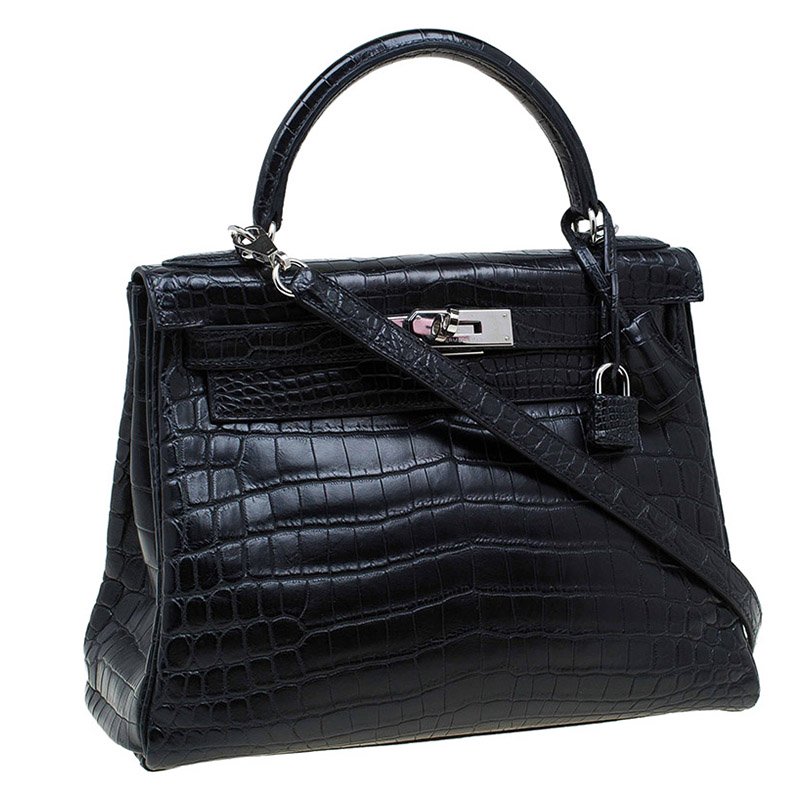

The result: no two exotic Hermès bags are identical. Every hide carries the unique scale geometry of the individual animal, including the characteristic umbilical scar (navel mark) that Hermès artisans traditionally position on the front face of the bag — a subtle proof of authenticity that counterfeiters consistently struggle to replicate convincingly.
2. The Species Hermès Uses — and Why It Matters
Hermès works with three distinct reptile species, each with its own geographic origin, scale character, and price point.
Niloticus Crocodile — Crocodylus niloticus
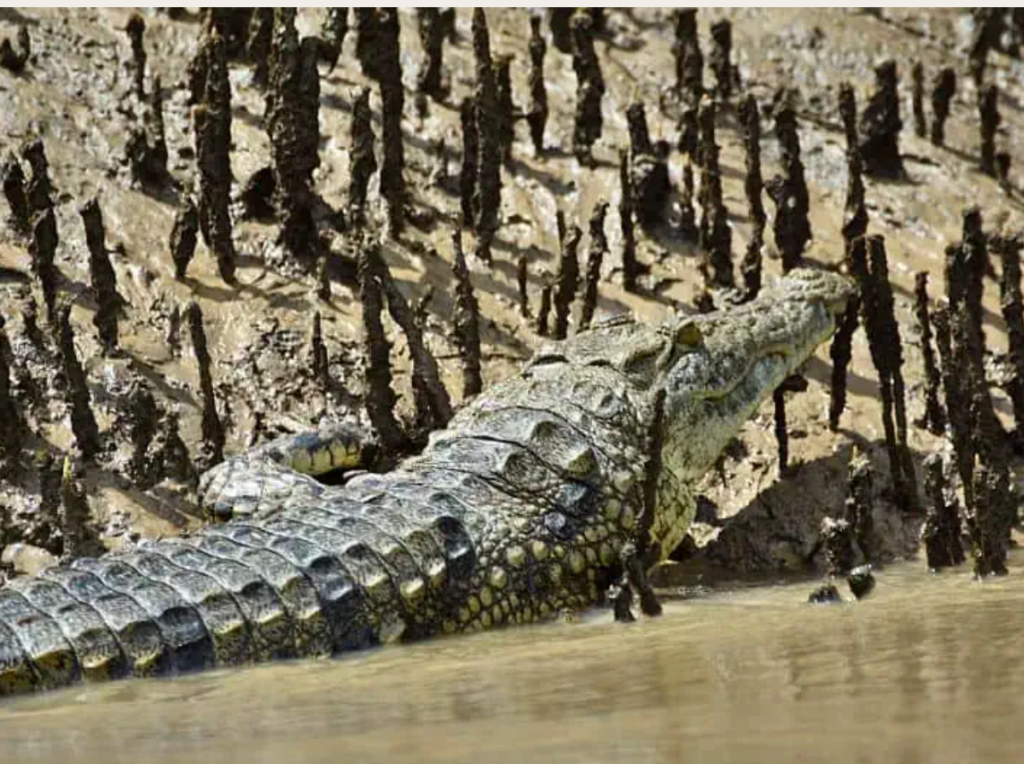
The Nile crocodile, sourced from licensed farms in sub-Saharan Africa (Zimbabwe, South Africa, and Madagascar are among the key producers). Niloticus scales are broader and more rectangular than Porosus, with a slightly softer, less defined pattern. It is still a premium skin by any industry standard, but it sits a notch below Porosus in both prestige and price.
American Alligator — Alligator mississippiensis
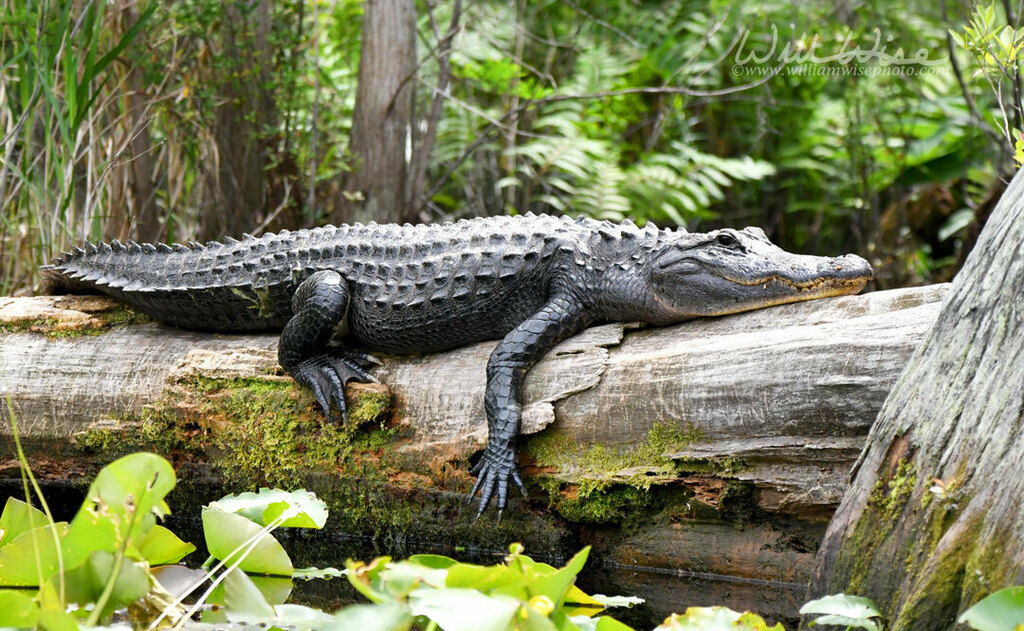
Sourced from licensed farms in Louisiana, Florida, and the broader Gulf Coast region of the United States. American alligators grow to approximately 11–14 feet; their belly skin — the only portion Hermès uses for bags — yields smaller, more symmetrical, and smoother scales than any crocodile species. The American alligator is the only non-crocodile species in Hermès’s exotic portfolio.
Porosus Crocodile — Crocodylus porosus
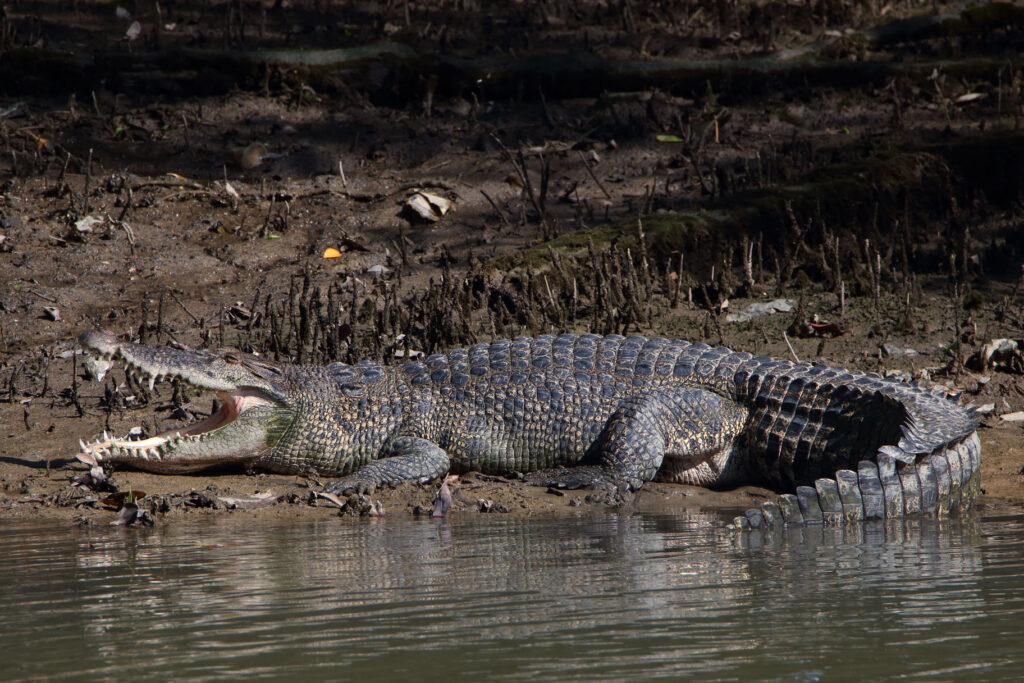
The saltwater crocodile, farmed primarily in northern Australia and parts of Southeast Asia. It is the largest living reptile on earth, reaching up to 20 feet, and its belly skin produces the tightest, most refined scale pattern of any commercially available exotic leather. Porosus is widely considered the most prestigious reptile skin in the luxury goods industry — and Hermès’s most expensive exotic offering.
3. Key Differences: Crocodile vs. Alligator at a Glance
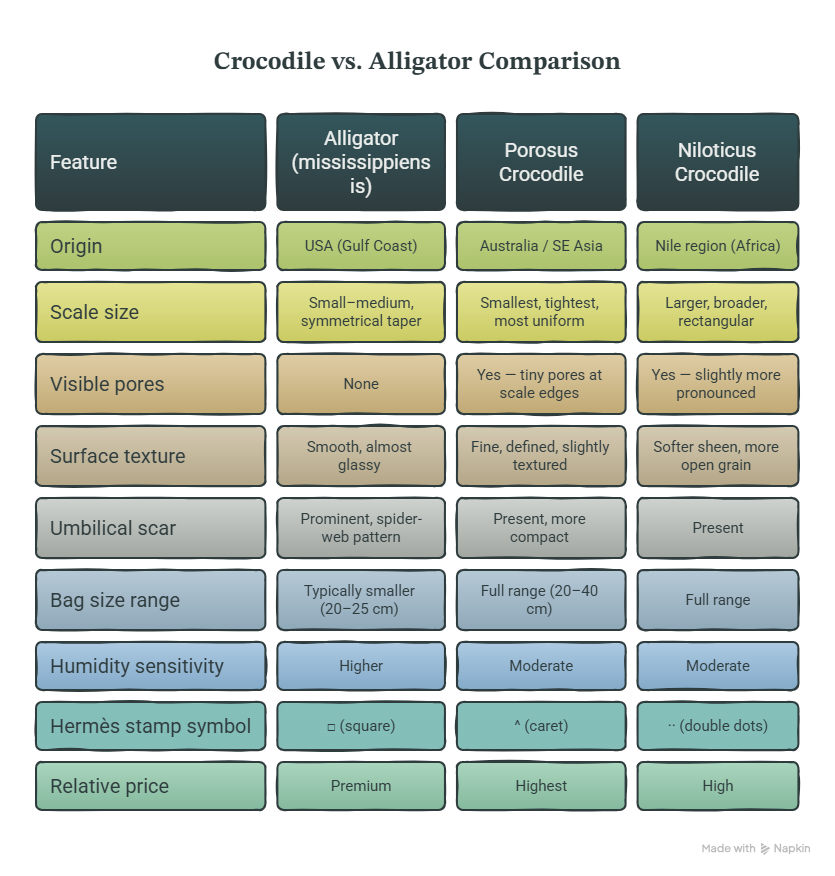
Scale Geometry in Detail

Alligator scales are notably symmetrical, with larger tiles toward the spine of the belly and a smooth taper toward the sides.

There are no visible pores — the surface under magnification looks almost polished. This uniformity gives alligator bags a particularly clean, graphic quality.
Porosus crocodile scales are smaller and more densely packed than those of any other species.

Look closely at the edge of each scale, and you will see tiny dots — remnants of integumentary sense organs (ISOs), the pressure and salinity receptors unique to crocodilians. These micropores are the single most reliable visual marker distinguishing Porosus from the alligator. 
Niloticus crocodile has a bolder, more open scale pattern. The rectangular tiles give it a slightly architectural quality that some collectors prefer; others find it less refined than Porosus.
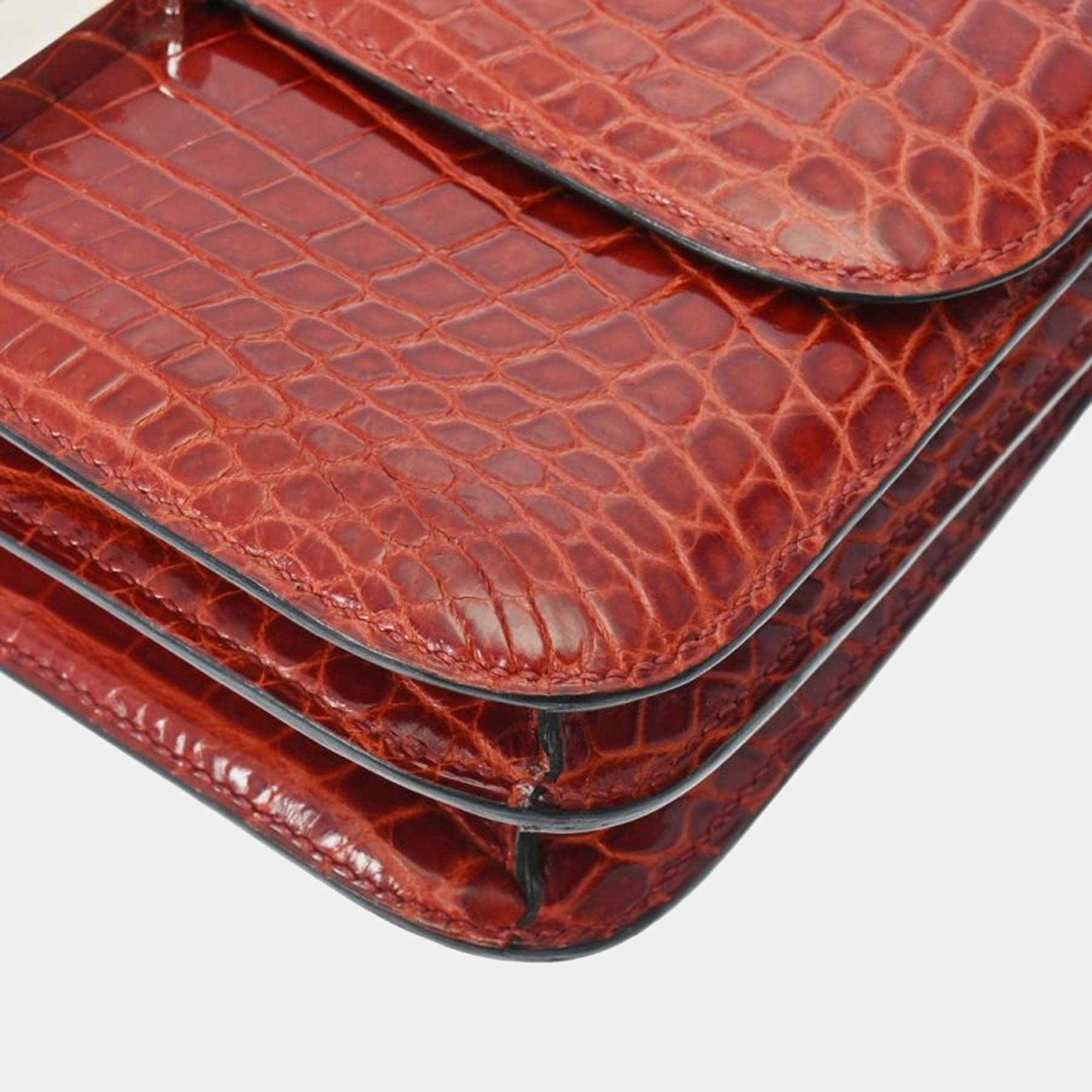
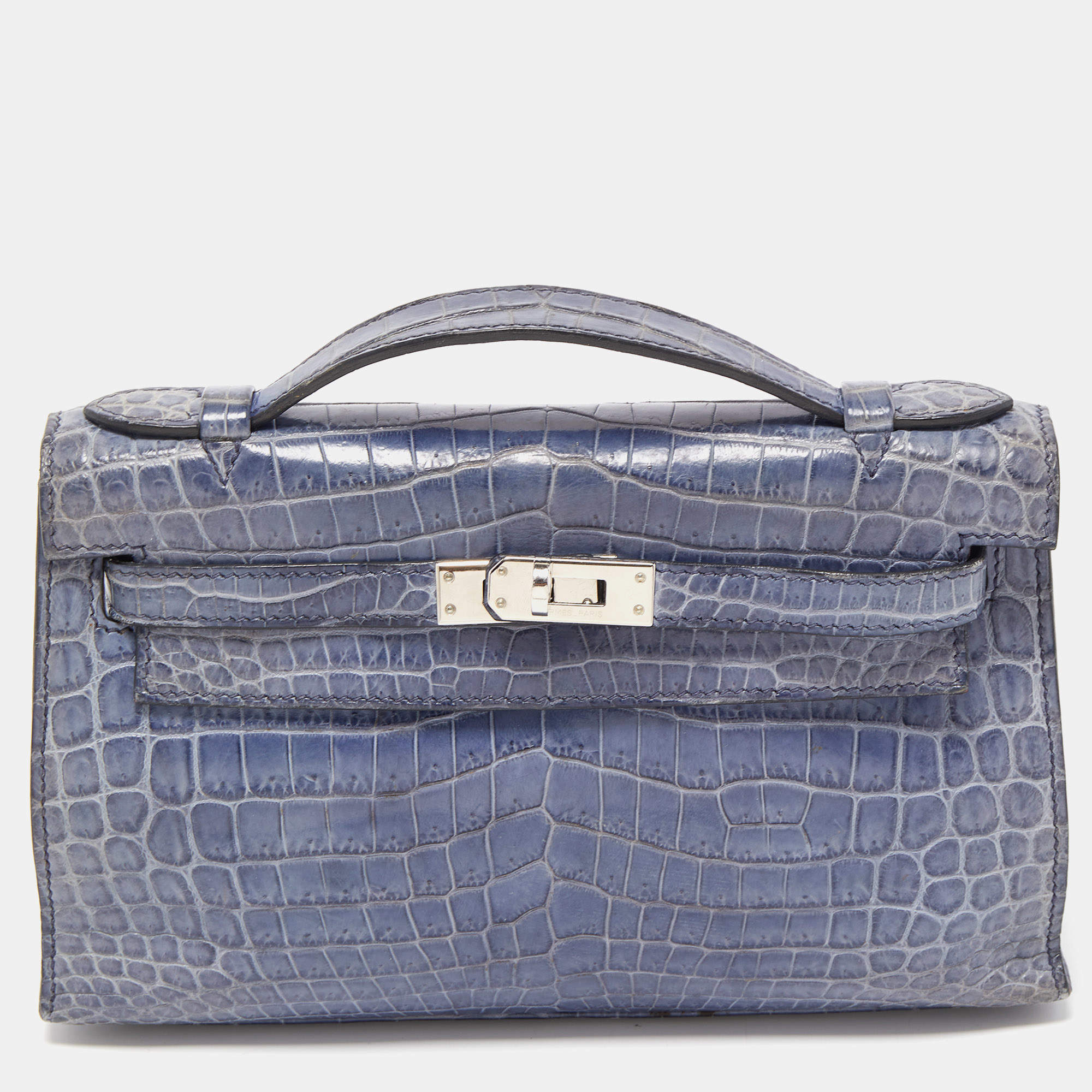
The pores are present but typically less crisp than in Porosus.
4. How to Tell Them Apart: The Hermès Stamp System
The most authoritative method of identification is the internal Hermès hallmark, stamped inside every authentic exotic bag, typically adjacent to the Hermès, Paris — Made in France blind stamp.
| Symbol | Species |
|---|---|
| □ (square) | American Alligator (mississippiensis) |
| ^ (caret/chevron) | Porosus Crocodile (Crocodylus porosus) |
| ·· (two dots) | Niloticus Crocodile (Crocodylus niloticus) |


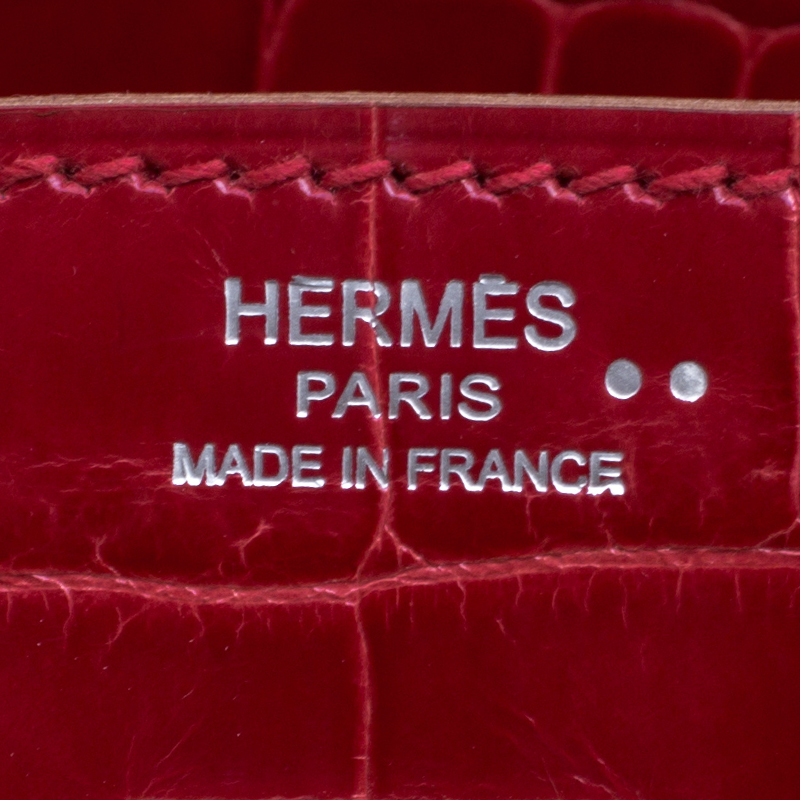
These symbols exist for regulatory compliance: CITES requires that goods made from protected species carry documentation of lawful origin. The Hermès stamp, combined with the CITES certificate that accompanies each bag at the point of sale, forms the legal and provenance record of the piece.
A note on authentication: the stamp system is known within the collector community, and sophisticated counterfeiters do attempt to replicate it. Always authenticate exotic bags with a reputable specialist — Sotheby’s, Christie’s, Artcurial, Madison Avenue Couture, The Luxury Closet (UAE), or WGACA — before making a purchase on the secondary market. Authentication services typically charge $25–$100 and are an indispensable step for any purchase above five figures.
5. Reading the Skin: Visual and Tactile Identification
Beyond the stamp, experienced collectors use several additional markers:

Pore check: Hold the bag under natural or bright directional light. On Porosus and Niloticus crocodiles, you should be able to see tiny pores — most visible at the edges of individual scales. An alligator will show a uniformly smooth surface with no pores.
Scale symmetry: Alligator scales follow a highly regular, tapering pattern from the spine outward. Crocodile scales, especially Niloticus, tend to be less uniform and more varied in individual tile shape.
Umbilical scar placement: Hermès traditionally places the navel scar on the front panel of the bag. On an alligator, the scar tends to be more diffuse and spider-web-like; on a crocodile, it is more compact and circular. Its presence is a strong positive signal of authenticity.
Bag size as a soft clue: Because alligators are smaller animals than saltwater crocodiles, larger bags (Birkin 35, Birkin 40) in alligator are exceedingly rare — the belly panel would require piecing multiple hides, which Hermès avoids for exotic bags. If you encounter a Birkin 40 described as alligator, scrutinize the species stamp with particular care.
Weight: Exotic skin bags are notably heavier than their Togo or Epsom counterparts of the same size due to the leather’s density. There is no significant weight difference between an alligator and a crocodile of the same dimension.
6. Finishes: Matte vs. Shiny (Lissé)
Both alligator and crocodile are available in two primary finishes, and the choice meaningfully affects aesthetics, durability, and value.
Matte
Produced by allowing the skin’s natural surface to remain after tanning, without buffing. The result is a velvety, almost suede-like appearance with subtle depth. Matte has surged in collector preference over the past decade, largely because it is significantly more forgiving: minor scuffs and handling marks are less visible, and the surface does not show water damage or fingerprints the way shiny does. Matte bags in neutral tones (Noir, Etoupe, Gold, Gris Perle) are among the most reliably appreciating pieces on the secondary market.
Shiny / Lissé
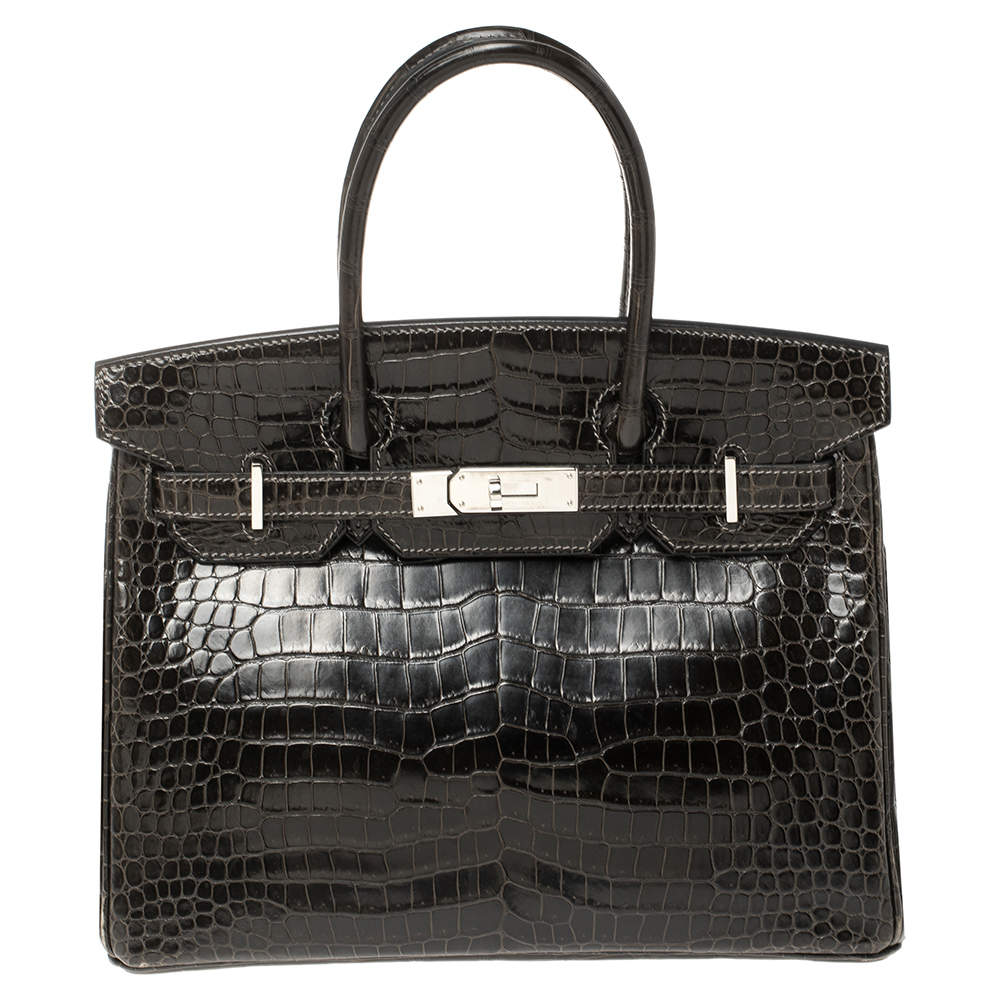
Achieved through a labor-intensive hand-buffing process that compresses the scales and brings out a mirror-like gloss. The effect is dramatic and immediately legible as exotic leather. The trade-off is fragility: a single water droplet can leave a permanent dull mark on a lissé finish, and any loss of gloss is essentially irreversible without professional intervention. Lissé pieces in vibrant colors (Rose Scheherazade, Bleu Électrique, Vert Émeraude) are highly sought by collectors willing to accept the care demands.
Boreal / Satin
A rare third finish — a semi-matte with a soft sheen — is occasionally seen in archival and special-order pieces. Not in current regular production.
7. Popular Models, Rare Colors, and Secondary Market Values
Most-Traded Models
The Birkin 25 and Kelly 25 in exotic skin are the most liquid pieces on the secondary market — small enough to be practical, rare enough to command serious premiums. The Mini Kelly 20 (also called Kelly Mini II) has seen exceptional price appreciation since 2019. The Birkin 30 in Porosus is the classic collector’s centerpiece: large enough to make an impact, rare enough to hold value.
Special orders

Hermes Kelly 25 Special Order HSS Vert Criquet U4/Vert Titien 1T Brushed Gold Hardware Ostrich D Stamp
(HSS — Hermès Special Service), in two-tone exotic combinations — for example, a Birkin 25 in Porosus with contrasting stitching and a different exterior panel — are among the most valuable pieces, as they represent client-directed customization and are essentially one-of-a-kind.
Colors and Their Value Dynamics
Neutral matte tones (Noir, Gold, Étoupe, Gris Perle, Vanille, Parchemin) are the most consistently strong performers. They are wearable, age gracefully, and attract the broadest pool of buyers at resale.
Rare and special colors (Himalaya white gradient, Vert Émeraude, Rose Scheherazade, Bleu Indigo, and Terre Battue) command substantial premiums.

The Himalaya colorway — a white-to-grey gradient ombré achieved through an exceptionally complex dyeing process — is the most famous exotic Hermès piece in the world and has achieved auction records exceeding $400,000 with diamond hardware.
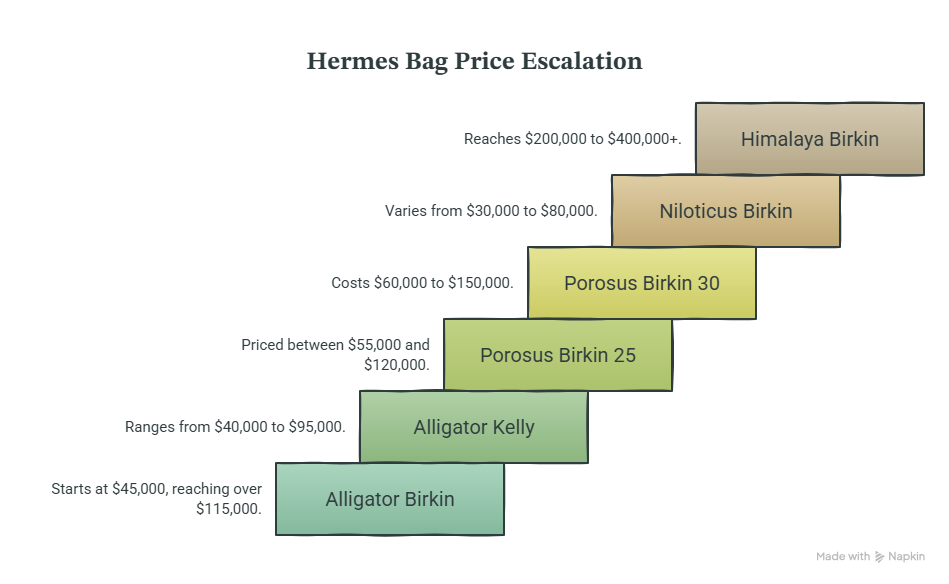
Approximate Secondary Market Values (2025–2026)
Values vary by condition, year stamp, hardware, and provenance. The figures below are broad ranges for pristine or near-mint pieces.
8. The Investment Case: Which Skin Holds Value Best?
The conventional wisdom — that the Porosus crocodile is the apex investment — is largely borne out by auction data. Its combination of rarity, visual distinction, and the prestige of Australian and Southeast Asian sourcing makes it the most universally coveted.
Alligator in small formats (Birkin 25, Mini Kelly) has appreciated sharply since 2020, in part because the smaller formats are increasingly practical for daily use and because the American alligator supply is more geographically stable than that of Porosus. A pristine alligator Birkin 25 in Noir matte with gold hardware bought at retail in 2018 would typically command a 3–4× multiple on the secondary market today.
Condition is the dominant variable. The difference in value between a pristine Porosus Birkin 30 and one with even moderate scuffing or water damage can be $30,000 or more. Exotic-skin bags are significantly less forgiving of wear than their smooth-leather counterparts.
Hardware matters. Gold hardware (GHW) is the most traditional and broadly liquid. Palladium (PHW) has grown in preference among younger collectors. Brushed gold and diamond-set hardware are ultra-niche but command dramatic premiums when paired with the right color and skin tone.
Year stamps have a nuanced effect. Very early stamps (1970s–1980s) can be valuable to archival collectors if in exceptional condition. Mid-period stamps (1990s–2000s) in excellent condition represent strong value. Recent stamps (2015–present) in pristine condition are the most straightforward to value.
9. Care and Maintenance: Protecting Your Exotic Bag
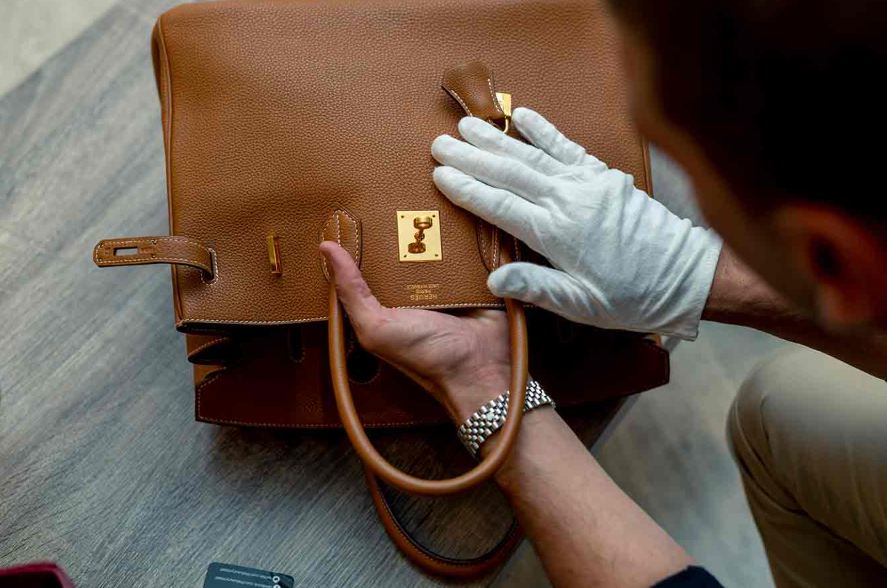
Exotic skin bags require more attentive care than standard Hermès leathers. The following protocols reflect best practice from specialist conservators and Hermès’s own after-sales service (Hermès Spa).
Water and humidity are the primary threats. Even a few drops of water on a lissé finish can cause permanent dull patches. Matte finishes are more resilient but still vulnerable to sustained humidity, which can cause scale edges to lift slightly over time. Never wear an exotic bag in the rain, and if caught in an unexpected shower, blot immediately with a soft, dry cloth — do not rub.
Storage: Store in the original Hermès dust bag inside the original box, in a cool, dry, dark environment. Avoid basements (humidity) and attics (heat fluctuations). Stuff the bag lightly with acid-free tissue to maintain its structure, and alternate which side faces out if storing long-term.
Handling: Natural skin oils can darken light-coloured exotic leathers over time. Use a twilly or thin scarf over the handles when wearing in warm weather. Avoid hand creams or sunscreen before handling.
Professional care: Hermès offers an official Spa service at its stores and service centers that can clean, recondition, and, in some cases, refinish exotic bags. Third-party specialists can also handle conditioning and minor restoration. Never attempt to condition exotic skin with standard leather products — the pore structure requires specialist formulations.
Alligator in humid climates is slightly more sensitive than crocodile, and matte alligator is more forgiving than lissé. If you live in a high-humidity environment (Singapore, Mumbai, Miami), a matte alligator or Niloticus crocodile piece may be a more practical choice than a Porosus lissé piece.
If you want to know more about how to care for your Hermes exotic leather, the following blog is for you:
How to Care for Your Hermès Bag: Expert Tips to Keep It Pristine
10. Frequently Asked Questions
Which is more expensive — Hermès alligator or crocodile?
Porosus crocodile is typically the most expensive exotic offered by Hermès, reflecting its rarity, tight scale pattern, and the limited supply from Australian farms. Niloticus crocodile is moderately less expensive than Porosus but still commands a premium over alligator. American alligator, while extremely valuable in absolute terms, is generally the most accessible of the three.
How can I tell if my Hermès bag is crocodile or alligator?
The definitive method is the internal species stamp: a square (□) indicates alligator, a caret (^) indicates Porosus crocodile, and two dots (··) indicate Niloticus crocodile. Supporting visual cues include the presence or absence of scale pores (crocodiles have them, alligators do not) and scale geometry.
Does Hermès use real crocodile skin?
Yes. Hermès uses genuine Porosus and Niloticus crocodile skin, sourced from CITES-licensed farms operating under government-supervised sustainability frameworks. All hides come with legal documentation of origin, and Hermès controls its own tanning process.
Is a Birkin made of crocodile skin?
Many exotic Birkins are made from crocodile skin (either Porosus or Niloticus), but Hermès also produces the Birkin in American alligator. Standard Birkins are made from non-exotic leathers such as Togo, Epsom, Clemence, and Swift. The exotic versions are significantly rarer and more expensive.
What is the rarest Hermès exotic bag?
The Himalaya Birkin — made from Niloticus crocodile in a white-to-grey gradient colorway, typically with diamond-pavé hardware — is the most famous and generally the most expensive Hermès bag at auction, with top examples exceeding $400,000.
Can I buy a Hermès crocodile or alligator bag directly from the boutique?
Officially, yes — but access is extremely limited. Hermès allocates exotic bags to clients with established purchase histories and strong relationships with the boutique. Many collectors wait years before being offered an exotic piece. The secondary market (auction houses, authenticated resellers) is the more accessible route for most buyers.
Which Hermès exotic skin is best for investment?
Porosus crocodile in neutral matte tones with gold hardware has historically shown the strongest and most consistent appreciation. However, condition, color, size, and provenance all significantly affect resale performance. Alligator in small formats has also performed very strongly since 2020.
How do I know if a second-hand Hermès exotic bag is authentic?
Check the internal species stamp, the blind stamp (artisan’s stamp and year letter), hardware quality, stitching consistency, and the umbilical scar placement. Always obtain a professional authentication certificate from a recognized specialist before purchasing at significant price points.
What is the difference between matte and shiny (lissé) exotic Hermès bags?
Matte finishes are produced without buffing and have a velvety, understated appearance. They are more durable and forgiving of daily wear. Shiny (lissé) finishes are hand-buffed to a high gloss and are visually dramatic but more susceptible to water damage and scuffing. Matte has grown in popularity in the secondary market in recent years.
Are Hermès exotic bags ethically sourced?
All Hermès exotic skins are sourced from CITES-regulated, licensed farms — not wild-caught animals. Hermès has published sustainability commitments around its exotic leather supply chain, and all pieces are sold with CITES documentation confirming lawful origin. Ethical standards and practices vary by farm and region; buyers with specific concerns can request supply chain documentation at the point of sale.
Where can I buy an authentic pre-owned exotic Hermès bag in Dubai?
Dubai is one of the world’s most active markets for pre-owned luxury, but authentic exotic Hermès pieces are rare even here. The Luxury Closet, headquartered in Dubai, offers a rigorously authenticated selection of pre-owned crocodile and alligator Hermès bags — with the convenience of regional shipping, Arabic customer support, and pricing in AED. It is the most trusted destination for exotic Hermès in the UAE. So if you’re looking for a Birkin or Kelly for women in the UAE, you can explore The Luxury Closet.
Where can I buy an authentic pre-owned exotic Hermès bag in Saudi Arabia?
Collectors in Riyadh, Jeddah, and across the Kingdom increasingly turn to authenticated online platforms to access exotic Hermès pieces that are unavailable through boutiques. The Luxury Closet ships to Saudi Arabia and offers a fully authenticated inventory of pre-owned Birkins and Kellys in crocodile and alligator — with every piece verified for species stamp, condition, and provenance before listing.
If you are unable to decide which one to choose, you can refer to this guide: Hermès Birkin or Hermès Kelly: Which One To Choose in 2026
What is the best place to sell your exotic Hermès bag online?
The best place to sell your exotic Hermès bag online is a platform that combines expert authentication, a qualified buyer base, and strong regional reach. The Luxury Closet is the leading pre-owned luxury platform in the Middle East. It offers white-glove consignment for exotic Hermès bags — including Porosus Birkins, alligator Kellys, and Niloticus special orders. Their in-house authentication team accurately identifies species, condition grade, and fair market value, ensuring you achieve the best possible price. Sellers in the UAE, Saudi Arabia, and across the GCC benefit from The Luxury Closet’s deep regional network and international buyer reach.
Is it safe to buy a pre-owned exotic Hermès bag online in the Middle East?
It is safe when you use a platform with verifiable in-house authentication and a clear returns policy. The Luxury Closet authenticates every exotic Hermès bag before listing — checking the species stamp, blind stamp, hardware, stitching, and umbilical scar — and provides full condition reports. For buyers in Dubai, Abu Dhabi, Riyadh, and Jeddah, it removes the guesswork and risk typically associated with peer-to-peer resale platforms.
Alligator or Crocodile — Choosing Authentic is What Makes the Difference

Understanding the distinction between Hermès crocodile and alligator bags transforms the buying experience from a luxury purchase into an informed collector’s decision. You may be drawn to the refined geometry of Porosus, its tight scales and characteristic pores, the hallmark of the world’s most coveted handbag material. Or you may covet the smooth, clean elegance of alligator in an intimate format; either way, you are choosing from the absolute summit of leather craft.
If you’re entering this space, a few things matter more than anything else: always authenticate, prioritize condition, and lean toward neutral matte tones if long-term value is part of your thinking.
And if you already know your taste, the rule is simpler—the right bag is the one you’ll actually carry, enjoy, and keep for years. That’s where real value lives.

At The Luxury Closet, every exotic Hermès bag—whether Porosus Birkin or alligator Kelly—is carefully authenticated by in-house experts before it reaches you. Each piece is verified for material, condition, and provenance, so you can buy with complete confidence.
Shop authentic pre-owned exotic Hermès bags at The Luxury Closet.
Authenticated. Curated. Yours.






