




 Macquarie University
One of Australia’s biggest cultural festivals has been thrown into chaos after deciding to cancel an invitation to a prominent Australian-Palestinian writer, sparking a massive backlash and mass exodus from fellow writers.
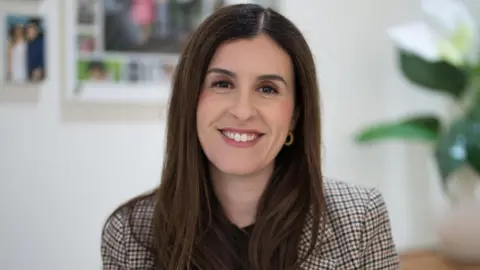
Last week the Adelaide Festival board said Dr Randa Abdel Fattah, a critic of Israel, had been removed from the Writers’ Week line-up due to ‘sensitivities’ after 15 people were shot at a Jewish festival at Bondi Beach in December by gunmen believed to be influenced by the Islamic State group.
The Adelaide Festival board said it was “not in any way implying” that Abdel Fattah had “any connection to the Bondi tragedy”, but decided that “taking her past statements into account” it would not be “culturally sensitive” to include her.
She called the decision to exclude her a “blatant and shameless act of anti-Palestinian racism and censorship” and attempts to link her to the Bondi attack “despicable”.
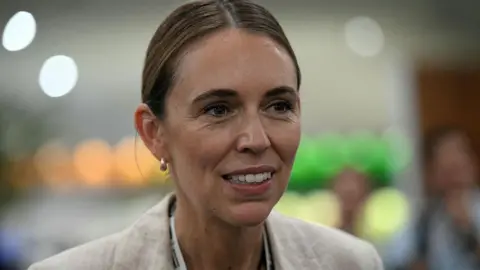
In the following days, dozens of other writers who had been scheduled to appear withdrew from the festival. By Tuesday, the list had grown to 180, including former New Zealand Prime Minister Jacinda Ardern, British author Zadie Smith, beloved Australian author Helen Garner and British-Australian novelist Kathy Lette.
Last weekend, four of the eight-member board of directors, including the chairman, resigned without giving a reason. And on Tuesday, the head of Writers’ Week, who had invited Abdel-Fattah, also stepped down.
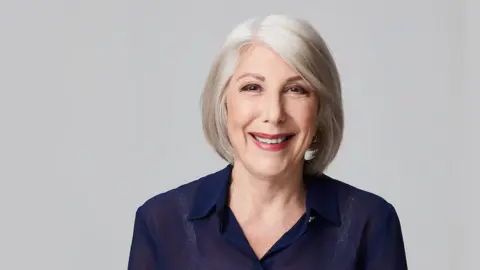
Louise Adler, the Jewish daughter of a Holocaust survivor, said the art world has come under increasing attack since the start of the Israel-Gaza war and that she “cannot participate in silencing artists.”
 alphabet
“Writers and writing are important even when they present us with ideas that are uncomfortable and challenging,” she wrote in Guardian Australia.
Hours later, the board issued a new statement apologizing to Abdel-Fattah “for how the decision was expressed” and announcing that Writers’ Week “can no longer proceed.”
“We recognize the pain this decision has caused and deeply regret it,” he wrote.
All remaining members of the Adelaide Festival board said they would step down from the first criteria, a move they hoped would “ensure the success” of the festival “and beyond” this year.
The saga has now left the festival without a board just weeks after its start at the end of next month, threatened to trigger legal action and reignited discussions about freedom of expression in Australia.
Why has Randa Abdel-Fattah been criticized?
Abdel-Fattah, a novelist, lawyer and academic, was invited to the festival to discuss his latest novel, Discipline. She describes the novel as “a cautionary tale about the cost of silence and cowardice.”
She has previously been criticized for comments asserting that Zionists have “no claim or right to cultural security” and for a 2024 post on
The controversy surrounding her also included an image posted to her social media hours after the Hamas attack on Israel on October 7, 2023, depicting a person parachuting with a Palestinian flag. As the attack began, Hamas fighters used paragliders to cross the high-tech security fence into Israel and land in civilian areas, killing many residents.
About 1,200 people were killed in this attack. This triggered a massive Israeli military offensive against the Gaza Strip that has since killed more than 71,419 people, according to the Hamas-run health ministry.
Abdel-Fattah confirmed to Australian broadcaster ABC that he had posted the image, but said he did so before the true scale of the attack was known.
“At that point, I had no idea about the death toll and I had no idea what was happening on the ground. Of course, I don’t support killing civilians,” she told ABC.
Academia has been the subject of public campaigns before. Opposition politicians and several prominent Australian Jews have called for research funding awarded to Abdel Fattah to be canceled in 2024. After a letter from Education Minister Jason Clare, funding was suspended while Abdel Fattah was investigated for allegedly breaching grant rules, but was eventually revoked last month.
 getty images
Norman Schueler, of the Jewish Community Council of South Australia, said last week his organization had written to the Adelaide Festival Committee lobbying for Abdel Fattah’s removal.
After her removal he told the Adelaide Advertiser “It was a very smart move and will improve the cohesion of the festival by not having her there”. Responding to news of the growing strike, he added: “For all the people who have left, I think that’s a bit pathetic, because it means they agree with what Dr. Fatah is saying, which is that Israel should not exist.”
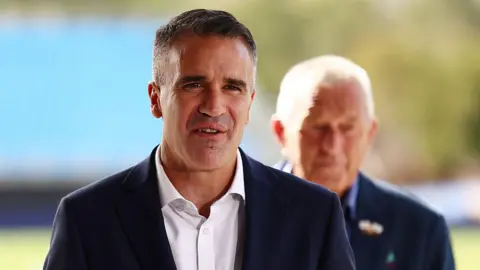
South Australian Premier Peter Malinauskus, whose government is a major sponsor of the festival, said he “wholeheartedly” supported Abdel Fattah’s exclusion and had “made it clear to the board that he did not think it was wise” to invite her.
But Malinauskus denied playing any role in the board’s decision, telling the ABC on Monday he shared his opinions but did not threaten to withdraw funding or fire anyone. He also denied that his positions were influenced by Jewish lobbying groups.
“The board’s decision was made despite my strongest objections,” Adler said. “In my view, the board, comprised of individuals with little experience in the arts and unaware of the moral implications of abandoning the principles of freedom of expression, is being unsettled by pressure from politicians calculating their electoral prospects and a relentlessly organized letter-writing campaign.”
“The board’s statement references community cohesion, an oft-mentioned source of anxiety that must be treated with skepticism,” she said. “You don’t have to be a student of history to know that art for ‘social cohesion’ is propaganda.”
After her appearance was cancelled, Abdel Fattah said Australian arts and cultural institutions had shown “utter contempt and inhumanity towards the Palestinian people”.
“The only Palestinians they will tolerate are the silent and invisible.”
This is not the first time Abdel Fattah has been at the center of a writers’ festival derailment.
The Bendigo Writers Festival, scheduled to start in August last year, published a code of conduct two days before the event asking presenters to “avoid language or topics that could be considered inflammatory, divisive or disrespectful”.
A subsequent strike led by Abdel Fattah and others over concerns that it could impede free debate on the Israel-Gaza war led to the cancellation of about a third of the program.
hypocrisy charge
But Abdel-Fattah has been accused of double standards by Malinauskus and media outlets, who claim he successfully called for New York Times journalist Thomas Friedman to be excluded from the Adelaide festival two years ago.
The letter she and nine other academics sent to the board came after he published a column comparing athletes from the Middle East to members of the animal kingdom, including caterpillars, wasps and spiders.
“After Dr. Randa Abdel-Fattah’s letter, we removed a pro-Jewish Israel speaker. Fast forward two years and I think it makes sense for the board to apply the same principles,” Malinauskus said.
In a statement to the BBC, Abdel Fattah dismissed charges of hypocrisy, saying Friedman’s article “likened various Arab and Muslim countries and groups to insects and pests in need of extermination at a time when narratives about ‘human animals’ are being used to justify genocide in Gaza.”
“Meanwhile, I was canceled because my existence and identity as a Palestinian was ‘culturally insensitive’ and linked to the Bondi atrocities,” she continued.
She also denied that Friedman was fired at her request. In a February 2024 letter cited by The Australian Press, the committee wrote that canceling the artist was a “very serious request” and that Friedman had been scheduled to attend but would no longer attend due to “last-minute scheduling issues.”
“If he was quietly canceled, it only highlights the racism of canceling me in a blatant and publicly humiliating way,” Abdel-Fattah said.
The BBC has contacted Friedman for comment.
What did other writers say?
 getty images
Adler said at least 180 writers had withdrawn from the festival, destroying the program. Some people said they did not necessarily agree with Abdel Fattah’s opinions but defended her right to free speech.
Peter Greste, an Australian journalist who was jailed in Egypt a decade ago over what human rights groups called a bogus case, wrote in an op-ed for Guardian Australia that her exclusion “undermines our ability to have difficult conversations” and means “doing the work” for extremists.
Kathy Lette argued in an Instagram post that audiences “must trust that they can make decisions about all speakers, including me. As authoritarianism rears its terrible head around the world, we must defend our havens of free speech.”
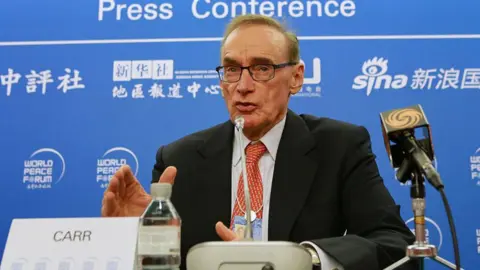
But former Australian Foreign Minister Bob Carr, who has strongly criticized Israel’s attacks on Gaza, said he supported Abdel Fattah’s exclusion. He told Guardian Australia he believed some of her previous comments had been counterproductive to the Palestinian cause and said the decision was not unreasonable given the circumstances following the Bondi attack.
“The Adelaide Writers’ Festival has supported ensuring that Palestinian voices are heard and its record on this is beyond doubt,” Mr Carr said.
He was one of the only festival speakers to publicly support the board.
 getty images
Former Greek Finance Minister Yanis Varoufakis posted a video on
Award-winning Indigenous poet Dr Evelyn Araluen said she was “deeply disappointed to witness yet another outrageous and irrational capitulation of the Australian arts community to the demands of a genocidal foreign nation.”
She added: “Removing Palestinians from Australian public life will not prevent anti-Semitism.”
ABC journalist and presenter Sarah Ferguson, who was due to host a talk with Tina Brown and Jacinda Ardern, said the festival had “created a place where debate… including the most difficult topics, thrive” and “should be kept out of cultural life”.
What happens next?
Abdel-Fattah’s lawyer, Michael Bradley, sent a letter to the committee asking whether any of her past statements were used to justify last week’s decision.
“The moral inexcusability of the Adelaide Festival board’s actions has been amply demonstrated by the reaction it has provoked. It has also trampled on Landa’s human rights and the board will have to answer for that,” Bradley told the BBC on Monday. Abdel Fattah added that he had not yet decided whether to take legal action.
“This is not about identity or dissent, but rather the ongoing rapid shift in the national discourse on freedom of expression in our country following the worst terrorist attack in Australian history,” the board said in a recent statement.
The focus will now turn to reassembling the board and “ensuring a successful Adelaide Festival that protects our state’s long and rich cultural heritage”, the statement said.
“We are committed to rebuilding trust with our arts community and audiences to enable open and respectful discussion at future Adelaide Writers’ Week events,” he added.





