



During the 2026 MCAS Cherry Point Air Show, The Aviationist interviewed F-35B pilot Major William Horn about expeditionary operations within the Marine Air-Ground Task Force and the demo for the public.
The 2026 MCAS Cherry Point Air Show featured a large-scale Marine Air-Ground Task Force (MAGTF) demonstration built around the current structure of Marine Corps expeditionary aviation. Rather than centering on a single tactical aircraft, the demonstration incorporated multiple aviation and ground elements operating together within the broader MAGTF framework that supports Marine Corps operational doctrine.
The MAGTF combines command, aviation combat, ground combat, and logistics combat elements into a single integrated force designed to operate rapidly from forward and austere locations. The aerial demonstration at the 2026 MCAS Cherry Point Open House put this integrated structure on direct display.
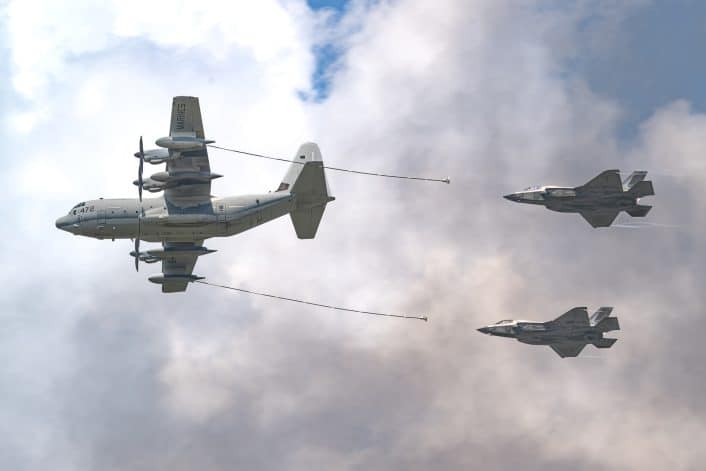
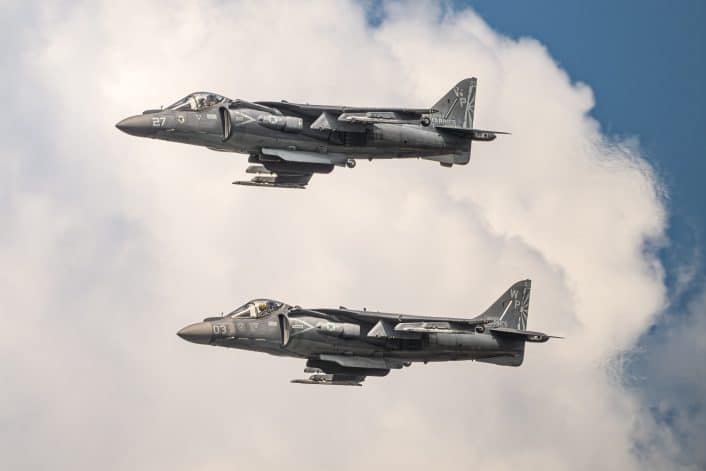
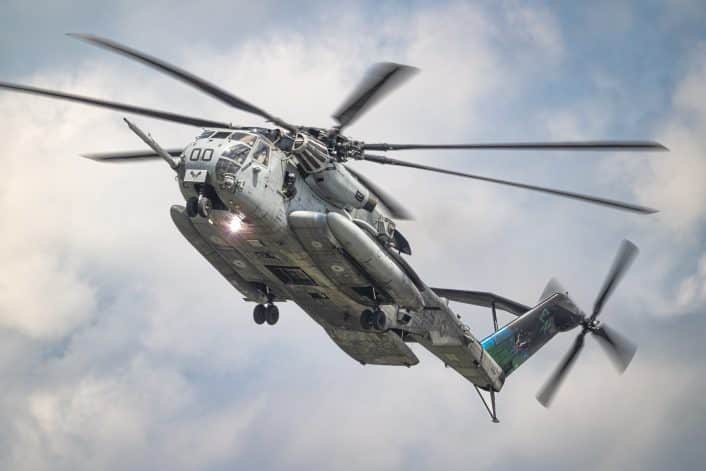
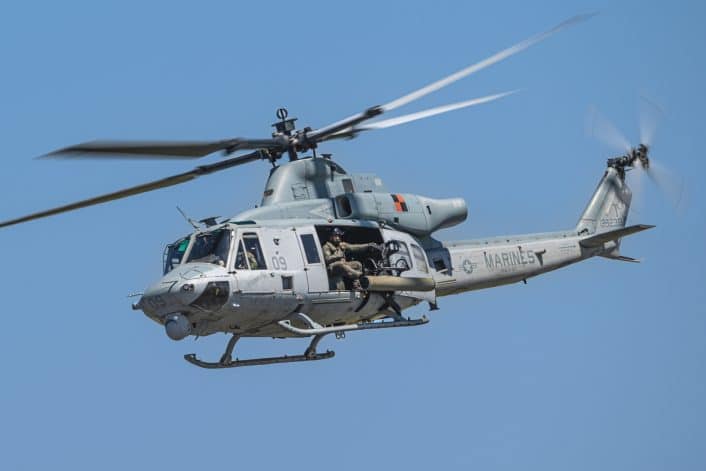
Participating aircraft included two F-35Bs from VMFAT-501 at MCAS Beaufort, South Carolina; two AV-8B Harriers from VMA-223 at MCAS Cherry Point; two MV-22 Ospreys from VMMT-204 at MCAS New River; two CH-53E Super Stallions from HMH-464 at MCAS New River; an AH-1Z Viper and UH-1Y Venom from HMLA-167 at MCAS New River; and a KC-130J Hercules from VMGR-252 at MCAS Cherry Point. The sheer scale of the lineup proved that Marine aviation relies on collective, expeditionary operations rather than individual aircraft performance.
From the crowd line, the MAGTF demonstration looks like a sequential series of events. Operationally, the concept is far more compressed. Assault support, aerial refueling, tactical strikes, rotary-wing attacks, and ground maneuvers converge simultaneously, with each element adapting as conditions evolve. This tight coordination proved vital during both the rehearsal and public demonstrations at Cherry Point, where aircraft timing and sequencing shifted rapidly within seconds.
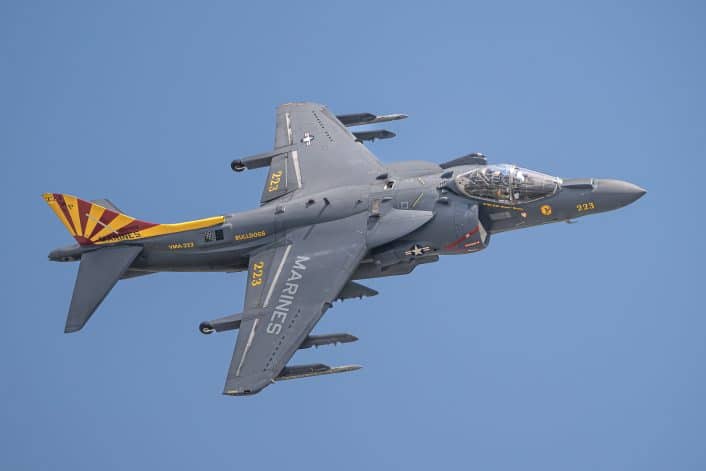
One of the more historically significant features of this year’s demonstration was pairing the legacy AV-8B Harrier alongside its successor, the F-35B. With the Harrier scheduled to retire from active Marine Corps service on June 3, 2026, MCAS Cherry Point marked the final public MAGTF appearance for the iconic jet.
Sharing the flight line with the F-35B highlighted the generational leap in technology currently transforming Marine tactical aviation. Yet, despite decades of engineering differences, both platforms share the same DNA, an uncompromising Marine Corps requirement to operate from short decks, expeditionary strips, and remote island bases.
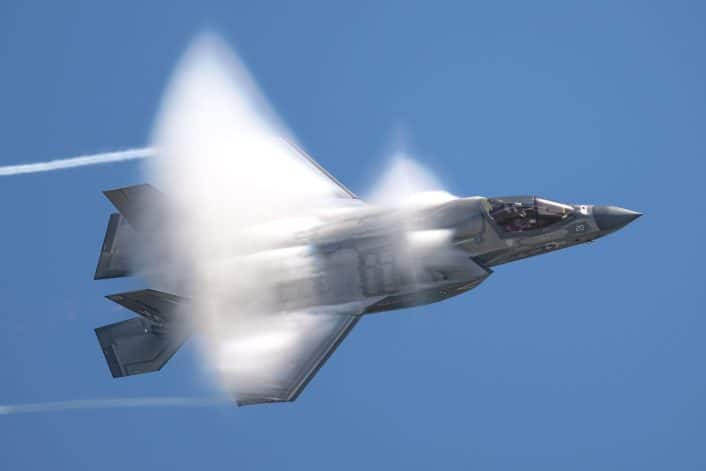
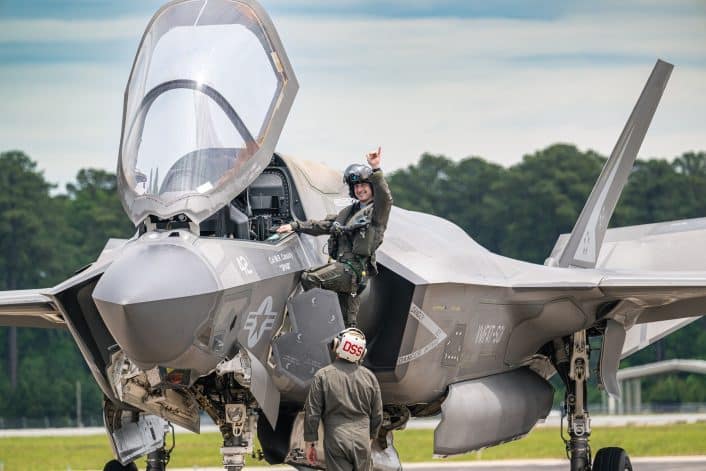
Major William Horn piloted the F-35B during the MAGTF demonstration and performed the aircraft’s solo tactical display over the weekend. In addition to observing and photographing the action during rehearsal and public demonstrations, The Aviationist spoke with Major Horn regarding the role of the F-35B within the MAGTF framework, the coordination required between participating elements, and the continuing transition from the AV-8B Harrier to the F-35B Lightning II.
Interview with Major William Horn
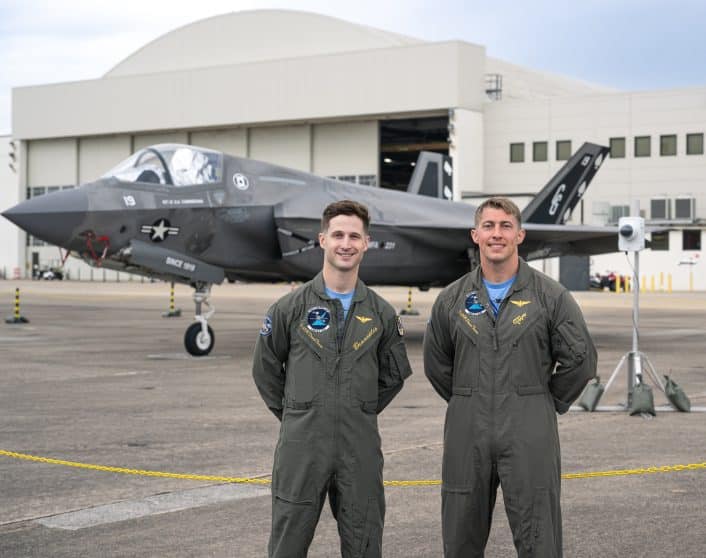
Question: Please tell us a little bit about yourself. Starting with your name, where you are from, where did you go to school, what made you choose a career as a USMC Pilot, and how many total hours in front line jets and total hours in the F-35.
Major William T. “Braankles” Horn, from Rochester, NY. Attended the University of Rochester, Class of 2014 (Biochemistry/Psychology double major).
I originally learned of the option of being a Marine Corps pilot growing up in Rochester – my neighbor’s two oldest sisters both married Marine Corps Cobra pilots, around that time I thought that seemed like a pretty cool gig. Before graduating high school, I went to a recruiter about flying for the Marines, and long story short he recommended doing the college/OSO route if I was dead-set on being a Marine Corps pilot.
My sophomore year at UofR, the Buffalo OSO set up a station and we chatted about exactly that, and I spent about 4 years afterwards at the Buffalo OSO (year off after college for a LASIK waiver where I was working on a commercial fishing boat in Alaska) before getting selected on a pilot slot for OCS, which I attended in June of 2015.
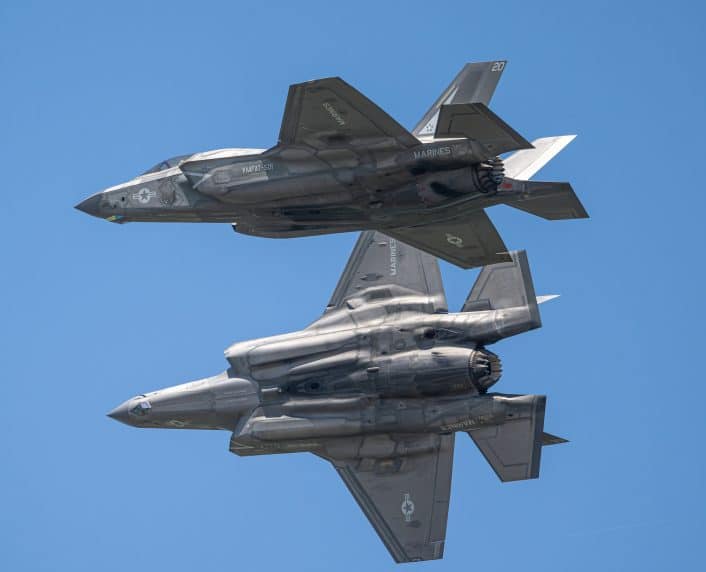
I have about 900 total military hours, including about 27 in the F/A-18 Hornet before getting redesignated to F-35B, and about 650 in the F-35B.
In the MAGTF demonstration at Cherry Point, what is your specific role as the F-35B pilot, and where does your piece fit within the broader arrangement the audience sees?
As an F-35 pilot, we generally see the (literal and metaphorical) high-altitude picture – our aircraft has extremely advanced sensors and datalinks, providing full battlefield situational awareness and provides us the ability to oversee a mission and influence its success by moving the individual parts around as needed.
We also provide the first-strike capability which you will see over the weekend, in which we are able to get farther into adversary territory and execute attacks that other platforms cannot. Our first-strikes are tailored toward opening the ability for other Marine Corps platforms and ground elements to conduct the main mission.
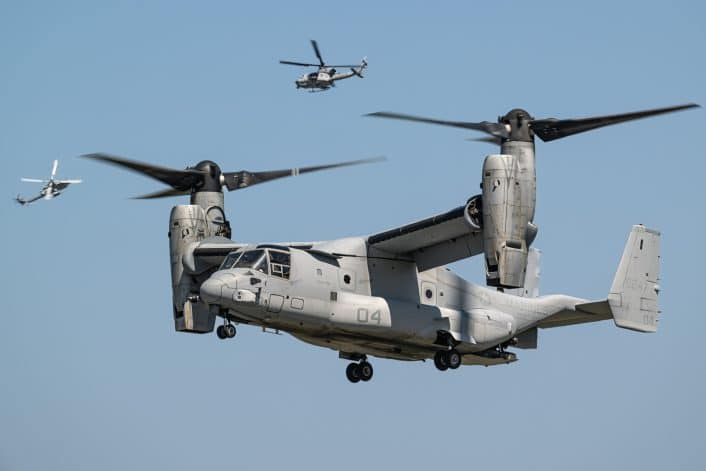
What is the MAGTF demonstration designed to communicate to the public that a traditional single aircraft demo cannot, and why is that important to show?
What the Marine Corps does better than anyone else is our ability to conduct a mission incorporating all aspects from air and on ground. We offer a full package to conduct a mission ourselves, where, if the Marines were not involved, would offer multiple elements from multiple branches of the military.
What you’ll see during the MAGTF demo is every aspect of Marine Corps power from air attack, refueling, to ground support and ground forces all working together to achieve a common goal. All of these elements being inherent to the MAGTF allow fast, effective response to nearly any contingency or provide rapid-response, all over the world on a moment’s notice.
What do people tend to misunderstand when they watch the MAGTF demo, and what’s actually happening in those moments?
During the demo, you are going to see each of our elements operating sequentially to allow each individual element to show off their inherent capabilities. Realistically, all of our elements are executing our missions nearly simultaneously to present our adversaries an unsolvable problem before they even know they have one.
We also can’t forget the days, sometimes months of planning, and years of training going into what you’re seeing, to enable to present such a formidable force to our adversaries.
From your cockpit, where are the critical coordination points with the ground and aviation elements during the demo, and where does timing become unforgiving?
We coordinate all aspects down to the second – if I were to drop my bomb 30 seconds too late, other friendly forces may have moved to a position in which they are at risk of being negatively impacted by my ordnance. We require strict coordination on timing and rapid communication of any delays or setbacks, so that each element can adjust accordingly and still execute the mission.
Sometimes things don’t go according to our plan, and that communication aspect allows us to be flexible and adapt to a rapidly changing problem. Even in the event of communications loss, each element of the MAGTF has a set of go/no-go criteria they can self-assess, so that each individual in charge of an element has the ability to assess when is right to continue to the next step, and how to adjust their own element’s posture to still allow our mission success.
How much of what you’re showing in the MAGTF demo is a compressed version of real operations, and where does it differ most from how you would actually employ the aircraft in a real-world scenario?
The MAGTF demo is designed to be a snippet of real-world operations to show off some of our capabilities and show how we work together. In reality, each ground or air element has a much broader range of capabilities and missions, and there likely would be significantly more players in a real-world operation.
For F-35B specifically, you would expect 4-8 F-35B or more, executing battlefield preparation and follow-on in-close operations like you see here, operating in such a way to remain unobserved by our adversary until there is nothing they can do to mitigate our attacks.
What does the preparation look like leading into a show like Cherry Point? How many repetitions are typical, and what are you actually refining from one rehearsal to the next?
Similar to real life, we generate a tentative mission concept, break out into individual element planning cells, and come back together at various meetings (normally over the course of 1-2 days for a real mission). At these meetings we refine the plan together and make any necessary changes as new problems or issues with coordination pop up.
While many of us have executed this demo before, we will practice 1-2 times prior to the demo. Each of us would be prepared to execute without a rehearsal after our final mission confirmation brief if it came down to it!
Which part of the demo has the least margin for error, and what specifically makes it difficult to execute consistently?
The coordination/communication piece is always relevant; each player needs to either make their times, or communicate otherwise so that all other players can adjust accordingly, and so that the mission commander can adjust the mission thereafter as required.
Within the MAGTF framework, what does the F-35B bring that actually changes how the team operates, even if that isn’t obvious to the audience?
The F-35 offers a unique first-strike capability in austere locations deep into enemy territory that few other platforms can provide. Since we are also Marines, when things don’t go according to plan, we know what the ground guys need for mission success and we can adjust our gameplan so that they can still accomplish their own mission.
Since we operate from the same few ships together while deployed on a MAGTF, we can also meet face to face, assess the presented problems to mission success, and identify how we can use our aircraft to allow the guys on the ground to accomplish the mission. No where else in the military is there the ability to get such close coordination during mission planning, where each player presents their needs and the other players can assess how their capabilities can solve the others’ problems.
How does the short takeoff and vertical landing capability factor into the demo sequence, and how closely does that reflect how the aircraft would be used operationally?
While it does not dramatically affect the MAGTF demo, it is critically important to be able to execute STOVL ops as part of the MAGTF. We can take off and land on an extremely short strip prepared by the Marines in austere territory, and also from Navy ships such as LHDs/LHAs, positioning us closer to the action and providing us with unique options. There is nothing quite like being able to move your airport to where you need it to allow for the mission to succeed.
You’re not flying a solo profile here. Therefore, what changes for you, practically, when you’re part of a MAGTF demonstration, instead of a solo aircraft demo?
Everything we do as Marines is about executing our role on the team to the best of our ability. As one of many participants, I know that I need to execute my role to the best of my ability so that others can be freed up to do the same. Individual execution leads to overall team success.
What’s something about participating in the MAGTF demo that surprised you, even after your operational experience?
I wouldn’t say surprising, since the MAGTF demo is a microcosm of the Marine Corps’ capabilities, but we have a certain way of doing things in the Marine Corps that is thoroughly trained into us from initial training all the way through fleet training and operational experience. With that training and experience, it is refreshing to see how all the players are on the same page without having to discuss tactics.
The MAGTF demo consists of professionals who are able to inspire confidence from the whole team by speaking intelligently and concisely to how each of us can use our platform to the full extent of its capabilities to ensure overall mission success.
With the AV-8B Harrier retiring in June from USMC service, the MAGTF demonstration offers a final opportunity to see both the Harrier and F-35B operating within the same Marine Air-Ground Task Force framework. From your perspective, what does that transition represent for Marine aviation?
The transition is both a continuation of Marine Corps TACAIR’s ability to conduct expeditionary operations, but also a leap forward in the capabilities we are providing for our fellow Marines. Each aircraft expanded the envelope technologically, and having the ability to operate from those same austere locations with 5th generation capabilities allows us to change how we conduct warfare on our terms.
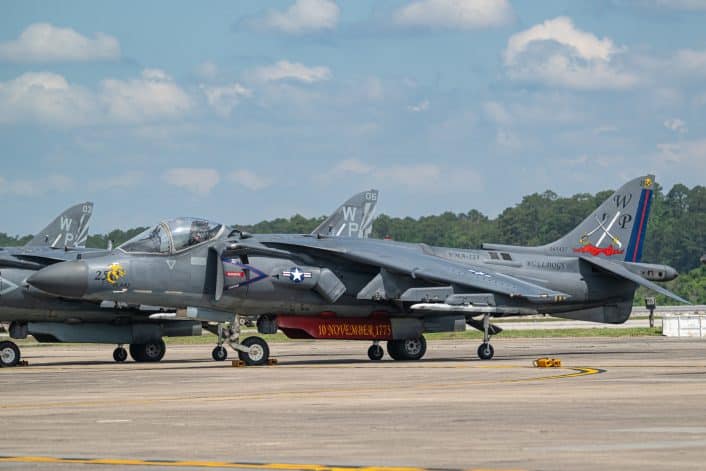
The Harrier has served admirably for over four decades and countless Marines made it home thanks to its unique ability to operate from forward locations. The F-35B is well-suited to fill that gap in a continually evolving battlespace, where we are able to operate forward in a contested battlespace that no one else can.
When the demo ends and the crowd walks away, what do you want them to understand about Marine aviation and the MAGTF that they likely didn’t appreciate before they arrived?
The participants of the MAGTF demo aren’t dedicated demo personnel – these are active-duty Marines executing a mission set forth by our leadership, and the preparation and planning is no different than it would be for any operational mission.
The Aviationist would like to send out thanks to Capt. Jacob Ballard – Deputy Director, COMMSTRAT, 2nd MAW, Captain Alessandro Rossi – Deputy Director, COMMSTRAT, MCAS Cherry Point, NC, and Chrystal Smith – Director, COMMSTRAT, MCAS Cherry Point, NC.
In addition, a very special thanks to Major William “Braankles” Horn, VMFAT-501, MCAS Beaufort, South Carolina, and Major Connor “TOPO” Sherin, VMFAT-501, MCAS Beaufort, South Carolina.







