



As the United States launched retaliatory strikes, officials told reporters that an Iranian Shahed drone appears to be responsible for downing a U.S. Army AH-64 Apache on patrol. The two crew members were rescued from the water by a U.S. Navy drone boat.
Hours after we first learned that U.S. forces had lost an AH-64 Apache in the Strait of Hormuz, more details about the incident are now flowing.
President Donald Trump first announced on social media platform Truth Social that Iran had “shot down” a helicopter and pledged that the United States would respond to the apparent attack. Unnamed officials later said Iran’s Shahed drone was believed to be responsible for the attack, and it was not yet clear whether it was a deliberate targeted action or an accidental collision.
The Apache was shot down by an Iranian drone, according to two U.S. officials and other sources familiar with the matter. via @halbritz @ZcohenCNN @Kevinliptakcnn https://t.co/PlGodOgjHT https://t.co/BNZtlIIG4v
— Natasha Bertrand (@NatashaBertrand) June 9, 2026
This incident was the first time an Apache was lost during Operation Epic Fury, and the first time a U.S. Army Apache was shot down since the Iraq War.
As previously reported, the two crew members aboard the helicopter were successfully rescued and are in stable condition, according to U.S. Central Command (CENTCOM). It was later revealed that the initial rescue was carried out by an unmanned surface vessel (USV), specifically the Saronic Technologies Corsair. The Corsair is 24 feet long, has a range of more than 1,000 nautical miles and a speed of more than 35 knots (64 km/h).
Corsair is operated by Task Force 59 (TF59), a U.S. Navy unit headquartered in Bahrain formed to operate and evaluate the evolving use of USVs and artificial intelligence (AI) in the naval domain. The majority of TF59’s USVs are used for intelligence, surveillance and reconnaissance (ISR) operations, with some specialized roles including mine detection and communications relay.
Read more here: The drone used was a 24-foot Navy Corsair manufactured by Saronic Technologies, said Navy Capt. Tim Hawkins, Central Command spokesman.
The crew was picked up by the vessel, taken to a second location on the water and then hoisted into a helicopter.
Pirates… https://t.co/phPk0NEWg3
— Dan Lamothe (@DanLamothe) June 9, 2026
Using USVs in a search and rescue (SAR) role is not a new concept, but this is the first time the U.S. Navy has used a USV to directly rescue a person from the water. After rescuing the two crew members, the unmanned vessel rendezvoused with a helicopter and transported them to land for medical evaluation.
Representing CENTCOM, U.S. Navy Capt. Tim Hawkins said TF59 began using Corsair USVs in March of this year.
U.S. Central Command (CENTCOM) forces launched a self-defense attack against Iran at 5 PM ET today under the direction of the Supreme Commander in response to the downing of a U.S. Army Apache helicopter that occurred yesterday. This mission is a proportional response to the unjustified Iran.
— U.S. Central Command (@CENTCOM) June 9, 2026
CENTCOM confirmed that at 21:18 UTC, the United States began airstrikes against Iran in response to the downing of the Apache, as previously promised by President Trump.
BREAKING NEWS: U.S. Central Command (CENTCOM) confirmed Tuesday that it has launched a “self-defense strike against Iran” in response to the downing of a U.S. Army Apache helicopter. https://t.co/zp9wd55iCM
– Ariel Oseran Ariel Oseran (@ariel_oseran) June 9, 2026
strait patrol
U.S. Army Apaches participating in Operation Epic Fury are tasked with countering Iran-backed militia activities in the greater Middle East region and maintaining armed surveillance in the strategically important Strait of Hormuz. These operations were conducted against the small number of remaining Daesh fighters in Iraq and Syria, in coordination with existing Operation Shader requirements.
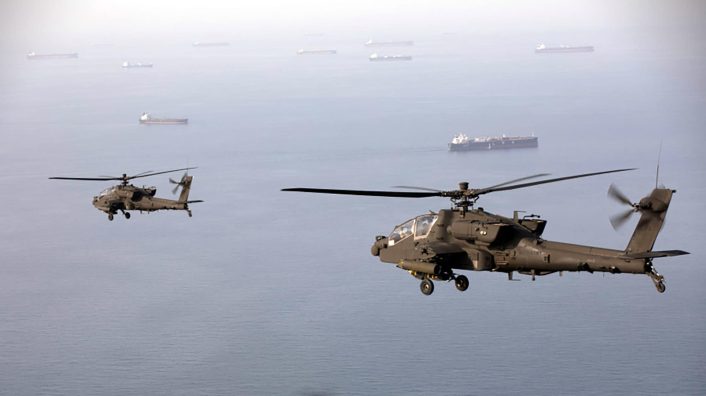
Iran declared the Strait of Hormuz closed on March 4, 2026, just days after Operation Epic Fury began. As an international waterway, Iran has no legal authority to close the strait, but the country’s large fleet of fast attack craft, small boats and a huge arsenal of sea mines mean any Iranian threats to passage through the chokepoint are taken very seriously. Civilian transit through the Strait by cargo ships and, crucially, oil and fuel tankers has suffered severe disruptions during the crisis.
Dozens of ships have secretly transited the Strait of Hormuz, often sailing in the dark to avoid detection by Iranian radar and patrol boats.
This is how America helps oil tankers navigate our waterways ⬇️https://t.co/DmEPOlmlkI pic.twitter.com/40pzQvFnJc
— The Telegraph (@Telegraph) June 6, 2026
Ships willing to risk transit have relied heavily on coordinated efforts by U.S. forces to monitor and escort the area. The downed Apache was likely part of this operation, with powerful ISR capabilities and a mixed weapons load ideal for detecting and countering a variety of surface and air threats.
Inside the Mine Hunting Mothership ⚡
RFA Lyme Bay faces the Arabian Sea.
She is equipped with unmanned boats, underwater sensors, autonomous sonar equipment and has a staff of over 100 professional minesweepers. pic.twitter.com/UN91zfnmHD
— BFBS Force News (@ForcesNews) May 28, 2026
Many countries have expressed their commitment to clearing the Strait of Hormuz from land mines. But large-scale minesweeping operations, typically carried out by ships with relatively limited self-defense capabilities, will be risky if hostilities with Iran continue. The ceasefire that went into effect between the United States and Iran on April 8 remains in place in theory, despite repeated exchanges of gunfire between the two sides.







