



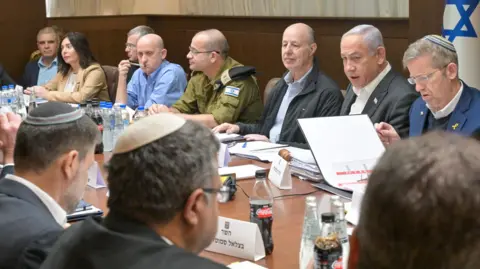
Israel’s government has approved a new Gaza ceasefire and hostage release deal with Hamas, paving the way for it to come into effect on Sunday.
The decision came after hours of discussions that lasted late into the night. Two far-right ministers voted against the deal.
According to Prime Minister Benjamin Netanyahu’s office, the security cabinet previously recommended ratification of the agreement, saying it “supports the achievement of war goals.”
This comes hours after the prime minister’s office and Hamas announced they had finalized the details of the agreement, two days after mediators Qatar, the United States and Egypt announced the deal.
Under the deal, Hamas will exchange 33 Israeli hostages still held in Gaza after 15 months of conflict for hundreds of Palestinian prisoners held in Israeli prisons during the first phase, which will last six weeks.
Israeli forces will also withdraw from densely populated areas of the Gaza Strip, displaced Palestinians will be allowed to return to their homes, and hundreds of aid trucks will be allowed to enter the area every day.
The second phase of negotiations for the release of the remaining hostages, full withdrawal of Israeli troops, and “restoration of sustainable tranquility” is scheduled to begin on the 16th.
The third and final phase will involve rebuilding the Gaza Strip, which could take years, and repatriating the bodies of the remaining hostages.
Qatar said the hostages to be released in the first phase would include “civilian women, female soldiers, children, the elderly, and sick and injured civilians.”
Israel said three hostages were expected to be freed on the first day of the ceasefire, with smaller groups expected to be released regularly over the next six weeks.
On October 7, 2023, the Israeli military launched a campaign to destroy Hamas, which Israel, the United States and others consider a terrorist organization, in response to an unprecedented cross-border attack that left about 1,200 people dead and 251 hostage. .
Since then, more than 46,870 people have died in Gaza, according to the Hamas-run health ministry. Most of the country’s 2.3 million people have been displaced, widespread destruction has occurred and the struggle to help those in need is causing severe shortages of food, fuel, medicine and shelter.
Israel says 94 of the hostages are still held by Hamas, and 34 of them are presumed dead. Additionally, four Israelis were kidnapped before the war, two of whom were killed.

“It is a very difficult decision, but we have decided to support it because it is very important to see all our children, men and women return,” Culture Minister Miki Zohar of Netanyahu’s Likud party said ahead of the Israeli government’s vote on the deal. He said. house.”
He added, “I hope we can finish our work in Gaza in the future.”
But far-right National Security Minister Itamar Ben Gvir said he was “appalled” by the details of the agreement, including that terrorists serving life sentences would be released in exchange for the hostages, and urged other ministers to join him in the vote. urged. I am against it.
On Thursday, Ben-Gvir announced that his Jewish Power party would leave the coalition government if the deal is approved. But he told parliament he would not topple the government and would return “if the war against Hamas is resumed in full.”
Finance Minister Bezalel Smotrich, another far-right politician who opposed the deal, said his Religious Zionist party would withdraw if the war was not resumed after phase one.
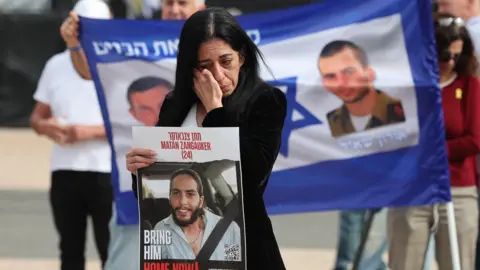
The three-tiered structure also caused division and anxiety among some hostage families. They fear their relatives will be abandoned in Gaza after Phase 1 is completed, and are calling on the government to ensure Phases 2 and 3 are also implemented.
“Our loved ones have been held captive for 469 days, and now we finally have hope,” said Einav Zangauker, 25, whose son Matan was kidnapped from Kibbutz Nir Oz. said.
“If we want to bring everyone home and end the war, we must follow through on this agreement. It is in Israel’s interest to end the war, bring everyone back and get back to normal.”

A government vote was scheduled for Thursday, but the meeting was postponed after Netanyahu accused Hamas of reneging on part of the deal. Hamas denied this.
Early Friday, the Prime Minister’s Office announced that the Israeli negotiating team in Doha had finalized an agreement.
Hamas also released a statement saying that the ‘obstacles’ that emerged regarding the terms of the deal had been resolved in the early hours of the morning.
A source close to Hamas told AFP that the first three hostages to be released would be women.
Last Friday, the Israeli Ministry of Justice released a list of 95 Palestinian prisoners who will be among the first group to be released in exchange for hostages. According to AFP, they consisted of 69 women, 16 men and 10 minors.
On Friday, a meeting was held in Cairo to discuss mechanisms for implementing the agreement, a senior Egyptian official told the BBC.
The official said all necessary measures had been agreed upon, including the establishment of a joint operating room that would include representatives from Egypt, Qatar, the United States, Palestine and Israel to ensure compliance.
Egypt’s state-run Al-Qahera News TV also quoted a source as saying that they had agreed to facilitate the entry of 600 aid trucks per day during the ceasefire period.
This would require an increase of more than 14 times the average daily number of trucks of 43 in January reported by the UN. But Rik Peeperkorn, the World Health Organization’s representative in Gaza, said it was “very likely” that other border crossings between Egypt and Rafah would open.
WHO also plans to provide a number of prefabricated hospitals to support the devastated health sector. Of the 36 hospitals in Gaza, half are non-functioning and the rest are only partially functioning.
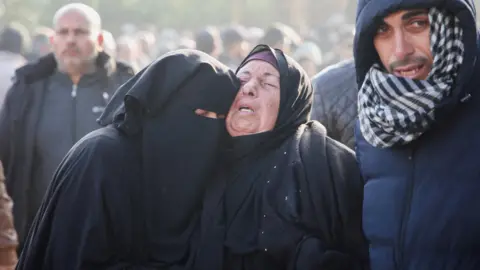
There has been no respite for Palestinians in the Gaza Strip since the ceasefire agreement was announced Wednesday night.
The Hamas-run Civil Defense Agency in Gaza said Israeli airstrikes have since killed a total of 117 Palestinians, including 32 women and 30 children.
Tamer Abu Shaaban said his young niece was killed by missile fragments while playing in the yard of a school in Gaza City where her displaced family was sheltering.
“Is this the truce they are talking about?” He spoke to Reuters as he stood next to her body in the morgue. “What did this little girl, this child, do to deserve this?”
The Israeli military said Thursday afternoon that it had carried out strikes against 50 “terrorist targets” across the Gaza Strip and had taken steps to mitigate harm to civilians.


