



Italian astronaut Luca Parmitano will serve as the pilot of Artemis III, marking a milestone for Europe’s participation in the program to send humans to the moon once again.
NASA has announced the four crew members assigned to the Artemis III mission and has chosen Italian astronaut Luca Parmitano as the mission’s pilot. With this selection, Parmitano becomes the first European Space Agency (ESA) astronaut assigned to NASA’s Artemis program.
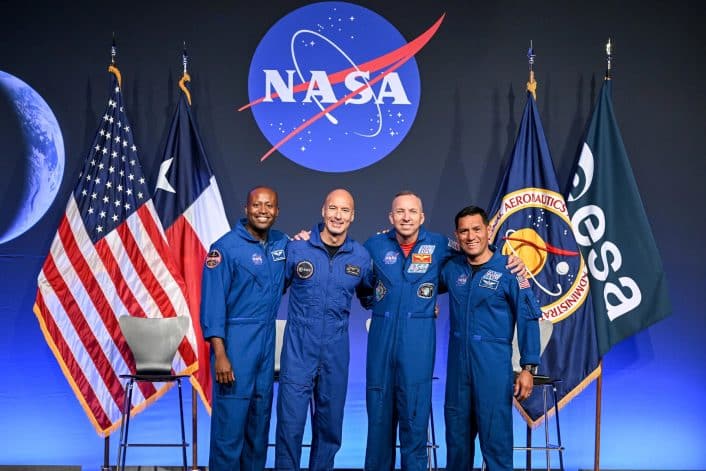
The announcement was made at NASA’s Johnson Space Center on June 9, 2026, and follows Canadian astronaut Jeremy Hansen’s participation in Artemis II. Parmitano joins NASA astronaut Randy Bresnik, who will serve as mission commander along with mission specialists Andre Douglas and Frank Rubio, and Bob Hines will be the designated backup crew member.
Introducing Artemis III.
4 astronauts. Three releases. Two docks. One splashdown.
In 2027, the Artemis III mission will practice docking the Orion spacecraft with two lunar landers in low Earth orbit. This is the capability needed to return humanity to the lunar surface. pic.twitter.com/8uhMUxuuWX
— NASA (@NASA) June 9, 2026
This mission marks a milestone for both Europe and Italy, further strengthening Europe’s participation in the Artemis program. In fact, Europe has supported this program from an early stage and, among other things, has supplied the European Service Module (ESM) that powers the Orion spacecraft during the Artemis mission.
Europe’s first Artemis astronaut
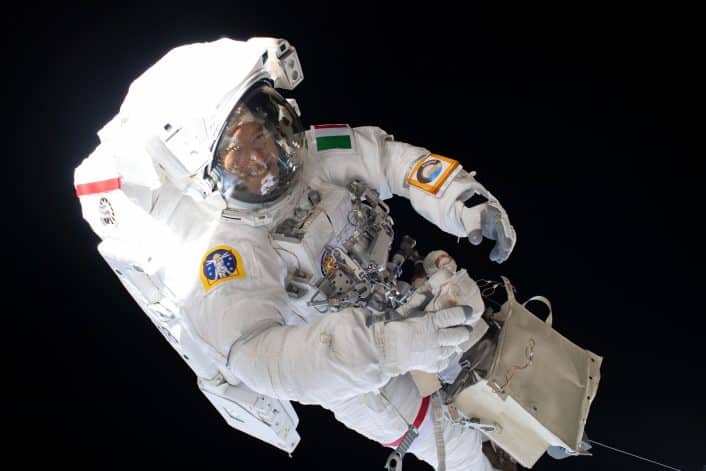
Parmitano, an Italian Air Force colonel, test pilot and veteran astronaut, was selected by ESA in 2009 and has accumulated 366 days in space over two long-duration missions to the International Space Station (ISS). On his second mission in 2019, he became the first Italian and third European astronaut to command the ISS.
His career includes six Extravehicular Activities (EVAs), also commonly known as “spacewalks,” two of them during the first ISS mission and four during the second. Parmitano is also known for solving a dangerous spacesuit leak during the 2013 EVA. This incident is the second to spark important safety improvements for future spacewalks.
While in the United States, Parmitano served as ESA Liaison, Capsule Communicator (CapCom), and EVA Instructor at Johnson Space Center. He also participated in Underway Recovery Test 12, which simulated Artemis recovery operations off the California coast.
We’re proud to continue our partnership with @esa as Luca Parmitano joins the Artemis III team.
Great things happen when trusted partners come together toward a bold goal. Together, Artemis III will demonstrate the capabilities and operating rhythms needed for the next lunar era… https://t.co/BXz3YpiwJS
— NASA Administrator Jared Isaacman (@NASAAdmin) June 9, 2026
After initially flying operationally in the A-11 AMX in the Italian Air Force, Parmitano graduated as an experimental test pilot from EPNER, the French test pilot school in Istres. During his career, he accumulated more than 2,000 flight hours in more than 40 aircraft.
In 2020 aeronautics I had the opportunity to interview Luca Parmitano about his experiences as an Italian Air Force pilot and astronaut. You can find it here (in English) or included at the end of this story (in Italian).
Europe and Artemis
Parmitano’s selection also reflects Europe’s commitment and investment in NASA’s lunar exploration program. In fact, Europe has a longstanding partnership with NASA, which already has an important partnership with the International Space Station.
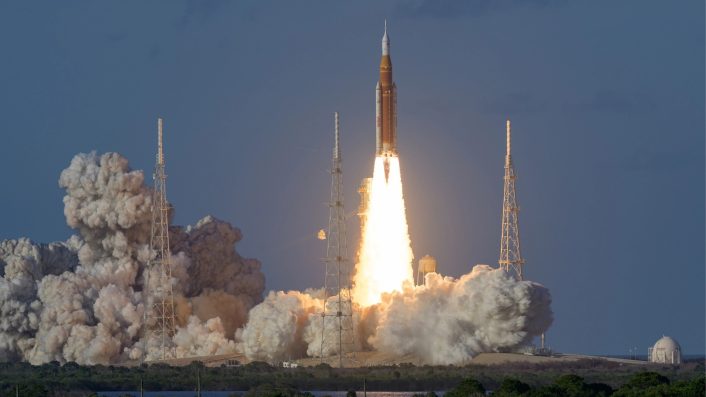
ESA has secured significant investment in Orion, particularly the European Service Module (ESM), which provides propulsion, power, thermal regulation and life support support capabilities for all Artemis missions. Produced by Airbus Defense and Space on behalf of ESA, the ESM has become one of Europe’s most important contributions to the Artemis program and one of the largest industrial partnerships between Europe and the United States in the space sector.
The selection comes at a time when lunar exploration is increasingly gaining attention from a geopolitical perspective. Through the Artemis Program and the Artemis Accords, the United States has created a coalition of international partners committed to a common framework for future exploration beyond Earth’s orbit, replicating the ISS model.
Ambitious work is what we do at NASA.
Artemis III will be unlike anything we’ve ever done. A multi-launch campaign bringing together the world’s most powerful rockets to test rendezvous, docking and interoperability in multiple near-Earth systems before we return… pic.twitter.com/wzYoDpiXyv
— NASA Administrator Jared Isaacman (@NASAAdmin) June 10, 2026
Europe has emerged as one of the leading contributors to this effort, providing both technical capacity and financial investment. Parmitano is currently just the first European astronaut to join this effort, and he already has more plans for future missions.
Italy’s participation in spaceflight
Parmitano’s selection also highlights Italy’s long-standing contribution to international manned spaceflight. The country has a long tradition in orbital flight, and in 1964 it became the third country in the world, after the United States and the Soviet Union, to operate its own space launch pad, and the fifth to launch its own satellite, San Marco 1.
Over the past 30 years, Italian industry has played a central role in the development of manned spaceflight infrastructure. With Thales Alenia Space Italia, Italy has become one of the main contributors to the International Space Station, manufacturing key pressurized elements including the Harmony (node 2), Tranquility (node 3), Cupola observation modules and the multipurpose logistics module used during space shuttle operations.
That expertise is now being passed down to the Artemis era. Thales Alenia Space is a key contributor to the Lunar Gateway program, providing key structural elements to modules such as the HALO and Lunar I-Hab habitats being developed for ESA. After Gateway was canceled, NASA signed a new agreement with Italy to cooperate in building a future lunar base.
We’re building a moon base!
@NASAMooonBase will serve as a habitat for astronauts to live and work during long-term science missions.Join us for a live news event on Tuesday, May 26th at 2pm ET where we will share updates on our lunar exploration plans: https://t.co/IJXA7xYwju pic.twitter.com/jAnkXDg3NY
— NASA (@NASA) May 20, 2026
The result is remarkable continuity across generations of exploration programs. Italian-made modules have helped sustain a human presence in low-Earth orbit on the ISS, Italian-made elements will support future operations on the lunar surface, and an Italian astronaut has now become the first European assigned to the Artemis mission.
Artemis III
Initial plans envisioned Artemis III as the first manned lunar landing since Apollo 17. The mission, scheduled to launch in 2027, has now evolved to focus on validating the technologies needed for future lunar surface operations.
According to NASA, crews aboard Orion will conduct rendezvous and docking demonstrations using Starship and Blue Moon, commercial lunar landing systems being developed by SpaceX and Blue Origin, respectively. The mission is intended to validate procedures, software, propulsion interfaces and life support systems before astronauts attempt future lunar landing missions.
Blue Moon is launched first, followed by Orion and four astronauts. The two spacecraft will dock for about two days, allowing astronauts to conduct tests during the blue moon.
Meeting of Blue Moon and Orion pic.twitter.com/6rR0iqqMzR
— Scott Manley (@DJSnM) June 9, 2026
Blue Moon will undock, allowing Starship to dock with Orion for a day, but without astronauts aboard. The entire mission lasts approximately two weeks.
As pilot, Parmitano will play a central role in executing these complex spacecraft operations. Similar to the close-quarters operations tested on Artemis II, he will likely take manual control of Orion to test the capsule’s handling near both landers and monitor automated rendezvous and docking operations.







