



Defense Minister Guido Crosetto said in parliament that Italy was continuing to apply long-standing agreements governing US military activities, after controversy was sparked by the refusal of a US plane to land at Sigonella airport.
On March 31, 2026, news spread that Italy had refused to allow the United States to use Sigonella Air Base in Sicily, a strategic hub and base of operations for many American assets. This news was first published by: Corriere della Sera Later, by other media outlets, including La republic. Government sources later confirmed that the incident occurred overnight on March 27, 2026.
This refusal was reportedly ordered by Defense Minister Guido Crosetto after Italian authorities learned that several American aircraft (sometimes referred to as “bombers”) were planning to land at Sigonella before heading to the Middle East in support of Operation Epic Fury.
The problem is that prior permission was not requested and Italian military authorities were not consulted. Ansa The news agency reported that Italy was only notified after the aircraft had already taken off, and later checks showed that the flight was neither routine nor logistical, so the existing agreement between Rome and Washington did not apply. This means that the permit must be granted only after it has been approved by the National Assembly.
Later the same day, Crosetto said:
Some people are trying to push the narrative that Italy has decided to stop using its bases for American assets.
That is simply false because the base is active and in use and nothing has changed.
The Government fully complies with the commitments made in Parliament and the policy reiterated by the Supreme Council of Defense, and continues to do what all previous Parliaments and successively all Italian Governments have always done for decades.
International agreements clearly regulate and distinguish between those that require specific approval from governments (it is decided that Parliament must always participate and that nothing can be granted without approval) and those that are technically considered approved because they fall within the scope of the agreement.
The pastor’s only job is to ensure that those rules are respected.
There is no third option.
Finally, I would like to reiterate that our relations with the United States are neither cooling nor strained. Because the United States knows as well as we do the rules governing its presence in Italy since 1954.
The type of aircraft denied the Italian landing has never been made public, which has led to confusion with some speculation pointing to assets deployed in the Middle East days before the “diplomatic incident” and claims related to the flight whose details do not match the official date confirmed by the Italian Ministry of Defense.
In any case, the incident caused considerable domestic controversy, and Crosetto was forced to address the issue at a briefing held in the Chamber of Deputies, Italy’s lower house of parliament, on April 7, 2026. At the hearing, the Italian Ministry of Defense provided some details and some interesting figures about its policy regulating the use of Italian air bases by American aircraft.
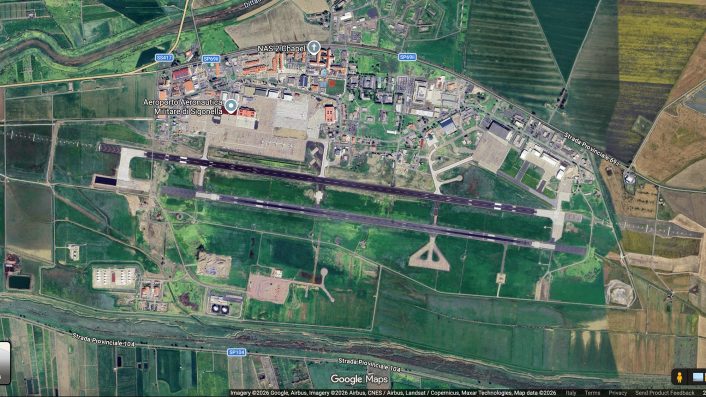
First of all, the Italian government has not changed its policy on the use of U.S. military bases in Italy, and no administration in the last 75 years has done so, Crosetto explained. It also said the decision to deny landing permission to U.S. assets did not signal a political change but reflected the continued application of the legal and treaty framework governing the U.S. military presence in Italy.
“No government of any political color has ever failed to respect or question the international and bilateral treaties between Italy and the United States,” he said.
Crosetto also explained that Italy is no exception in Europe, as countries such as Germany, Spain, Greece, Poland and the United Kingdom have similar bilateral agreements allowing the use of US military facilities on their territories. In his view, compliance with such agreements does not automatically mean involvement in the conflict, but simply means respecting obligations within the limits established by Italian law and the Constitution.
“Respecting the agreement on US military bases in Italy does not mean participating in the war, but responsibly fulfilling the commitments required by law. Italy is not at war, but it is part of NATO and acts in full compliance with its constitution and treaties… pic.twitter.com/Q2dqmvP71B
— Ministry of Defense (@MinisteroDifesa) April 7, 2026
Interestingly, Crosetto cited statistics on American military activity at Aviano AB in northeastern Italy and Sigonella in southern Italy to support his argument. The statistics were obtained from the Italian military in response to questions about whether there had been an increase in activity at the two bases. According to the Italian Ministry of Defense, the statistics demonstrate that the current Meloni government has not changed the long-standing framework regulating access to US military bases in Italy.
The U.S. section of the base, a naval air station called Sigonella, is home to a rotating detachment of P-8 Poseidons and MQ-4Cs from Unmanned Patrol Unit (VUP) 19 “Big Red,” as well as many other manned and unmanned aircraft that regularly deploy to the base or make stops in the middle of the Mediterranean. The base was used as a forward operating location for missions flying in North Africa and the Black Sea region. Aviano Air Force Base is home to the 31st Fighter Wing, including the 510th Fighter Wing, which operates the F-16 Fighting Falcon, the 555th Fighter Wing, and the 56th Rescue Wing, which operates the HH-60W Jolly Green II.
In 2018, Aviano had 525 cargo aircraft landings, including 43 classified as “hot cargo” (meaning flights carrying sensitive cargo or munitions), 120 U.S. tactical aircraft passes and 35 helicopter passes. In 2019, the number of landings increased to 628, including 52 hot cargo flights, 44 fighter planes on the move and 107 helicopter movements. In 2020, Aviano recorded 528 landings, 51 cargo transfers, 28 transport aircraft and 32 helicopter movements. Crosetto cited 505 landings, 43 cargo flights, 59 fighter lifts and 24 helicopters in 2021. In 2022, the total number of landings increased again to 609, including 62 hot cargo flights and 172 transfers. It is unclear why he did not continue to collect data for 2023, 2024, and 2025.
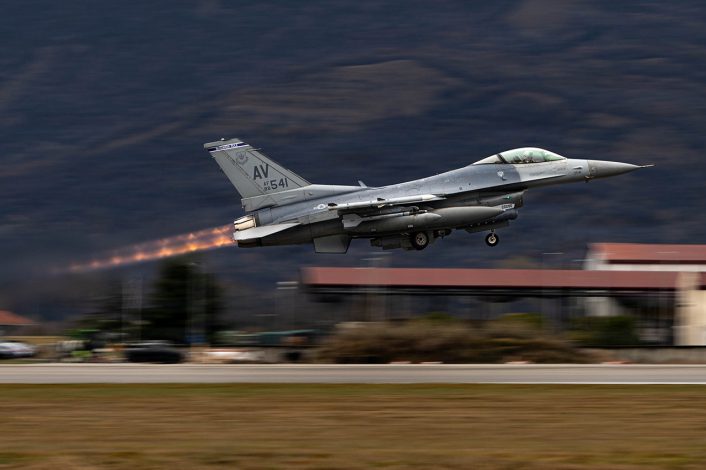
There was much more American traffic at Sigonella Air Force Base. According to figures cited by Crosetto, the base recorded 2,547 landings and transits in 2019, including 271 hot cargo movements and flights of 18 aircraft, 28 helicopters and 898 remotely piloted aircraft. In 2020, there were 2,081 total landings, 178 hot cargo cases and 755 unmanned aircraft system (UAS) flights. The 2021 figures were 1,954 landings, 195 hot cargo movements and 805 UAS flights. Activity increased sharply again in 2022, with 2,919 landings, 273 hot cargo cases, 15 aircraft, 177 helicopter movements and 1,293 remotely piloted aircraft flights. Crosetto also cited Sigonella’s latest drone activity figures, which showed 246 UAS flights in 2023, 466 in 2024 and 338 in 2025.
Perhaps the most obvious trend in the data set is Sigonella’s UAS activity. It remains at a very high level between 2019 and 2022, peaks sharply in 2022, then declines sharply in 2023, recovers only partially in 2024, and declines again in 2025. Compared to 2019, drone activity decreased by 62.4% in 2025.
These figures are presented to demonstrate that the Italian government is not politically redefining the pace of operations at these bases, but rather checks whether such activities fall within the legal and treaty framework already in place.
“When we can, we say yes, and when we can’t, we say no,” he explained, while also dismissing the idea that the government could claim deductions for reduced activity (perhaps due to the transfer of some assets to other bases in the region).
He said Italy will continue to act within the framework of its constitution and laws, respecting international agreements it has signed while continuing to respect parliament and state institutions.
That said, it’s also worth noting that Sigonella-based P-8A Poseidon and MQ-4C Triton aircraft operate regularly in the Persian Gulf region, as extensively reported by the ItaMilRadar account for X.
The U.S. Navy’s dual strategy move this morning: P-8A patrol aircraft and MQ-4C Triton drones both took off east from Sigonella. P-8As are on their way to the Middle East, while Tritons are operating over the Persian Gulf. https://t.co/hnVwZMHDpN
– itamilradar (@ItaMilRadar) March 14, 2026
As the world questions whether President Trump will actually follow through on his threats, Triton launched from Sigonella today and entered an extended orbit over the strategic Khark Island. https://t.co/XFFA0ZzT85
– itamilradar (@ItaMilRadar) April 7, 2026







