



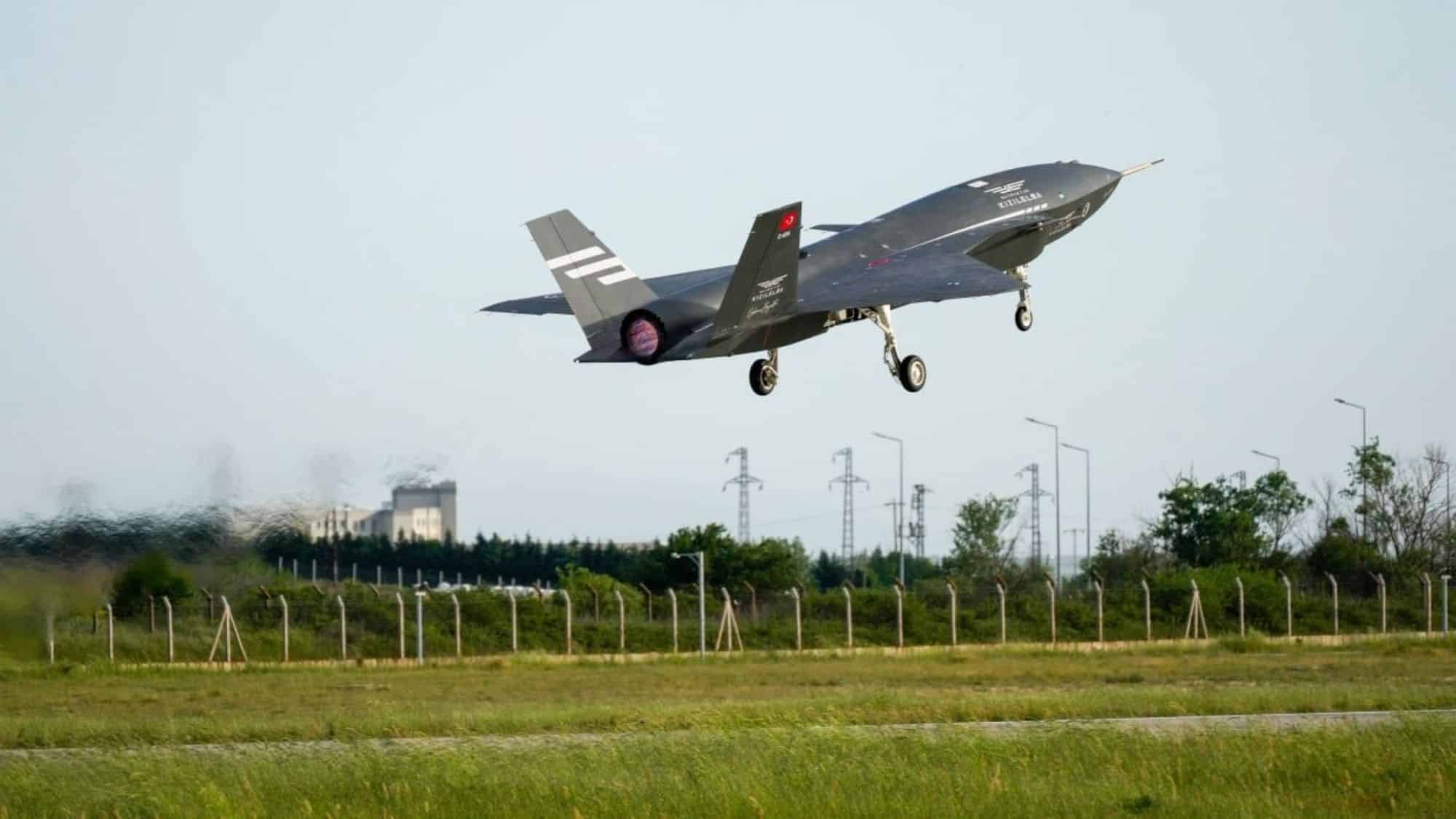
The K-SWARM project saw the Kizilelma UCAV operate in a Crewed/UnCrewed Teaming scenario, responding to a series of commands sent from the M-346.
The Turkish-Italian cooperation in manufacturing Baykar’s unmanned combat aerial vehicle (UCAV) at Leonardo’s facilities for the European market with local mission systems and certification has taken a major leap forward. The M-346 trainer and Kizilelma conducted the first Cooperative Crewed/UnCrewed Teaming (CUC-T) tests of what Leonardo calls the K-SWARM series “joint autonomous formation flights” held at the Çorlu Test Flight Center in Baykar last May.
A joint statement from Leonardo and Baykar on June 22, 2026 said the “autonomous formation flights” validated the engineering, software and hardware developed for autonomous warfare. This test campaign laid the foundation for improving operational, conceptual, industrial, logistical and doctrinal processes as the combat-ready system is now mass-produced.
The first test flight in a test campaign that will continue over the coming months saw the Kizelelma prototype integrate Turkish flight autonomy hardware and software with Italian unmanned control code. Two Leonardo M-346s, the company’s own M-346FA (fighter attack) variant, and an Italian Air Force (Aeronautica Militare – ItAF) T-346A serving as a pursuit aircraft took part in the K-SWARM test with a single Kizilelma, Leonardo announced.
🔴#LDO_PR #Leonardo and @BaykarTech mark an important milestone for the development of advanced Crewed/UnCrrewed capabilities with the first successful K-SWARM live trial. https://t.co/WKZtLHugbM pic.twitter.com/uomPsBc46N
— Leonardo (@Leonardo_live) June 22, 2026
Supported by artificial intelligence (AI), Kizilelma automatically took off and joined the M-346 formation before being controlled and commanded through a series of formation maneuvers by the M-346FA crew.
System, hardware, software development
The test flight was preceded by several months of preparatory work and testing activities with other related systems considered for both ground testing and first flight testing. Teams developed a radio frequency-based Leonardo GCC Tactical Platform data link that synchronizes and fuses all data between the Kizilelma and M-346 used in the flight.
The latest generation algorithms and associated tactics and procedures developed by Leonardo at Avionic Flight Control Innovation Labs and the Product Capability and Concept Laboratory (PC2LAB) in Turin were used. At the same time, Baykar “integrated advanced smart fleet autonomy features into the CUC-T algorithm.”
“Kizilelma’s advanced autonomy capabilities greatly simplify the integration process, enabling smooth implementation and rapid deployment,” Leonardo’s release added.
hot development | Strategic moves in Italy and Türkiye!
Within the scope of the K-SWARM program, the Bayraktar KIZILELMA unmanned combat aircraft and the Leonardo M-346 aircraft performed the first joint autonomous formation flight in Çorlu.
Guaranteed coordination of manned and unmanned platforms… pic.twitter.com/1xlttDQTaZ
— SavunmaSanayiST.com (@SavunmaSanayiST) June 22, 2026
These were first tested with the M-346 Full Mission Simulator based in Venegono, Italy. According to the framing of the release, the simulator was used to simulate and choreograph CUC-T command missions, formation flights, and test various autonomous flight, data connectivity and networking algorithms developed by Baykar and Leonardo.
“These operations were executed during an M-346/KIZILELMA formation flight, supporting validation of the advanced cooperation and coordination of a variety of high-performance combat platforms and air systems as the program transitioned from simulation to real-world operations,” the Leonardo release explained.
M-346 and Kizilelma teaming test flights
The final flight campaign saw Kizilelma take off autonomously and join the M-346FA in formation flight via Baykar’s Smart Fleet Autonomy algorithm. The SFA manned and unmanned autonomous flight code was developed at Baykar’s Hardware-in-the-Loop (HIL) laboratory, which will allow the M-346 to “take full control of the unmanned aircraft thereafter.”
During the K-SWARM live flight test held in Çorlu, Bayraktar KIZILELMA successfully demonstrated manned/unmanned collaborative capability (CUC-T) using two M-346 aircraft.
KIZILELMA with autonomous takeoff capability, M-346 with airborne integrated avionics suite and smart fleet autonomy algorithms… https://t.co/YRD4RvWmg2 pic.twitter.com/t40691rTZC
— SavunmaSanayiST.com (@SavunmaSanayiST) June 22, 2026
M-346FA pilots used “fully integrated onboard avionics” and “dedicated crew/unmanned computing systems” to command Kizilelma into “different formations” where the Turkish aircraft “run autonomously.”
“Various maneuvers and formations, including repositioning, separation and recombination, have been successfully tested using Kizilelma, which responds accurately to M-346 commands,” Leonardo added.
Technology Efforts and Future
Leonardo said the Çorlu flight test was preceded by months of extensive and intensive preparatory work involving pilots and engineers from both companies. With the required level of system technical integration and algorithm validation to ensure safe and effective testing, the next step will be analyzing the data collected during the K-SWARM program.
Bayraktar #REDELMA✈️🚀🍎
✅ TEST FLIGHT WITH KARAT IRST#Baykar 🤝 @Aselsan#NationalTechnologyInitiative 🌍🇹🇷 pic.twitter.com/aB4FVm0wSA
— BAYKAR (@BaykarTech) April 3, 2026
In the coming months, K-SWARM will evolve “to more complex operations (and) additional capabilities (…) that require greater situational awareness and assets working together ‘as one’ toward the mission objective.” AI technologies and algorithms can now “progressively transition from remote piloting to autonomy”, ultimately “reducing pilot workload while maintaining full control and decision-making (…)”.
“This first phase of testing demonstrates the solid partnership between Leonardo and Baykar and their respective technological and industrial capabilities,” Leonardo’s press release concluded. The company added that this “confirms the company’s competitive advantage in the field and represents a concrete step towards developing core capabilities for modern combat air operations in multi-domain operational scenarios.”







