



The MQ-4 Triton was on a patrol mission over the Persian Gulf when its transponder indicated that it had lost communication link with the pilot and began its descent.
The U.S. Navy MQ-4C Triton unmanned aerial vehicle (UAS) disappeared from a flight tracking website over the Persian Gulf on April 9, 2026. Just before disappearing, the aircraft sounded 7400. This is a transponder code indicating that communication link with the remote pilot has been lost.
While returning to Naval Air Station Sigonella, Italy, the Triton began a descent from its cruising altitude of 52,000 feet to 9,500 feet, where it lost signal. The descent took less than 15 minutes.
#USNAVY U.S. Navy – 🚨 7700 General Emergency
1x Northrop Grumman MQ-4C Triton#AE7815 169804 – Unknown C/S
A U.S. Navy MQ-4 drone operating over the Persian Gulf and Strait of Hormuz declared an emergency while returning to Sigonella Naval Base.
At 0956z it was… pic.twitter.com/xbqvrOby2t
— Armchair Admiral 🇬🇧 (@ArmchairAdml) April 9, 2026
It is said that the gurgling sound before disappearing changed to 7700, a general emergency code. In the final stage of descent, the drone was also seen heading toward Iran.
There has been no official statement at this time and it is unclear what happened at this stage. Observers appear to agree that the drone may have crashed in the Persian Gulf.
A U.S. Navy MQ-4C “Triton” high-altitude, long-endurance maritime reconnaissance drone appears to have descended into the Persian Gulf after sounding 7400 (loss of communication link) and 7700 (general emergency) while returning to Naval Air Station Sigonella, Italy. pic.twitter.com/3E4i0yTZsa
— OSINTdefender (@sentdefender) April 9, 2026
The U.S. military lost a number of drones during operations in Iran, including at least 16 MQ-9 Reapers. However, it is still too early to tell whether Triton was actually hit, malfunctioned, or had its communications links disrupted or disrupted by Iran.
In June 2019, Iran shot down a U.S. Navy RQ-4A BAMS-D demonstrator, a Global Hawk-derived test and development asset linked to the MQ-4C Triton program. According to a CENTCOM statement issued at the time of the incident, the aircraft was flying in international airspace about 34 kilometers off the Iranian coast when it was hit by a missile reportedly launched near Goruk, Iran.
Generally speaking, as noted in 2011 after the RQ-170 stealth drone was captured by Iran, the aircraft’s link loss procedure was understood to keep the drone in orbit until link was restored or fuel was depleted, rather than providing an autonomous landing on its home base, taking into account variables such as wind and air traffic.

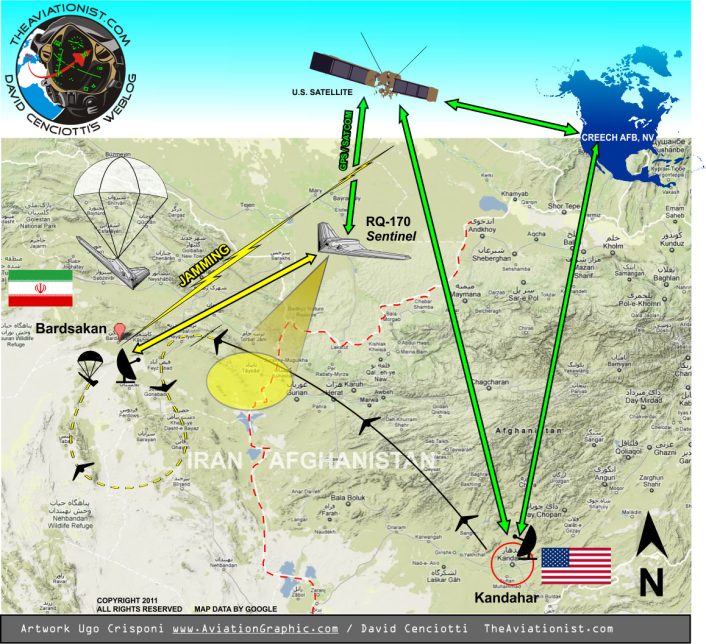
For example, even in remote split operations, landings are performed within line of sight of the local ground control station. This is because the latency introduced by the SATCOM link is incompatible with the final phase of flight, where the drone’s control surfaces must respond immediately to the pilot’s remote inputs to ensure a safe landing.
If the usual logic applies here as well, one possible theory is that Triton was not simply “link lost” but either physically damaged or subjected to a more complex and deliberate hostile action that prevented normal link loss recovery procedures from working as expected.
However, it is unclear how the latter could have happened, given the pressure that US and Israeli forces have placed on Iran’s jamming and electronic warfare capabilities over the past six weeks of air warfare. This means that even poorly performing EW networks have the potential to produce transient or localized effects. This is especially true when used against satellite communications or other vulnerable nodes in the command and control chain. Alternatively, the apparent loss of control may not be the result of jamming alone, but may be caused by damage to the aircraft itself or a malfunction on board. However, as already said, the available information is too limited to suggest one scenario is more likely than the other.
This is a developing story so it will be updated as new details emerge.


