



The MQ-9B, which is adapting to the ASW role, was shown with four Sonobuoy Dispensing System pods after previously only shooting two pods.
The MQ-9B Sea Guardian remotely piloted aircraft (RPA) was shown equipped with four Sonobuoy Dispensing System (SDS) pods during its transition to an anti-submarine warfare (ASW) role on May 27, 2026. The SeaGuardian has been tested for an anti-submarine warfare (ASW) role for several years, but so far almost all representations and images have shown it with only two SDS pods.
GA-ASI hinted at using all four pods in a December 2025 test, in which SeaGuardian would become the first unmanned system to drop a Multi-static Active Coherent (MAC) sonobuoy. However, while the officially released images showed the RPA with only two pods, it’s unclear whether the photo in the press release was captured during that test.
SeaGuardian’s latest frontal image, showing four diagonally oriented pods, was released on the occasion of the Canadian National Security (CANSEC) 2026 exhibition held May 27-28. The RPA also carries another pod on its centerline that can host a Leonardo Seaspray 7500E V2 or Raytheon SeaVue ocean search multi-mode radar.
The MQ-9B SeaGuardian® advanced intelligence, surveillance and reconnaissance #UAS with anti-submarine warfare system maintains maritime domain awareness for U.S. and international forces while enabling persistent submarine tracking. https://t.co/C6VlvcwDA3… pic.twitter.com/NFhrmabYtD
— General Atomics Aeronautical Systems, Inc. (GA-ASI) (@GenAtomics_ASI) May 27, 2026
Renderings and images with radar pods on the centerline show only two SDS pods. The MQ-9B appears capable of carrying a payload of five pods, but may have to sacrifice range and durability. SeaGuardian can fly for 24 to 40 hours, depending on payload.
SDS Ford
According to GA-ASI’s product catalog page on SDS and Sonobuoy Monitoring and Control Systems (SMCS), each SDS can carry up to 10 U.S. Navy standard ‘A’ size sonobuoys or 20 ‘G’ size sonobuoys. This allows the drone to carry 40 ‘A’ size or 80 ‘G’ size sonobuoys, depending on the number of SDS pods to be carried.
The weight of an empty SDS is 132 kg, and after packing the sonobuoy it weighs 340 kg.
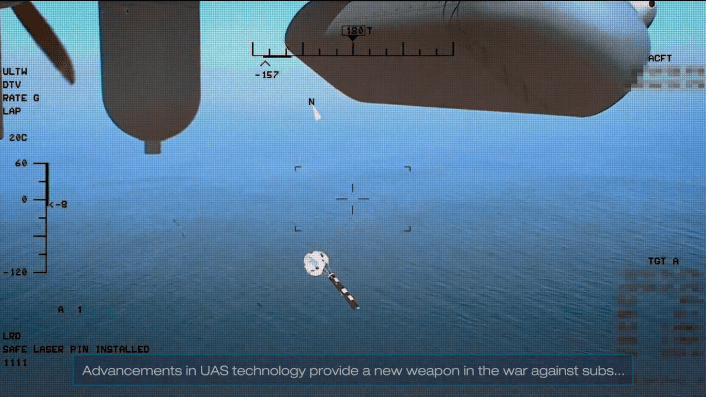
For the December 2025 test, GA-ASI said the number of pods installed on the aircraft was “more than in previous tests, doubling the number of usable sonobuoys.” This suggests that the MQ-9B SeaGuardian in those tests carried four SDS pods. However, as we mentioned, the attached image shows the aircraft in a hangar with only two SDS pods.
In this trial, SeaGuardian became the first UAV to test a Mutli-Static Active Coherent (MAC) sonobuoy using the AN/SSQ-125 underwater sensor. Including the January 2025 test, GA-ASI also conducted tests using the AN/SSQ-36 Bathythermal, the passive AN/SSQ-53G Directional Frequency Analysis and Recording (DIFAR), and the active AN/SSQ-62F Directional Command Activated Sonobuoy System (DICASS) sonobuoy on the MQ-9B SDS.
MQ-9B ASW
GA-ASI’s press release highlighted the MQ-9B SeaGuardian’s effective combination of SDS and Sonobuoy Monitoring and Control System (SMCS), while also providing standard maritime surveillance, reconnaissance and battlespace awareness capabilities.
#SeaGuardian’s nautical capabilities aren’t limited to the water’s surface. Integrating with naval units, it demonstrated the ability to release sonobuoys and track submarines. #UAS #ASW
Learn more: https://t.co/ghb2ABJ6et pic.twitter.com/TAjZJM54tr
— General Atomics Aeronautical Systems, Inc. (GA-ASI) (@GenAtomics_ASI) December 21
“Combined with the MQ-9B SeaGuardian’s proven multi-domain sensors, the aircraft can provide complete surveillance of the entire marine environment from the air to the surface and even deep sea,” the company says. “SeaGuardian with the GA-ASI ASW system enables persistent submarine tracking while maintaining maritime battlespace awareness. The SDS pod and SMCS enable navies operating SeaGuardian to continuously protect critical waterways, shipping lanes, chokepoints and joint forces from ever-increasing submarine threats. All while significantly reducing manpower and equipment, and significantly reducing cost and risk compared to manned alternatives.”
The #MQ9B SeaGuardian, equipped with GA-ASI sonobuoy dispensing pod and Raytheon SeaVue radar, participated in @USNavy’s W-291 Test Range in Southern California to demonstrate the ability to launch submarine detection sonobuoys and track underwater targets.
See more: https://t.co/h6BQyWrYGt pic.twitter.com/zJoi1SrlPe
— General Atomics Aeronautical Systems, Inc (GA-ASI) (@GenAtomics_ASI) March 20, 2024
future
This follows GA-ASI and Saab announcing last week the first flight of the MQ-9B equipped with the developed Airborne Early Warning and Control (AEW&C) pod. The evolution of the MQ-9B into an ASW and AEW&C platform comes as the drone has shown its vulnerability in conventional combat, with nearly 30 reportedly lost to Iranian air defense and surface strike fire. Air Force and Space Force Magazine.
ASF Also appearing before the House Armed Services Committee (HASC) on May 20, U.S. Air Force Commander General Kenneth Wilsbach praised the MQ-9 as the “most valuable player” in Operation Epic Fury. Wilsbach noted that unmanned operations and loitering capabilities well beyond the limits of human endurance have nonetheless helped it strike many of Iran’s ground targets and surface-to-air missile systems.
Moreover, ASW and AEW&C are much less risky roles as aircraft operate at much greater distances from enemy weapons engagement zones, over friendly territory, and not too far from friendly assets. A single MQ-9 costs between $16 and $30 million, depending on the variant and how it is kitted.
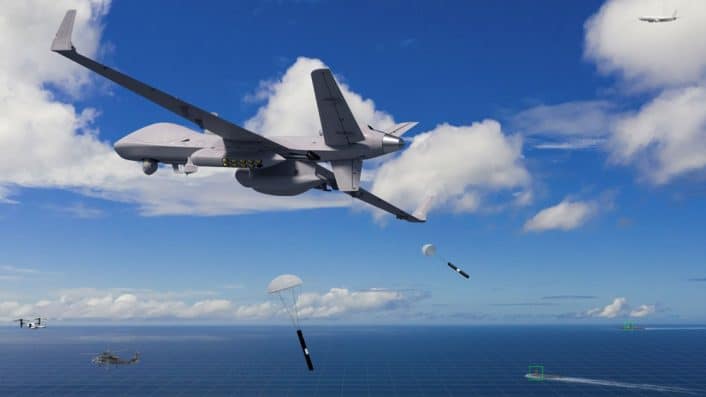
A single MQ-9B SeaGuardian can partner with P-8A Poseidon ASW maritime patrol aircraft and MH-60R naval helicopters to significantly expand and extend the search area while offloading manned platforms while also providing standard optical maritime surveillance capabilities.







