




 Joyce Liu / BBC
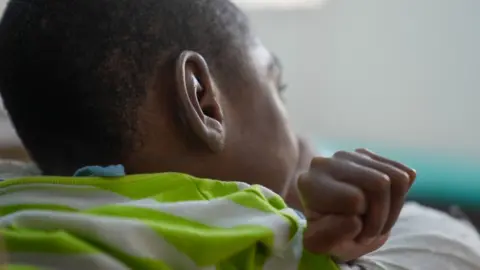
Babatunde Fashola, affectionately known as Baba, is 22 years old but stands less than 70 cm (2 feet 4 inches) tall.
He has cerebral palsy and will require lifelong treatment. He cannot speak or walk and receives his nutrition through a tube connected to his stomach.
He was abandoned by his parents as a child, but found a home at a cerebral palsy center in Lagos, Nigeria, 10 years ago.
“Baba weighs about 12 kg (26 lb). He is doing well,” said Nonye Nweke, the facility’s founder, when I visited.
Ms Nweke and her staff are working around the clock to support him and other young people living with permanent brain damage.
Cerebral palsy is believed to be one of the most common neurological diseases in Nigeria, although official data is lacking. In 2017 A medical professor at the University of Lagos said 700,000 people suffer from the disease..
For many people living with cerebral palsy in the country, their condition was caused by a phenomenon that is common among newborns. newborn jaundice.
This is caused by a buildup of a yellow substance, bilirubin, in the blood, which means the baby’s skin takes on a yellow tint.
Professor Chinyere Ezeaka, a pediatrician at the Lagos University Hospital, told the BBC that more than 60% of all babies suffer from jaundice.
Most babies recover within a few days. More serious cases require additional medical intervention, and even then, they are easily treatable.
Children are exposed to ultraviolet light, basically to dissolve excess bilirubin in their red blood cells. Treatment lasts several days, depending on severity.
However, this treatment is often not readily available in Nigeria, and data from the World Health Organization (WHO) shows the country is one of the top five countries in the world for neurological diseases caused by untreated jaundice.
Any treatment for neonatal jaundice “must be done within the first 10 days of life, otherwise it can lead to permanent brain damage and severe cerebral palsy,” says Professor Ezeaka.
To make matters worse, the West African country lacks facilities to care for people with neurological disorders. Nigeria, with a population of over 200 million people, has only three cerebral palsy centers, all of which are privately run.
Ms Nweke, a single mother, founded the Cerebral Palsy Center after struggling to find support for her daughter Zimuzo.
“When I took her to the daycare center, they told me to take her back because other mothers would take their children. As a mother, I have to say it was quite shocking,” Nweke told the BBC.
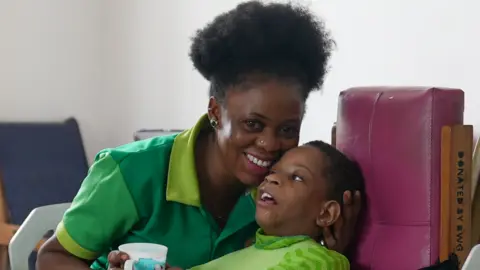
Zimuzo is now 17 and Mr Nweke’s Cerebral Palsy Center provides dedicated support to others with similar experiences.
On the day I visited, there were colorful play mats and toys neatly placed on the floor. Mickey Mouse and his friends are chatting while watching the wide screen TV in the lounge.
Twelve children as young as five years old are staring at the TV, ignoring their bright surroundings for a moment. They neither move nor speak.
 Joyce Liu / BBC
At lunchtime, caregivers help children eat. Some consume liquefied food through a tube connected to their stomach.
Guardians carefully and slowly Support your head with a pillow and push the contents of the syringe into the tube.
Young children need feedings every two hours and regular muscle massages to prevent stiffness.
But they are the lucky 12 who receive free treatment at a cerebral palsy center funded exclusively by donors.
This facility has a long waiting list. Mr Nweke received more than 100 applications.
However, additional financial support is needed to employ more young people. It costs at least $1,000 (£790) a month to look after someone at the centre. This is a huge amount in a country where the national minimum wage is about $540 per year.
“As a mother, I have to say that this is very overwhelming. There are moments of depression, it causes heartache and it is quite expensive. In fact, it is the most expensive congenital disorder to manage,” says Nweke.
“Of course, you distance yourself from people because you’re not discussing the same things. They’re talking about the baby, walking, enjoying the baby moment. You’re not doing that. You’re sad,” she adds.
Mr. Nweke explains that he adopted Zimuzo from an orphanage.
A few months after taking her newborn daughter home, Ms. Nweke realized that Zimuzo was not developing in the same way as the children around her. She was examined at the hospital and diagnosed with cerebral palsy.
Ms Nweke was told she could take Zimuzo, who was only a few months old at the time, to an orphanage and adopt another baby instead, but she refused.
“I decided to keep her and started researching what the disorder was, the treatment and type of care my child would need. She is my life.
“I was also told by the doctors that she would not live more than two years. Now it has been 17 years,” Nweke said with a laugh.
In Nigeria, the diagnosis and treatment of neonatal jaundice is difficult due to lack of awareness and adequate medical care.
Ms. Nweke also says the common belief in the community that children with congenital disabilities are spiritually damaged or enchanted leads to stigma.
Some children suffering from neurological disorders (mostly in rural Nigeria) are labeled as witches. In some cases, they are abandoned in prayer houses or driven away from their families.
 Joyce Liu / BBC
Nweke is not alone in her mission to clear up misconceptions and improve care.
The Oscar Project, a charity aimed at improving the diagnosis and treatment of neonatal jaundice, recently began operating in Lagos.
The project is named after Oscar Anderson, a Vietnamese-born British disability advocate who developed cerebral palsy due to untreated jaundice.
“We have equipped primary, secondary and tertiary level healthcare facilities with jaundice treatment equipment, mainly light boxes, but also detection and testing equipment,” Toyin Saraki, who oversaw the launch, told the BBC.
Project Oscar, supported by consumer health company Reckitt, is training 300 health workers in Lagos. The hope during the first year is to reach 10,000 mothers, screen 9,000 children and introduce new protocols to prevent babies with jaundice from developing cerebral palsy.
In a country with an overstretched public health system, the government praised Project Oscar’s goals but said little about the obstacles.
Treating newborn jaundice is much cheaper than the cost of lifelong treatment, doctors say.
Project Oscar, which first launched in Vietnam in 2019, has helped approximately 150,000 children in the Asian country.
Mr Anderson, 22, said he wanted to prevent other children from experiencing what he went through.
“Disabled people should not be underestimated,” he told the BBC.
He is working to ensure that all newborns are screened for neonatal jaundice and to enable better understanding and faster treatment with the support and courage of mothers, midwives and healthcare professionals.
But achieving this is a very ambitious goal for Africa’s most populous country, where thousands of babies are born with neonatal jaundice every year.
Nonetheless, Mr. Anderson decided to defy the odds.
“This work will not stop until every baby is protected from neonatal jaundice,” he says.
More Nigerian stories from the BBC:
 Getty Images/BBC





