



Buenos Aires, Argentina – José Roberto Acosta, a former senior official in Gustavo Petro’s government and current ambassador to Argentina, has assessed the next presidential election, which will put the first progressive government in Colombia’s history to the test this Sunday, May 31.
“Colombia is a protagonist, for better or for worse,” Acosta said, describing the country as “the navel of the Americas” because of its strategic geopolitical position.
Acosta was appointed ambassador in August 2025 as part of a broader cabinet reshuffle after serving as director of public credit under Petro, one of the most sensitive positions within Colombia’s economic team. His arrival in Buenos Aires followed a diplomatic crisis sparked by public clashes between Petro and liberal Argentine President Javier Millais.
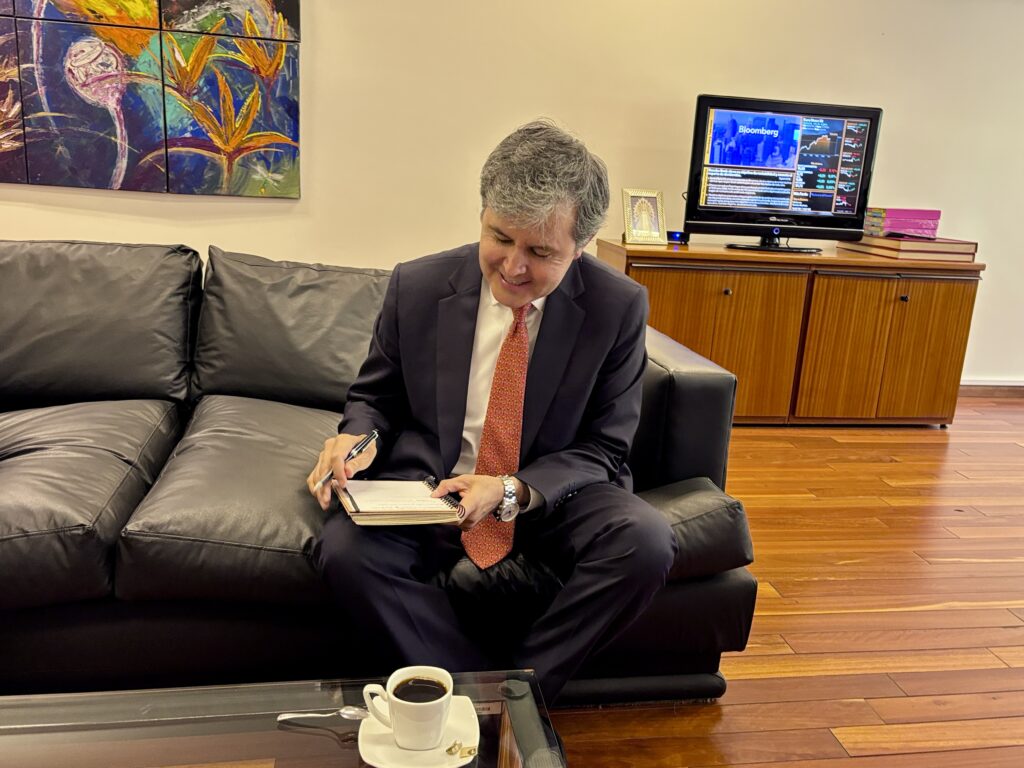
In an exclusive interview with Argentina Reports at the Colombian Embassy, Acosta described Colombian politics as “sancocho,” a traditional Colombian stew in which various forms of violence continue to overlap within a strong institutional framework that he defines.
“In Colombia, assassinations are undoubtedly a political tool.” He added in general terms to comply with internal restrictions that prevent government officials from speaking directly about race. He cited the atmosphere surrounding the campaign, which revived memories of the intense political violence of the 1990s, particularly the attack on senator and presidential candidate Miguel Uribe Turbay.
Acosta described Colombia as a country where ‘multiple forms of violence coexist simultaneously’, with conflicts related to ‘drug trafficking, armed groups, illegal mining and political extremism’ overlapping within the electoral environment. At the same time, he argued that Colombia is still “institutionally very strong,” pointing to the 1991 constitution and the fact that President Petro, who began his political career participating in the guerrilla movement, came to power through democratic elections.
Asked about the sustainability of Petro’s political movement, Acosta referred to Senator Iván Cepeda, the candidate chosen to succeed Petro and lead the ruling Historic Pact party.
“The potential for continuity is enormous,” he said.
With less than a week left until Colombia’s presidential election, a recent Invamer poll found Cepeda leading the first round with 44.6% voting intention. His closest rival, outsider and right-wing opposition candidate Abelardo de la Espriella, came next with 31.6%, while conservative Senator Paloma Valencia, candidate of the traditional right-wing Eurivista movement, came in third with 14.0%.
Regarding the current government, Prime Minister Acosta also defended Petro’s controversial ‘total peace’ strategy despite criticism surrounding the security situation in various parts of the country.
“We are always optimistic about peace,” he said. “Saving lives is our top priority.”
Addressing drug trafficking, one of the central pillars of Washington’s renewed regional security agenda under President Donald Trump, Acosta described the ‘war on drugs’ as a ‘lost war’ that requires international cooperation rather than a unilateral response.
“As Colombians, we have seen bombs, trucks and buses loaded with explosives destroying entire buildings and killing many people,” he said.
When asked about the appearance of ‘narco-terrorism’ with a local dimension, he replied, “Anyone can frame it in any way they like, but in the end, the result is the same. We never want to see that kind of violence in our country again.”
Wall Street trader joins Petro government
Acosta’s profile remains unusual within Latin American diplomacy, where outsiders and traders are increasingly joining conservative governments, along with Economy Minister Javier Millay and Foreign Minister Pablo Cirno.
Instead, Acosta served under Petro, a figure close to local progressive leaders such as Luiz Inácio Lula da Silva, Claudia Sheinbaum, and Pedro Sánchez.
A lawyer, economist and former stockbroker before the digital age of Wall Street, Acosta worked as a journalist at El Espectador, where he participated in investigations related to the Odebrecht corruption scandal and oil company Pacific Rubiales.
Throughout the interview, Acosta moves seamlessly between political theory and market logic, frequently referencing thinkers such as Karl Marx, Michel Foucault, and Jürgen Habermas to explain global power dynamics.
“I don’t know another left-wing merchant or banker in Colombia,” he joked.
Acosta defines himself as a “Marxist” rather than a Marxist, and claims that reading the German philosopher helped him understand the difference between “price” and “value,” a concept he later applied to financial markets and public policy.
“As we live under a capitalist structure, whoever controls capital controls many other things: the media, the networks, the narrative,” he said.
Between Petro and Miley
President Petro’s confrontational style on social media has repeatedly stoked diplomatic tensions across the region, including disputes with the governments of the United States, Ecuador and Bolivia. This “X/Twitter diplomacy,” as some analysts describe it, has become a recurring feature of the foreign policy style of several presidents, including Javier Millay.
In 2025, the Argentine president publicly referred to Petro as a ‘terrorist communist’ on his social media, which led to the expulsion of an Argentine diplomat from Bogotá before relations between the two countries gradually normalized through diplomatic channels.
Despite the ideological distance between the two presidents, Acosta described their operating relationship as pragmatic.
“In reality, the relationship operates beyond political rhetoric,” he said.
The Ambassador highlighted agreements related to aviation, trade and migration, including the expansion of air links between the two countries and progress in commercial procedures affecting Argentine exports.
“We do not discuss tweets or political tensions during our meetings with the business community,” he said. “The conversation immediately moves to infrastructure, trade, coffee or export channels.”
Acosta also reaffirmed Colombia’s historic support for Argentina’s sovereignty claims over the Malvinas Islands and suggested that Colombia could eventually pursue a more active role within Mercosur.
“I can imagine Milei meeting Petro,” he said. “But I don’t think it will be easy.”
Featured image caption: Ambassador Jose Roberto Acosta of the Embassy of Colombia in Argentina.
Featured image credit: Cecilia Degl’Innocenti.







