After November 2013 Cyclospora cayetanensis After hundreds of people became sick in Iowa and Nebraska, the FDA released an environmental assessment of the Taylor Farms de México processing plant in Dr. Mora, Guanajuato. The report concluded with recommendations. The second told the company to decide whether to do so. Cyclospore It is reasonably likely that this is a risk in Guanajuato’s leafy green growing areas, and if so, the cleaning steps used in salad mixes should be reevaluated. Thirteen years later, the same area became the center of the largest cyclosporiasis outbreak in U.S. history, with no documentation showing that such a decision was ever made.
Here’s what the person who performed the risk analysis found: Located 235 meters (approximately 800 feet, a 3-minute walk) from the processing building, Balneario Las Fajanas, a public hot springs complex with a swimming pool, water slides, changing rooms, showers, grills and picnic shelters, is open every day of the year. This is where the concentration of human waste is highest anywhere near the plant. And satellite images show it was already built, filled and operational in March 2010, three years before FDA and COFEPRIS set foot on the site.

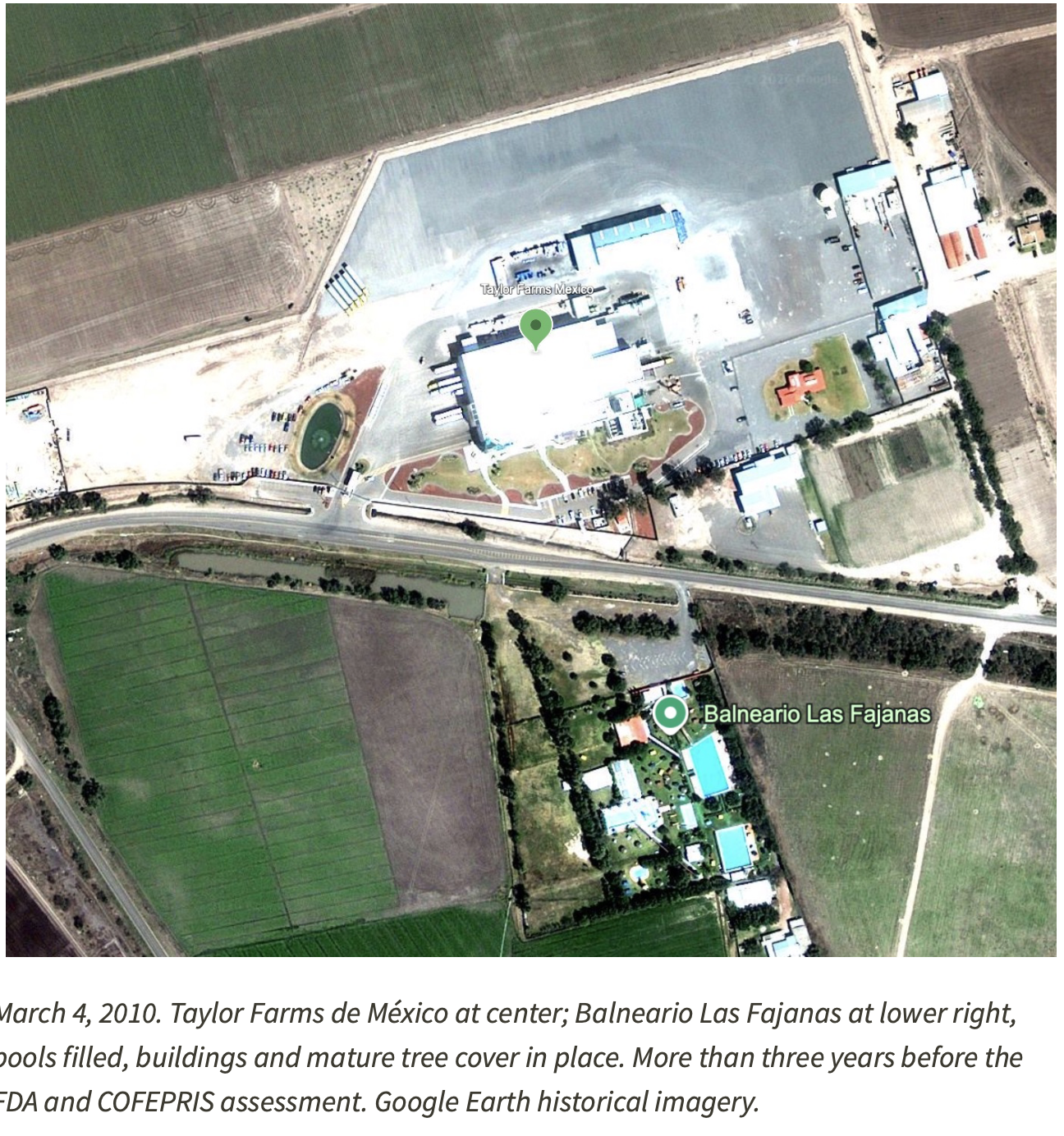
The image rules out the only naive explanation. Now no one can say that the balneario came later or that the circumstances changed after the inspectors left. When FDA and COFEPRIS visited the site in August 2013, a public bathhouse complete with swimming pool had stood prominently across the highway for years. The published assessment describes the processing plant and five ranches. It does not describe the bath complex.
Because details matter, it’s a good idea to explain what’s actually on the property. The Guanajuato Tourism Board lists Las Fajanas in its official state guide under balnearios and water parks at Km 16 of the San Miguel de Allende-Doctor Mora highway, Cruz de la Maza area, with state-issued coordinates: 21.10266, -100.45159. The state describes and lists hot springs pools, large lawns, parking lots, water slides, palapas, grills, restrooms, showers, locker rooms and snack shops as accessible sites. Other listings include soda fountains, stores, sports courts and bars. Operators advertise 40-degree Celsius spring water and that the facility is open 365 days a year. Admission fees have steadily increased. In the previous list, it was 80 pesos for adults and 40 pesos for children, 100 pesos and 40 pesos thereafter, 120 pesos and 60 pesos on February 1, and 150 pesos for adults and 80 pesos for children from March 23. When demand supports it, prices rise that way. Our listing has 897 reviews. There is no website. The business operates on Facebook.
Water slides cause high water intake, especially among children. Grills and picnic shelters mean families stay all day instead of just an hour, increasing the number of bathroom uses per visitor. The 40-degree thermal water means the facility draws from deep geothermal sources and moves around a lot, so every liter that goes into the pool ends up coming out of the pool. Where you go when you leave is the whole question, and the public list doesn’t answer that.

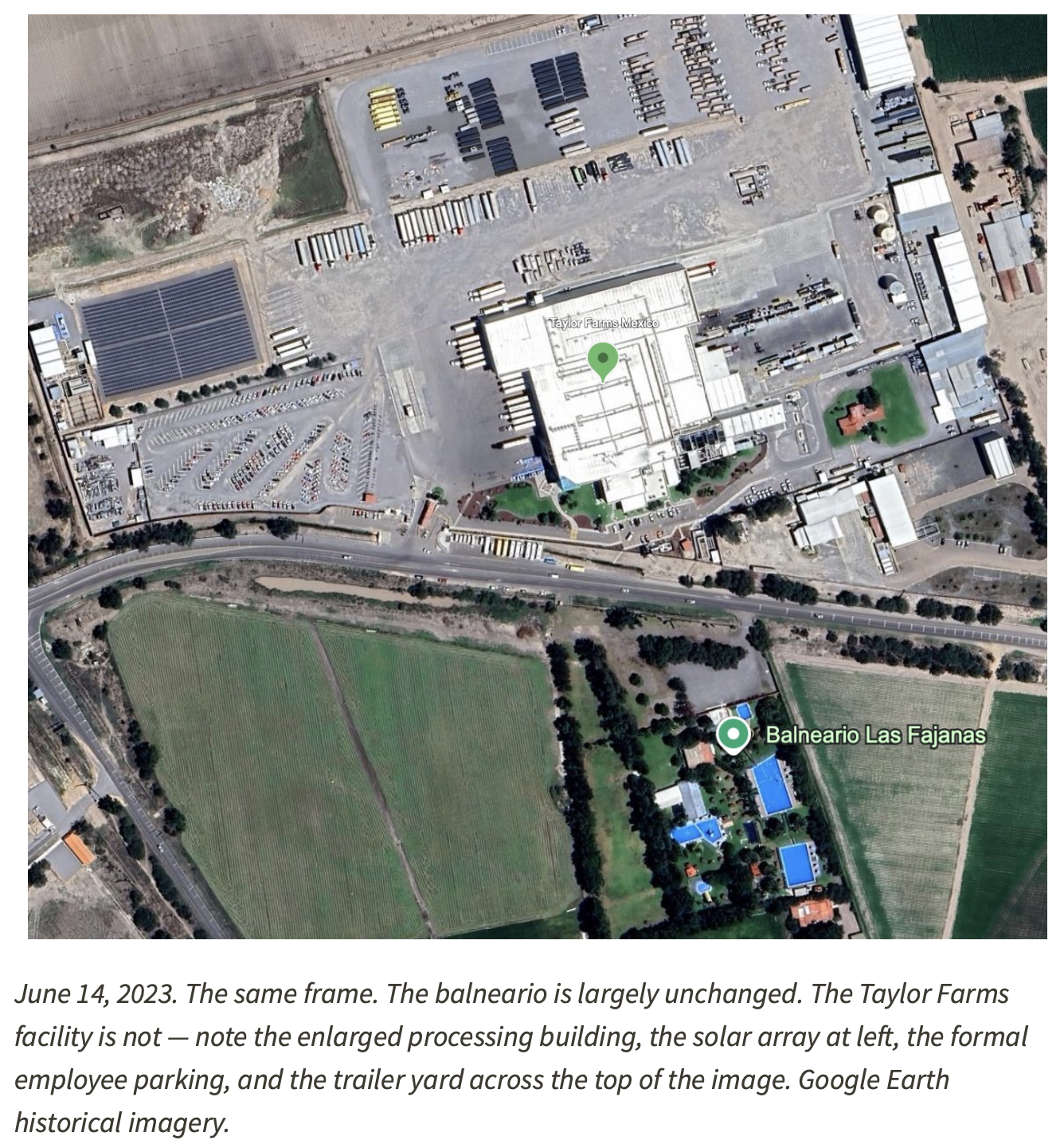
If you place the two frames side by side, the second argument emerges. One has nothing to do with balneario. Bath complexes in 2023 will look a lot different than they did in 2010. The Taylor Farms facility does not. The 2010 image shows a medium-sized factory. One main building, blue-roofed outbuildings and a large unpaved sloping area to the north. The 2023 image shows a much larger processing building, solar panels along the western border, hundreds of staff vehicles in the official parking lot, and a trailer yard storing well over 100 units. It’s not gradual growth. These vary in scale of operation: higher throughput, more wash water, more workers, more waste.
In both frames, one more feature is visible and requires the attention of a qualified person to identify it. A linear waterway runs east to west between the vegetation and the balneario, just north of the highway, and appears to hold water in both images. The 2023 frame also shows standing water along a channel southwest of the power plant. If it is an irrigation canal or drainage canal, this is a surface path between the two properties and a surface connection is much easier to establish than an aquifer connection. It could have been seen on the factory floor in 2013. Separately, the 2010 frame shows a dark oval pond just southwest of the main building that is not found in the 2023 frame. If it was a reservoir or process water lagoon, what was lost during expansion is a historical question worth asking.
Cyclospora cayetanensis There is no animal storage. Cows don’t carry it, wild animals don’t carry it, birds don’t carry it. It completes the human life cycle and is not complete anywhere else. All oocysts deposited on iceberg lettuce leaves come from humans. with E. coli O157:H7 You go to find the upgraded aviary in the field. with Cyclospore You go looking for human minions.
Cyclospore Oocysts are shed without spores and are not infectious. Because it takes approximately one to two weeks at temperatures between 22 and 32 degrees Celsius to infect someone, the CDC says direct person-to-person spread is unlikely. A sick person cannot transmit the parasite to people around them. All the person can do is place the inert oocysts in soil or water, walk away, and let them ripen. And northeastern Guanajuato is ideal for this ripening. San José Iturbide’s average daily maximum temperature ranges from 23 to 31 degrees Celsius year-round, well within the monthly sporulation window.
I want to be careful here. Because there is a wrong version of this claim. On July 15, the International Fresh Produce Association criticized the Michigan Department of Health for failing to recognize recreational water as a hazard, cited three papers for the proposal and told The Packer that Michigan was ignoring reputable science. Consumer FAQs still tell readers that pool chlorine will not kill you. Cyclospore And people who swallow pool water are just as unprotected from other waterborne diseases. County health departments in Ohio and Arizona said much the same thing. The sense that runs through all of this is that swimmers are picking up on this. That’s not true.
The most recent global review of waterborne protozoan outbreaks, published by Bourli and colleagues in the Journal of Water and Health in 2023 and the fifth in a continuous series since 2007, recorded 416 outbreaks worldwide between 2017 and 2022. In 313 of those cases (three-quarters of the total), the suspected source was recreational water and swimming pools, and in 92% of those cases: Cryptosporidium. Cyclospore There were a total of three outbreaks over a six-year period, and the review lists each by name. Drinking water in Poland traced to a traveler from Indonesia, drinking water in Korea traced to a traveler drinking it at a church in Nepal, and a British cluster among travelers returning from Mexico whose exposure was recorded to fruit, salad vegetables, fresh herbs, bottled water and ice. None of them have a swimming pool. Cryptosporidium Because it owns the category. Cryptosporidium It is contagious the moment it leaves the body. Cyclospore That’s not true. The Department of Health is heeding caution when it comes to swimming pools. Trade associations that say recreational water is a real risk factor for the outbreak are taking different steps. Moving the story from lettuce.
The defensible claim is not that the balneario infected the swimmer. The balneario is a loading point for fecal matter into the environmental water bodies surrounding the ready-to-eat produce plant. And I didn’t invent that mechanism. This is the explicit premise of a study the produce industry has been funding for a decade.
The Production Safety Center clearly stated that it invested $1.6 million. Cyclospore Studies since 2014 have shown that the parasite is endemic to the United States and can be recovered from wastewater and irrigation water, which poses a significant risk of contaminating agricultural products. The industry’s own research institute says the parasite lives in sewage water and reaches crops through water. Going one level down, the mechanism is fully named. The CPS and USDA-registered project, led by Charles Gerba, Kelly Bright, Paula Rivadeneira and Walter Betancourt in Arizona, was built to determine whether U.S. agricultural products are at risk from irrigation water contaminated with human sewage, specifying sources including faulty and leaky septic systems, damaged sewer pipes and treated wastewater discharged into surface waters used to irrigate food crops. The same framing applies to the USDA National Library of Agriculture catalog. Having a defective septic tank near a produce field is not a theory I believe. This is a federally funded research issue.
Surveillance results tell you where the parasites actually are. The two-year study of southeast Georgia growing regions, published in the Journal of Food Protection and funded through CPS, sampled municipal wastewater sludge, on-farm portable toilets, irrigation pond water and used packinghouse dump tank water. Parasites definitely live in human sewage. and unconfirmed molecular positivity for agricultural water is a known publication. That’s exactly what happened at the border in July and why those false positives proved nothing about whether the lettuce was contaminated.
Treatment does not solve the problem. Kitajima, Haramoto, Iker, and Gerba made the detections by sampling two Arizona wastewater treatment plants monthly for a year. Cyclospore Using a purpose-built assay, it was concluded that conventional treatment methods have limited ability to remove protozoan oocysts and cysts from wastewater. It is a working urban factory. Rural recreation facilities couldn’t get any better. This isn’t new either. Sterling and Ortega reported in Emerging Infectious Diseases: Cyclospore The oocysts were recovered from a sewage lagoon next to an endemic area in Lima, whose water irrigates pastures, corn and vegetable crops elsewhere in the city. It was 1999.
Taylor Farms will argue that it has no control over what its neighbors plant on their land. That argument failed in the 2013 record. The FDA instructed Taylor Farm in writing to determine: Cyclospore This is reasonably likely to be hazardous in these growing regions, in which case the washing steps should be reevaluated. A risk analysis worth the paper it was printed on would have identified a public bathhouse complex 800 feet from the water intake. Satellite records now show the bathhouse complex was sitting there with a full pool for three years before inspectors arrived. The failure here is not that the balneario is there. The failure is that the federal government said and 13 years later we have a record outbreak and no one can show that they did.