



To commemorate the 40th anniversary of Operation El Dorado Canyon, the 48th Fighter Wing unveiled a special livery F-15E Strike Eagle featuring the same camouflage used on the F-111 Aardvark.
At a ceremony held at RAF Lakenheath, England, the 48th Fighter Wing unveiled the F-15E Strike Eagle in a new special livery to commemorate the 40th anniversary of Operation El Dorado Canyon. In this operation, conducted on April 14, 1986, 24 F-111F Aardvarks from the 48th Tactical Fighter Wing took off from Lakenheath for long-range attacks against Libyan targets.
special color
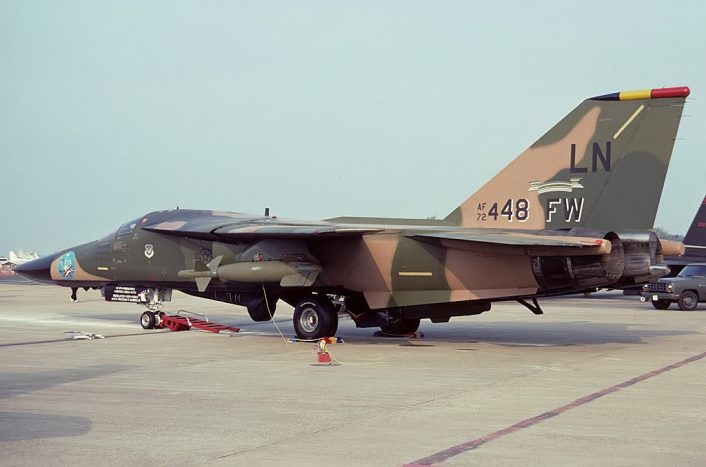
The F-15E Strike Eagle (serial number 91-0311) was painted in the same camouflage as the F-111 once operated by the 48th Tactical Group. The camouflage featured tan and two shades of green, while the nose radome was left in standard gray paint.
The tail shows different markings depending on its surface. As usual, the “LN” tail flash and serial number can be seen on the outer surfaces of the tail along with the previous 494th Tactical Fighter Squadron markings.

Additionally, the top features both the red band of the 494 TFS and the “40th Anniversary Eldorado Canyon” markings. Starting at the bottom and extending upwards, you will see the 48FW Statue of Liberty insignia. The inner surface of the vertical twin tails is decorated with the shape of an F-111 and the Panther emblem of the 494th FS.
Moving to the nose section, we see another F-111 shape with red letters reading “Karma 52”. This is a tribute to the only aircraft lost during the Libyan operation, an F-111 with call sign Karma 52 flown by Capt. Fernando Ribas-Dominicci and Weapons Systems Officer Capt. Paul Lorence.
el dorado canyon
In April 1986, U.S. President Ronald Reagan ordered an attack on Libya after accusing it of being behind an attack on a West Berlin discotheque that killed two Americans. The attack was carried out by assets of the US Navy and US Air Force.
On April 14, 24 F-111Fs took off from Lakenheath, RAF, and were joined by five EF-111A Ravens from the 42nd Electronic Fighter Squadron, which took off from Upper Hayford, RAF. After the first aerial refueling, six F-111s and one EF-111 spare aircraft turned around and returned to base.

The remaining aircraft crossed the Atlantic Ocean, reached the Strait of Gibraltar, and entered the Mediterranean Sea. At approximately 2 a.m. on April 15, the F-111 completed final refueling and began the attack.
The Air Force jets were joined by 27 Navy aircraft, including the A-6E Intruder, A-7 Corsair II and F/A-18A Hornet. These aircraft were launched from the aircraft carriers USS America (CV-66) and USS Coral Sea (CV-43).
During the planning, five targets were selected across Libya. The Air Force attacked a terrorist training camp, command and control facility and airfield near Tripoli, while the Navy attacked another training camp and airfield near Benghazi, the Air Force explained in a recent feature published before the anniversary.
Due to malfunctions and strict rules of engagement, only 11 of the 18 F-111s dropped their bombs, but nonetheless hit their assigned targets. Some aircraft used GBU-10 laser-guided bombs on ground facilities, while others dropped parachute-delayed bombs on Il-76 transport planes at Tripoli Airport, it said.
After the attack, the U.S. military conducted a Battle Damage Assessment (BDA) on the target. For this mission, the SR-71 Blackbird was an obvious choice as Libyan airspace was heavily defended.


