




Yeo Si-hoon
While everyone was out and about the world during the holidays, I stayed home in Singapore and watched the world go by through posts, reels, streams and stories.
Since when did the world become a stage where everyone becomes an actor in their own movie?
Looking at their posts, it seemed like half of my friends were in Japan and the other half were in China. China’s visa-free policy has really worked in the Southeast Asian market. Airlines have launched numerous flights to secondary cities and travelers are moving to previously inaccessible destinations such as Xi’an-Nanjing and Ningbo. Chengdu is a city that continues to be loved.
I asked my nephew, who is in his 30s and was traveling in northern China for two weeks, what he liked about China. “It’s interesting, because it’s so different from region to region. The prices are cheap, the food is delicious, and the technology is so convenient.” SuperApp has removed many travel barriers in China, including language, for the mobile-using Asian population.
So my first prediction for 2026 is not that difficult. In fact, inbound traffic from China will be groundbreaking news in Asia.
Anyway, in between this voyeurism watching other people’s holiday movies, I’ve been visiting local places, slowing down, reading books, and watching professionally made films.
Sorry for keeping up with the trend and taking away more than 15 seconds, which is the standard for video content these days. Let me summarize my thoughts gathered over the holidays into four points.
1. Be a standout, not a supporter.
One day I decided to explore “rural” Singapore. I shared this wish with my friend in New Zealand, and he immediately laughed. “Is there any countryside left in Singapore?”
Well, it turns out there is one last kampong (village) left. It is called Kampong Buangkok. It’s easy to miss as it’s sandwiched between a highway and high-rise buildings. Gravel road. wooden house. Fruit trees are pouring over the fence. The sound of a rooster crowing in the distance.
It feels somehow out of place, but it fits together like it’s always had a right to be there. It was founded in 1956 by Sng Teow Koon, who leased land to his family at a low rent.
What’s amazing is that Singapore has survived despite the tremendous developments it has experienced. That’s because the founder’s daughter, Sng Mui Hong, often referred to as Singapore’s “last kampong landlord”, has rejected all proposals by developers to monetize the remaining 12,248 square meters of land. Approximately 30 families currently live here and continue to pay low rents.
It is a quiet statement of personal choice, resistance to norms, standing up for and standing up for what is important to you.
In a world where everything is sucked into machines and crushed into a mass of sameness, people like her can become the heroes of our time.
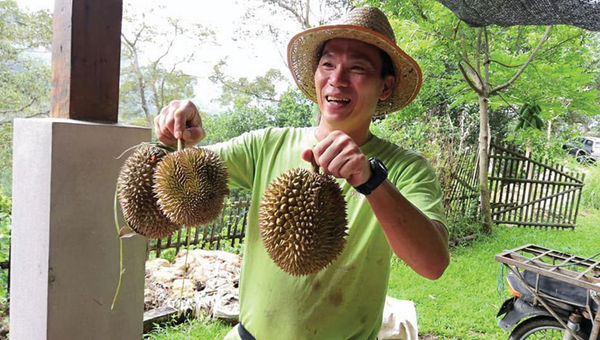
Eric Chong of Green Acres runs a durian operation on his farm in Penang. Photo credit: Green Acres
2. Slowly smell the durian.
As I slowed down, my mind went back to the last Web in Travel event of the year in Seoul. That’s when we invited Penang farmer Eric Chong of Green Acres to talk about the slow tourism trend he thinks will pick up speed this year and is expected to grow after the pandemic.
He is a proponent of the slow food travel movement, which aims to “bring travelers closer to preserving food biodiversity and understanding local cultures, identities and gastronomy.”
He and his wife, Kim, a corporate trainer, actually purchased the 16-acre farm nearly a decade ago as a retirement idea, driven by a desire to reconnect their son with nature. They decided to turn it into the only organic farm in the area, known for its abundant durian harvests.
They found it difficult to make a living from fruit farming, even with the most precious fruit, durian, which smells like hell and tastes like heaven. So the pair put their entrepreneurial skills to good use and entered the tourism industry, creating experiences for individuals, businesses and school groups.
His guests came from everywhere. In fact, one guest from Oregon, Lindsay Gasik, visited Green Acres a few years ago. She now runs a durian-focused travel business, running tours and shipping the fruit to customers in the US, Canada and the EU.
Chong said that in addition to durian hunting, many visitors seek nature and slower forms of travel.
“They come to our farm to learn about organic farming, the origins of food and activities such as harvesting. We take them to nearby villages to see aspects of rural life,” he said.
What they enjoy is the personal experience of Eric and Kim serving as hosts. “Technology can’t replace that love or warmth,” Chong said. “This is what travelers want.”
While in Seoul, he visited a farming village in Jeongeup, two hours away from the city, and experienced slow travel firsthand.
He found that wherever he went, people were friendly and offered him free food and drinks. The Ssanghwa tea made by local farmers was so delicious that I wondered why hotels in Seoul did not serve local tea. “Travellers are looking for local food, going out to get a taste of the local cuisine, eating and drinking,” he said.
It sounds like the perfect antidote to a year of demon-driven change.
3. The lost art of writing letters and keeping an open mind.
I usually avoid books that tell their stories through letters. For some reason, perhaps due to childhood trauma, I find it difficult to read other people’s letters.
But I recognize that sometimes I need to break my own algorithmic bubble, so I decided to pick up Virginia Evans’ “The Correspondent.” In this work, a woman’s life is conveyed to others through her letters.
It made me want to write the letter again.
The content of the book supports this. “Everything you’ve said to someone else, every comment you’ve made over drinks with friends, every comment you’ve exchanged over the phone with colleagues and distant relatives, every quick and thoughtless chatter you’ve sent via email, the messages you’ve typed on your cell phone – in fact, the sum of these interpersonal communications is the essence of your life, relationships are the core of our lives as we know them in old age, but all of that is gone. Gone!”
The unexpected joy I found in things I normally avoided made me realize that keeping an open mind has become one of the greatest challenges of our time.
Algorithms keep us in a bubble, and information is so readily available that we can know everything about everything. Social feeds with incredibly beautiful images raise our expectations. How do you keep an open mind that is constantly being manipulated and filled with so much confusion?
But the best way to travel is to keep an open mind. Better yet, take a pen and writing utensil with you on your trip and write letters, even if you are alone.
4. Prepare for ‘continuous battles’.
I can’t write more about “KPop Demon Hunters”, but one of the movies that touches the world is “One Battle After Another” by Paul Thomas Anderson.
It’s been described as a breathtaking action thriller, but it’s much more than that. It’s epic. You’re brave. It’s naughty. It’s fun. It’s ironic. I’m rebellious. A fellow film buff described it as “the type of anti-hero hero we needed at this moment, something we didn’t know we needed.”
For Western audiences, he is this generation’s ‘Easy Rider’. For Eastern audiences, it is this generation’s ‘Enter the Dragon’.
This is also a love story, and as we all know, love is universal.
It occurred to me, especially as I watched the crazy, dizzying, heart-stopping car chase over the rolling hills, that travel in 2026 would be very similar, whether in Osaka, Oman, or Oregon.
It will be one battle after another as we wait to see where technology, politics and economics will take us and figure out the best way to get up and down the hill.
Spoiler alert: In movies, newer, faster cars don’t win.
Have a happy 2026.





