



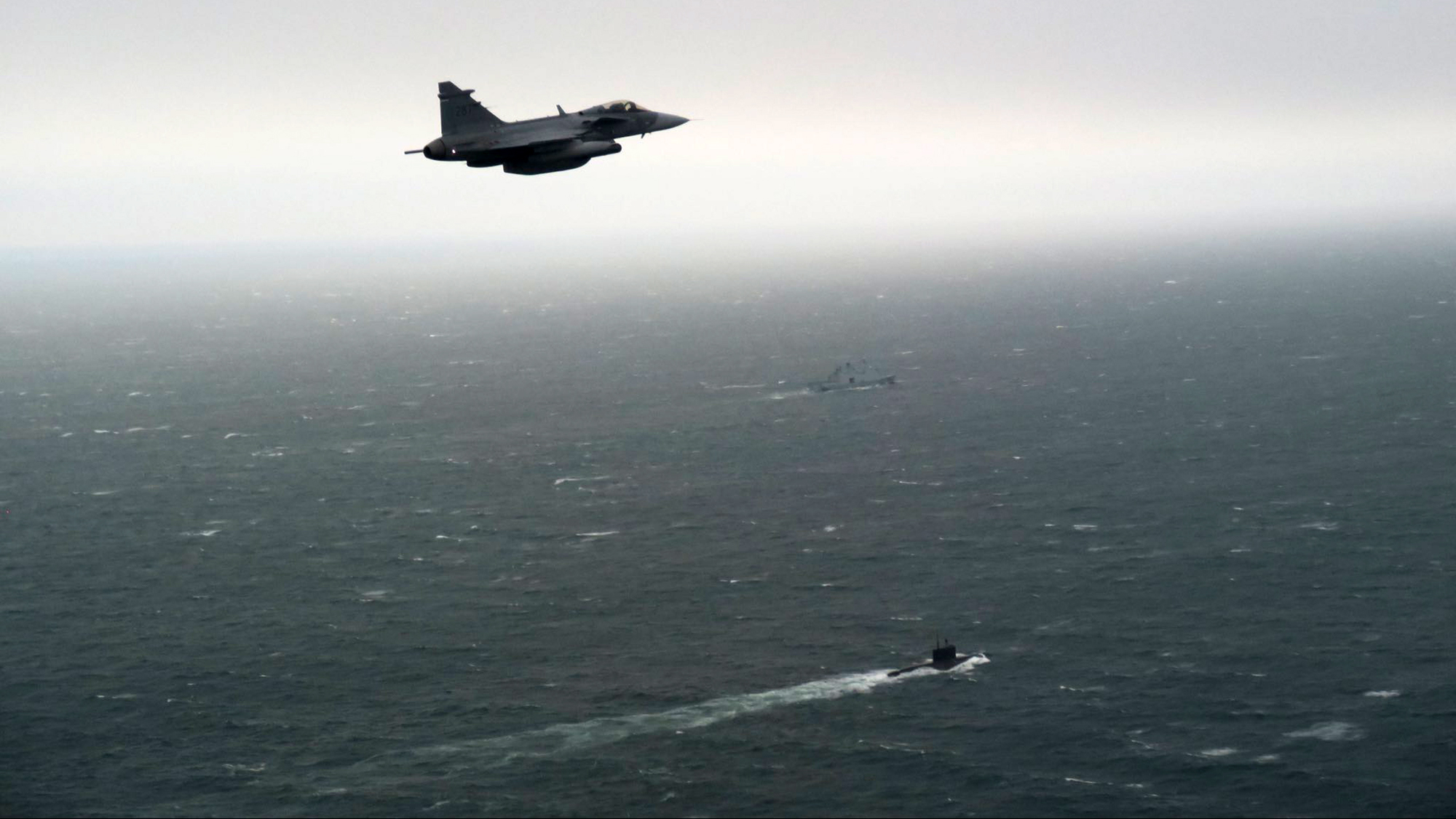
The Russian submarine, shadowed by the Swedish Gripens, was transiting the Kattegat, a strategic waterway linking the Baltic approaches to the North Sea system.
Although Iran is currently in the spotlight, Russia’s military activities in the Baltic Sea region continue to attract attention. The Swedish military has just released interesting images of a JAS 39 Gripens escorting a Russian Kilo-class submarine through Kattegat. The photos come at a time of growing concern about the scale and regularity of Russian underwater operations in Northern Europe, which Swedish naval officials said were occurring almost weekly.
Swedish fighter jets tracking a Russian submarine in Kattegat.
On Friday, the Swedish JAS 39 Gripen intercepted a Russian Kilo-class submarine off Kattegat. We are currently monitoring the submarine’s ongoing path to the Baltic Sea with our allies. https://t.co/BrIU6SD4AS pic.twitter.com/XBcwTPQ1bS
— Armed Forces (@Forsvarsmakten) April 10, 2026
The encounter is far from isolated. An extensive pattern of continuous monitoring and rapid response activity has recently been observed in Kattegat, a strategic waterway linking the Baltic approaches to the North Sea, with several reported passages of Kilo-class submarines intercepted by Swedish fighter jets.
Warships of the Swedish Navy and Coast Guard, together with the Swedish Air Force’s JAS-39 Gripen, are currently tracking the Russian Kilo-class diesel-electric submarine Novorossiysk (B-261) in the Baltic Sea. The submarine passed near the Great Belt yesterday, passing east. pic.twitter.com/1lUH7rxIcq
— OSINTdefender (@sentdefender) October 15, 2025
On December 6, 2025, Swedish Naval Operations Commander Captain Marko Petkovic stated that encounters with Russian submarines in the Baltic Sea occurred “almost every week,” emphasizing that such encounters were no longer considered rare or exceptional events, but rather part of the Swedish military’s routine operational activities. As reported guardianPetkovic said there had been a noticeable increase in Russian submarine activity in the area in recent years, with sightings “becoming very common.” It said this reflected Moscow’s ongoing efforts to strengthen its military presence in the Baltic Sea. He also pointed to Russia’s ongoing naval modernization, including production of one Kilo-class submarine per year, as evidence that this is not a temporary surge but part of a broader, intentional long-term build-out.
The Swedish “team” sent to monitor Russian Kilo-class submarine activity in Kattegat waters is identical to what was observed in similar intercept missions, relying on a tiered package combining JAS 39 Gripen fighters and seagoing Visby-class corvettes to provide aerial surveillance capabilities.
The latter is a type of Swedish corvette optimized for covert operations near the coast. Built with a composite hull and designed to minimize radar and infrared signatures, the Visby class is designed to operate in the shallow, complex marine environments found in the Baltic Sea, combining speed, sensors and multi-function capabilities to hunt submarines, monitor maritime traffic and defend key shipping lanes.
The Kilo class is a family of Russian diesel-electric low-acoustic attack submarines designed for covert operations in coastal and confined waters. The boat is armed with six 533 mm torpedo tubes and, in later versions, can also fire Kalibr cruise missiles. They are considered a credible threat to surface ships, land targets and maritime traffic in restricted waters such as the Baltic Sea.
Although they may need to surface for a variety of different reasons (ventilation, communications, navigation updates, or dealing with technical issues), diesel-electric submarines, unlike nuclear submarines, must occasionally surface, or at least to snorkeling depths. When submerged, the boat relies on batteries that can keep it quiet for only a limited period of time. When the batteries are depleted, the submarine must raise the snorkel mast or surface to provide oxygen, run the diesel engines, and recharge.
Once on the surface, it becomes easier to detect and track and becomes more vulnerable to Swedish Gripen C fighters and Visby corvettes. At the same time, their presence above the surface may provide a rare opportunity to capture interesting images, such as the one released by the Swedish military today.
What makes Sweden’s approach particularly interesting is the fact that it appears to rely on anti-submarine warfare missions on its assets, a combination of JAS 39 Gripens and Visby-class corvettes, rather than dedicated maritime patrol and anti-submarine warfare (ASW) aircraft such as the P-8 Poseidon. In that sense, this appears to reflect a workaround imposed, at least in part, by the lack of a specialized fixed-wing ASW platform. Aircraft such as the P-8 (and P-72) are specifically designed for the maritime patrol role, combining long endurance, wide-area search capabilities, sonobuoy deployment, and onboard acoustic processing. It is also equipped with a variety of Electronic Support Measurement (ESM) sensors, making it an Intelligence, Surveillance and Reconnaissance (ISR) platform.
In contrast, the use of fighter jets and patrol ships, while still capable of operating in the confined environment of the Baltic Sea, points to a significantly different approach from the more traditional ASW model built around purpose-built patrol aircraft.







