



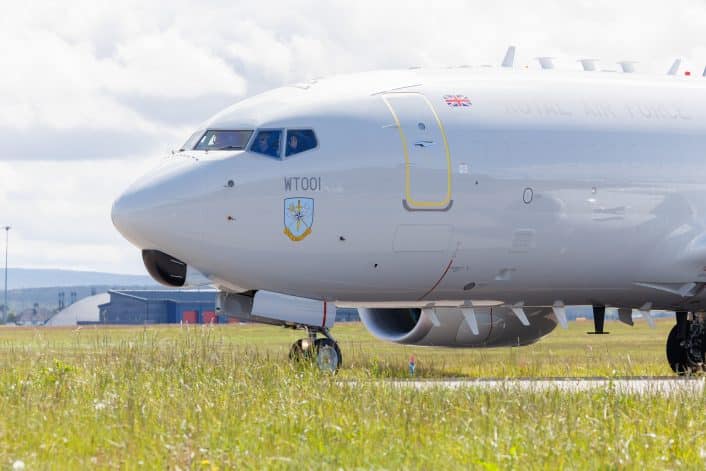
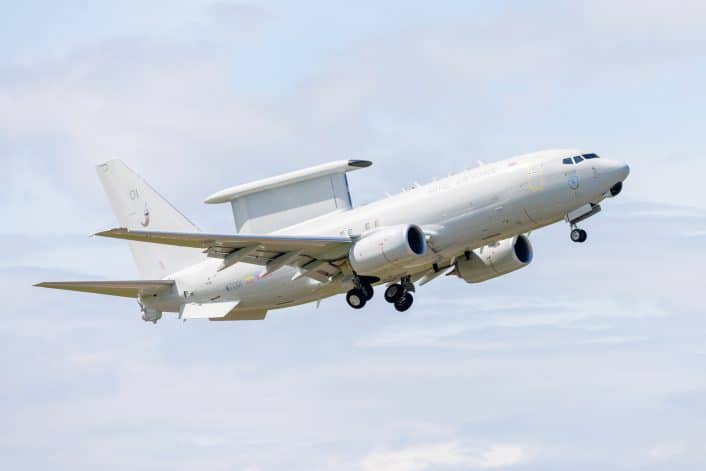
The first of three RAF E-7 Wedgetail AEW&C aircraft has arrived at RAF Lossiemouth in Scotland for testing and evaluation trials ahead of squadron operations.
The aircraft was flown to the air base by a mixed crew from Boeing UK and the RAF, and on arrival the jet was greeted by members of the RAF Lossiemouth Pipe Band to mark the occasion. Group Captain Sarah Brewin, Base Commander RAF Lossiemouth, attended along with Boeing UK representatives, the Wedgetail project team and members of No 8 Squadron, who will operate the aircraft.
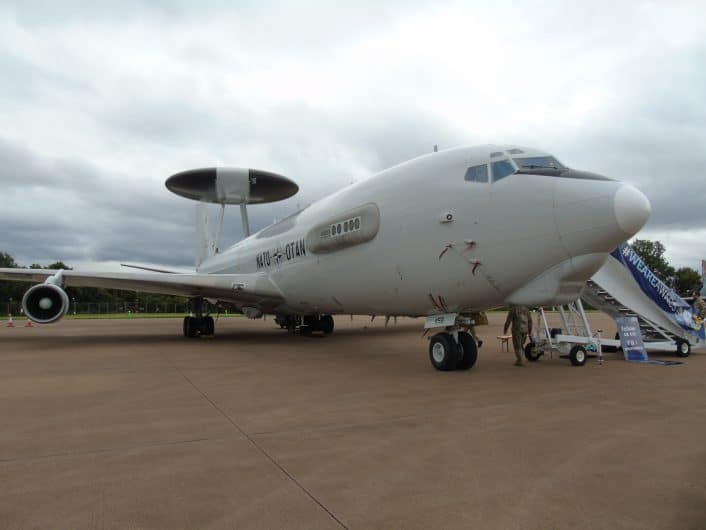
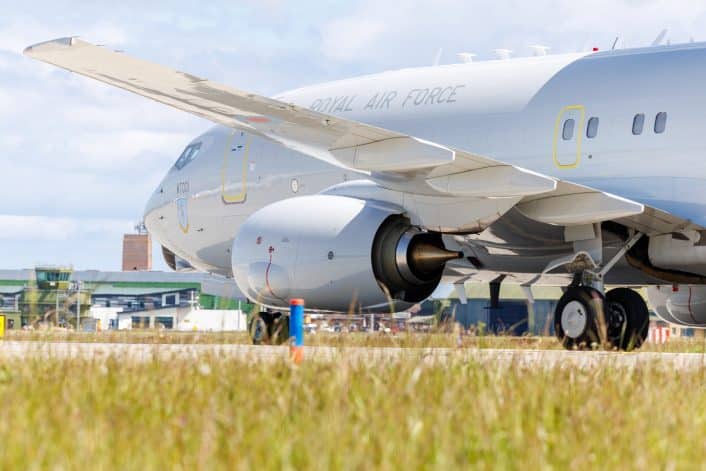
Designed to provide long-range aerial surveillance for the Royal Air Force and other Allied forces, the Wedgetail AEW1 is a significant advancement in design compared to its predecessor, the E-3 Sentry. The aircraft, a serial WT001, has now completed testing and evaluation trials split between MOD Boscombe Down and RAF Lossiemouth to ensure the aircraft is safe and suitable for squadron service.
Once complete, No 8 Squadron will officially receive the aircraft for operations, but it is unlikely the aircraft will be deployed immediately as the squadron’s other aircraft are still several years away. Nonetheless, the Wedgetail will be a powerful force multiplier for the RAF, especially when operated in conjunction with the nine-strong Poseidon maritime patrol aircraft that will monitor the seas while the Wedgetail watches the skies.
welcome home @RAFLossiemouth The first of the E7 wedge tails, WT001, arrived this afternoon. #Boeing #aviationnews #flight #army #avgeek #avgeeks pic.twitter.com/Y7gVNOsTKF
— Stevo Howells (@Stevo_SnakeDR) May 21, 2026
Both the P-8 Poseidon and the E-7 Wedgetail are based on the Boeing 737 NG airframe, with the main differences being that the P-8 has a longer fuselage and an open bomb bay that allows for the deployment of torpedoes and sonobuoys from the air. Both aircraft having the same base airframe will allow for a shared pool of spare parts for both aircraft, allowing for more efficient maintenance of both aircraft once the other E-7 enters service.
E-7 #wedgetail We’ve landed in Lossiemouth!
The world’s first wedge tail, WT001 @royalairforcedeparted from @STSAviation to @RAFLossiemouthTesting continues.
Welcome to Scotland. 🏴�����������������������������������������������������������������
See more: https://t.co/YzByzkGsLm
📷: © Crown Copyright pic.twitter.com/USWGKUJBNk
— Boeing UK (@BoeingUK) May 21, 2026
Upon the aircraft’s arrival, General Sarah Brewin said:
“We are delighted to welcome the arrival of the first Wedgetail aircraft at RAF Lossiemouth to continue the testing and evaluation phase. This is an important step to deliver the RAF’s next-generation air surveillance and control capability, supporting the defense of the UK for many years to come. RAF Lossiemouth has been working hard to prepare this aircraft for operational use and we very much look forward to the next exciting chapter in the station’s history when the aircraft enters RAF service.”
Additionally, Stu Voboril, Boeing E-7 Vice President and Program Manager, said:
“The E-7 will provide the UK with the world’s most advanced, capable and reliable airborne early warning and control platform, while supporting UK industry through UK jobs and supply chain opportunities. We look forward to working closely with the RAF and MOD to continue testing and evaluating the aircraft as it approaches service entry.”
delivery delay
The RAF’s plans to equip the E-7 Wedgetail have gone through many trials and tribulations since they were first announced in 2019. The original plan was to operate five aircraft alongside the E-7s operated by NATO and the United States, but this was later abandoned due to differing priorities between the two organizations.
The first speed boost to the program came when the 2021 Defense Review decided to reduce the number of aircraft from five to three to save an initial cost of £21.55bn. Two aircraft have been jettisoned, but the British government has already agreed to pay for all five airborne radars. This means you have two extra sets available for spare parts and maintenance. At this point the cost for the three aircraft and five radar sets was £1.89 billion and the aircraft were expected to enter squadron service in 2023.
It has also been decided that the E-3 Sentry AWACS will be retired in early 2021 instead of its original decommissioning date of 2035. The aircraft had been flying since 1991, reducing the fleet size to three until they were retired due to age and wear.
Airframe fatigue and the decision in the 2000s not to upgrade the airframe contributed to the decision to retire the aircraft early. That’s because it was seen as a better use of taxpayers’ money to purchase a new aircraft that could deliver greater power output than the high-maintenance E-3.
Following their decommissioning and decommissioning, the UK suffered a significant capability gap, forcing it to rely on allied AWACS operated by France, NATO and the US, as well as the Royal Navy’s Crowsnest-equipped Merlin HMA2 helicopters. However, neither solution was ideal for the defense of Britain’s sovereignty, as each country had its own AWACS commitments and the Crowsnest system was short-range and unreliable.
The E-7 is a seemingly off-the-shelf aircraft used in Korea, Turkey and Australia, and despite the two aircraft being converted from second-hand aircraft, there have been significant delays in putting these aircraft into service. This is due to the aging of many aircraft components requiring new certification for replacement parts. The E-7 Wedgetail program began in the 1990s with aircraft produced for Australia, and since then technology has advanced rapidly requiring significant updates.
Internal difficulties at Boeing have also contributed to the delays, preventing the aircraft from meeting its original service date by three years, with the first aircraft, WT001, unveiled in RAF livery in October 2024. Now, with the aircraft finally arriving at RAF Lossiemouth, it is hoped the troubled program can begin a new phase and provide the RAF with a much-needed airborne detection system.
As it stands, a second aircraft, WT002, is currently being fitted out at the STS Aviation site in Birmingham, with the aircraft most recently sighted in January this year. The final airframe, WT003, is a newly built 737 that will not be completed until 2022. It is unknown when this aircraft will begin conversion, as the focus is likely to be on WT002.
Awesome sight at Birmingham Airport today…
No.2 RAF E-7A Wedgetail (WT002) carrying out full engine operational tests just outside the STS hangar. This 14.7 year old ex N449BJ 737-700BBJ (ex Hong Kong Jet/Longtail) arrived in 2021 for conversion and is running well… pic.twitter.com/gVeXMRhZmm
— Fahad Naim (@Fahadnaimb) February 21, 2026
international disagreement
Plans to buy just three aircraft were not enough to meet the UK’s strategic early warning needs, so the 2025 Strategic Defense Review said the government would consider buying more aircraft. This will be done either when UK defense funding is high enough to allow for follow-on aircraft, or through agreements with other NATO allies depending on the joint needs of the alliance.
However, the plan may have been torpedoed by NATO, which canceled its E-7 Wedgetail order citing the U.S. withdrawal of E-7 acquisitions in 2025.
Instead, NATO will likely choose a SAAB-based option such as Globaleye. This is because NATO members Sweden and France are currently in the process of equipping the platform, while other NATO operators are already utilizing older Erieye AEW&C aircraft.
The U.S. government opposed the acquisition of manned AEW&C platforms, preferring instead a space-based system that had the potential to revolutionize airborne detection and command and control of the USAF. But these capabilities are so far in their infancy that Congress has begun allocating funds for the E-7 regardless of what the U.S. government originally planned. Considering the loss of E-3 Sentries after this year’s war with Iran, the decision to introduce the E-7 is a wise decision in the short and medium term.
However, due to delays and delays arising during the procurement process and difficulties in operating the aircraft in the UK, NATO placed orders for the platform on hold. As it stands, all three AEW&C platforms are airborne in terms of longevity and capability, and only time will tell whether either can field effective aircraft.
This whole story of aircraft procurement across the UK, US and NATO is emblematic of a disorganized and disorganized alliance, with allies failing to consult and keep up to date on their individual plans and requirements. The clear, integrated, joint aircraft procurement path that underpinned the E-3 Sentry acquisition in the early 1990s was degraded here, with member states now unable to support each other in terms of spare parts and supplies.
With any luck, NATO will be able to overcome these obstacles in due course and all three AEW&C fleets will be able to work together to improve the alliance and security.







