



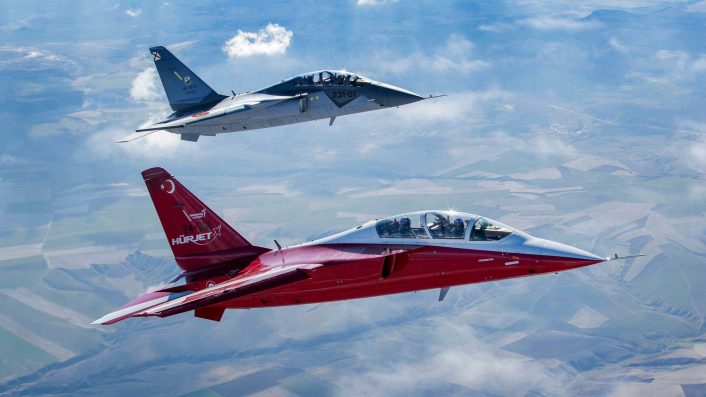
One of the Hürjet prototypes was spotted flying with underwing weapon pylons, which may suggest TAI’s intention to introduce the jet to the highly competitive light attack aircraft market.
Images of the Turkish Hürjet prototype, which emerged on May 19, 2026, showing it flying with weapon pylons under the wings, suggest a weaponized variant may be in the works. This photo was taken by aerial photographer Enes Ötken and posted to his Instagram page.
The location is believed to be the Türk Havacılık Ve Uzay Sanayi Anonim Şirketi/Turkish Aerospace Industries (TUSAŞ/TAI) facility northwest of Ankara. The images emerged earlier this month after claims a combat variant was in development.
This represents steady progress towards a light attack version of the indigenously developed advanced jet trainer, competing in a tight market dominated by other products such as the South Korean KAI T-50 and the light fighter FA-50. Boeing T-7A Red Hawk; Italian M-346A Master; and Russian Yak-130M.
What the image shows
The tail number of the aircraft carrying the pylon is TUS-A003. This is the same aircraft that flew on November 21, 2024 in a new light gray and dark gray paint scheme.
The aircraft had a flight data probe (pitot tube) in the nose, and was captured during landing after a test flight, given that both the landing gear and speed brakes were deployed. You can also see two cameras placed in a V-shaped pattern behind the landing gear, possibly to observe and record the vibrations and impacts the pylons have on the wings.
The Hürjet is reported to be currently in serial production, with four prototypes currently flying, TUS-A003 being one of them. Turdef claimed that the aircraft will soon be integrated with the MURAD family of Active Electronically Scanned Array (AESA) radars and the Gökdoğan beyond visual range and the Bozdoğan within visual range air-to-air missiles (AAMs).
Primarily, the jet will replace the Turkish Air Force’s (Türk Hava Kuvvetleri) older T-38 Talon jet trainers, of which 68 are in service. 2026 World Air Force report. Little information is available about the pylons of TUS-A003 and TAI has not released any statement.
Turkish and Spanish Hürjet fleet
The Turkish Air Force (Türk Hava Kuvvetleri) ordered 12 aircraft, and Hürjet’s first foreign customer, Ejército del Aire y del Espacio (Spanish Aerospace Force – SASF), ordered 30 airframes under the now designated SAETA II program.
60% of the jet is produced locally in Spain, with an Airbus-led consortium producing a variety of custom subsystems and components. The Hürjet will eventually replace the SASF’s existing fleet of 19 F-5M trainers.
The Hürjets are deployed to Ala 23 (23rd Wing) at Talavera La Real Air Base, which currently operates F-5Ms. It is used to train pilots to fly the Eurofighter Typhoon and F-18 (Spain does not use the F/A-18 designation for the Hornet).
Hürjet is the future Gen. 4.5 and Gen. 5 forms part of the much broader Integrated Combat Training System (ITS-C), including ground simulators, theoretical and practical guidance training aids to better prepare TurAF and SASF aviators for the aircraft.
A light attack version of the HÜRJET is also in the development stage and flight tests are already being carried out at the prototype stage.
Additional time is required to complete development and validation of this variant.@TUSAS_TR general manager @dr_mdemiroglu | https://t.co/3t8h8h1FH2 pic.twitter.com/isJWASgW77
— Karakulak (@KaraKulak__) May 1, 2026
defense SAETA II said it will be split into two phases, with the first phase involving the delivery of 21 aircraft starting in 2028 and using one aircraft as a prototype to test Spanish components, mission systems and avionics technologies developed by GMV, Sener, Aertec, Grupo Oesía, Orbital and Indra. The larger ground-based training system is scheduled to come online in 2029-2030, while the second phase, between 2031 and 2035, will see all 30 aircraft converted to Spanish SAETA II standards.
The aircraft will be flown using American-made GE F404 engines, at least until the TF series of domestically developed powerplants manufactured by TUSAŞ Engine Industries (TEI) become operational to power future batches.
#HÜRJET Within the scope of the program, an engine supply contract has been signed with GE Aerospace. ✈️
This contract, which covers the F404 engine, contributes to HÜRJET’s volume production goals and sustainable growth of the program, while further improving the platform’s competitiveness on a global scale. pic.twitter.com/YoBcoiVLfN
— Turkish Aerospace Industry (@TUSAS_TR) May 5, 2026
Hürjet naval version and Türkiye’s next aircraft carrier
In an interview in January 2026 field istanbulTAI’s Major General Mehmet Demiroğlu also shed light on the naval version of the Hürjet. The aircraft will take off from the Turkish Navy’s future MUGEM aircraft carrier, which has been depicted in both official and unofficial representations with trainer aircraft among the platforms on which it will operate.
Without expanding on the Turkish Navy’s specific interest in the Hürjet, Demiroğlu simply answered affirmatively when asked if the Turkish Navy had contacted the aircraft manufacturer. He reiterated the company’s production readiness to meet larger orders.
#HÜRJET The low-altitude-high-speed test took the wind over the Mediterranean at the foot of the Taurus Mountains.
HÜRJET’s 79 test points were completed in 18 sorties using two prototypes in Antalya, and important data was acquired at supersonic speeds.
By national means… pic.twitter.com/VfQsy3Sh2H
— Turkish Aerospace Industry (@TUSAS_TR) March 13, 2026
“We can say that we have entered mass production in this sense. Now the arrival of Spain and the fact that there will soon be additional orders from the Turkish Air Force and Navy have further accelerated the preparations for mass production. We are working towards a production line of 100 units. Normally, this is 1-2 aircraft per month for this type of aircraft. We want to reach 2 per month, and then 3 per month as soon as possible. And when we talk about mass production of these aircraft, we mean cars “It should not be compared to mass production. Even if we produce one aircraft a month, it is still mass production.”
MUGEM and TF-2000 scale models will also be on display at the Naval Systems Seminar. pic.twitter.com/NPs4YDAnQt
— Defense Türkiye Magazine (@DefenceTurkey) May 26, 2025
An infographic at the exhibition showed the future MUGEM aircraft carrier, a ski-jumping short-takeoff barrier interdiction (STOBAR) vessel that, in addition to the Hürjet, will also operate the Baykar TB3, ANKA-3 UCAV and Kizilelma Cooperative Combat Aircraft (CCA).
We would like to thank Enes Ötken for permission to use his photo. you can follow him Instagram To see more of his work, visit his page.







