



According to the most read Italian newspaper, Italian Air Force Reapers remained at Ali Al Salem Air Base even after Rome decided not to relocate the base to avoid any move that could be perceived as being involved in the war with Iran. Despite Italy’s non-participation in Operation Epic Fury, the aircraft was destroyed there.
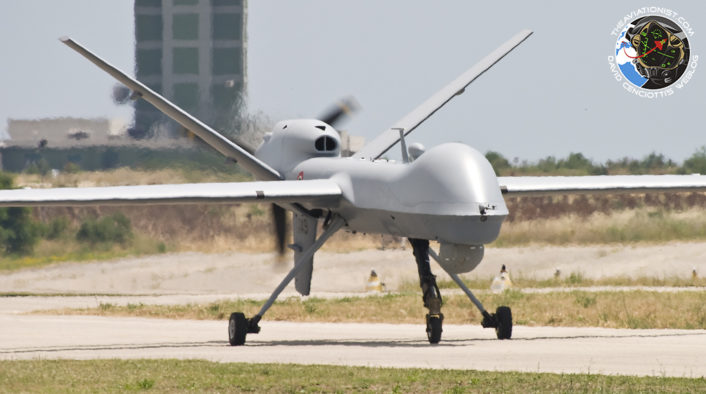
On March 15, an Iranian drone strike struck Ali Al Salem Air Base in Kuwait, destroying an Italian Air Force MQ-9A Reaper (Predator B) inside the shelter.
The Remotely Piloted Aircraft (RPA), one of six Predator B unmanned aerial vehicles belonging to the Italian Air Force’s 32° Stormo Wing based at Amendola Air Base in southeastern Italy, was assigned to the Arava Fenice Task Group of the Italian National Expeditionary Command Air Force/Task Force Air Kuwait (IT NCC AIR/TFA-K) to perform intelligence surveillance and surveillance (ISR). The (reconnaissance) mission is part of “Prima Parthica”, Italy’s contribution to the multinational campaign against Daesh in Iraq and Syria.
Task Group Araba Fenice has been operating from Ali Al Salem Air Base (ASAB) in Kuwait since October 2014. It was initially operated as the MQ-1C Predator A+ and, from January 2015, as the more advanced MQ-9A “Predator B”.
The Italian Air Force website describes the MQ-9 drone as follows:
The MQ-9A is a strategic-class remotely piloted aircraft system that provides long endurance at medium and high altitudes and demonstrates high performance in intelligence, surveillance, and reconnaissance (ISR) missions, as well as land and maritime patrol operations, search and rescue, convoy and troop escort, and personnel and facility protection.
Thanks to its onboard sensors and the expertise of its flight crew and analyst personnel, the MQ-9A can enhance knowledge and awareness of the operational situation by detecting the presence of threats or improvised explosive devices and monitoring a broad operational area to immediately share useful information with coalition partners to gain a detailed understanding of the environment of interest.
According to a recent article in the Italian newspaper Corriere della Sera, citing “authoritative sources familiar with the matter”, the Italian Ministry of Defense has already assessed that its aircraft in Kuwait could be targeted after the start of hostilities in the region and discussed possible force protection measures.
One option the Italians considered was to launch or redeploy the aircraft to prevent them from hitting the ground.
However, such defensive moves can also be interpreted as hostile actions. Since Italy was not a party to the conflict, Rome wanted to avoid any action that could be perceived as drawing Italy into a dogfight with Iran. After consultation, it was reported that it was decided to keep the aircraft on the ground. As a result, MQ-9As worth approximately 34 million euros remained inside a shelter in Ali Al Salem and were destroyed during the Iranian attack.
Satellite images released by Iran show an attack on an Italian facility at Ali Al Salem Air Base in Kuwait, destroying an MQ-9 Reaper in a hangar and a satellite dish potentially associated with the system. (29.336° 47.5334°) 1/6 pic.twitter.com/UT52W7A7cr
— Fabian Hinz (@fab_hinz) March 24, 2026
Immediately after the attack, the Italian Ministry of Defense issued an official statement:
“This morning, the Ali Al Salem Air Base in Kuwait, home to US and Italian capabilities and forces, was targeted by a drone attack targeting a shelter housing remotely piloted aircraft belonging to the Italian Air Force Task Force. The aircraft was destroyed. I immediately spoke with Colonel Manghini to confirm the status of the Italian troops on the base. All personnel were safe and uninvolved at the time of the attack. I immediately informed Minister of Defense Crosetto of the incident and will remain in constant contact with him to keep him updated on the situation of all units abroad. We are monitoring,” said General Luciano Portolano, Italy’s chief of defense staff.
In recent days, the strength of the Italian Air Force Task Force has been precautionarily reduced as part of measures adopted in response to the evolving security situation in the region. Personnel remaining on base are employed to perform essential activities of the mission.
The hit aircraft was an indispensable asset to the operation and remained stationed at the base to ensure operational continuity.
The situation is being continuously monitored by the Chief of Defense Staff and the Joint Operations Command (Comando Operativo di Vertice Interforze, COVI), which is in constant contact with ground contingents.
If the Corriere della Sera article is accurate, it means that Italy decided not to get drawn into the conflict, risking losing valuable assets like the MQ-9 Reaper.
The article, published by the most-read Italian newspaper, comes after Italian Defense Minister Guido Crosetto criticized NATO Secretary-General Mark Rutte for saying that around 500 US aircraft had used US air bases in Italy during the war with Iran. The revelations led Tehran to accuse Rome of involvement in the conflict. Crosetto called Rutte’s comments “random,” “inappropriate” and “unnecessary,” making it clear that Italy only approved logistical, non-combat operations that complied with international treaties.

What about Eurofighter?
Revealing why valuable assets were not transferred during the initial US and Israeli airstrikes against Iran, Corriere della Sera The report does not provide further details about the damage to the Italian Eurofighters, which were also deployed to Ali Al Salem. Their condition has been the subject of speculation and unconfirmed reports since the aftermath of the attack. OSINT accounts and some media outlets at the time claimed that the two Italian Eurofighters were damaged, although repairable. However, these claims have not been officially confirmed.


We noted that four Italian Eurofighters were reportedly deployed to Kuwait at the time of the attack, with three returning home a few days later, suggesting that only one aircraft was actually affected, or that one of the two jets believed to have been damaged suffered only very light damage and was still able to fly.
Not sure here. Four Italian Eurofighters have been deployed. A few days ago, three people returned home. Only one was damaged or one of them could return home with very mild effects. https://t.co/IIU2Jrk5r1
— The Aviationist (@TheAviationist) March 20, 2026
We have contacted the Italian Air Force, the Italian Defense General Staff and the Italian Ministry of Defense to seek an official response. None of them responded to our multiple questions. So while it is likely that up to two Italian F-2000s were hit by shrapnel, the MQ-9A destroyed on March 15 remains the only publicly acknowledged Italian aircraft loss related to the Iranian attack on Ali al-Salem.


