




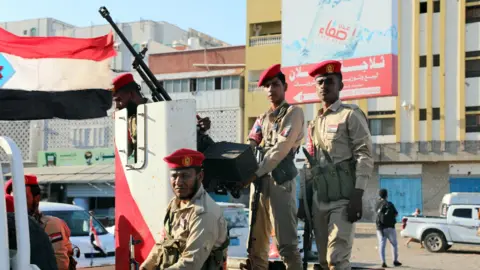
 EPA
EPAAfter Saudi Arabia supported the Yemeni Presidential Council’s request for a withdrawal within 24 hours, the United Arab Emirates (UAE) announced that it would withdraw its remaining troops from Yemen.
The UAE’s announcement came after the Saudi-led coalition carried out airstrikes on a shipment of weapons for UAE-backed separatists at the southern port of Mukalla.
The UAE denied the shipment contained weapons and expressed “deep regret” over the Saudi accusations.
Saudi Arabia and the UAE have been allies in the war against Yemen’s Iran-backed Houthi rebels for a decade, but infighting between rival factions they support has deepened the rift between them.
Saudi Arabia also accused the UAE of “pressuring” separatists to attack Saudi-backed government forces in two eastern provinces and warned it would take steps to combat such “extremely dangerous” actions.
On Tuesday afternoon, the UAE’s Ministry of Defense issued a statement saying it would end its remaining counter-terrorism personnel in Yemen of its own volition, six years after the UAE military ‘ended’ its presence there.
The Pentagon said the decision to withdraw them was made “in light of recent developments and the potential impact on the safety and effectiveness of counter-terrorism missions,” without mentioning the coalition attack or the Saudi warning.
Saudi Arabia’s Foreign Ministry said in a strongly worded statement issued Tuesday morning that it was “working to curb the escalatory measures” recently taken by the Southern Transitional Council (STC), which seeks independence for southern Yemen.
The report accused the UAE of pressuring the STC to carry out attacks in the eastern Hadramawt and al-Mahra provinces, which it said was a “threat to the national security of the Kingdom, the security and stability of the Republic of Yemen and the region.” He also warned that Saudi Arabia would take steps to combat such “extremely dangerous” behavior.
The UAE Foreign Ministry condemned claims of “pressuring or directing Yemeni political parties to carry out military operations aimed at undermining the security of the Kingdom of Saudi Arabia or its borders.”
The UAE also claimed that from the beginning of the STC offensive, it “has focused on containing the situation, supporting efforts to de-escalate tensions, and promoting understanding to contribute to maintaining security and stability.”
The chairman of Yemen’s eight-member Presidential Council, including the STC representative, previously announced that he was canceling the joint defense agreement with the UAE and ordering UAE forces to withdraw within 24 hours “to protect the safety of all citizens and affirm Yemen’s commitment to its unity, sovereignty, stability and territorial integrity.”
Rashad al-Alimi also declared a 90-day state of emergency, which he said was necessary to combat Houthi rebels, which he described as “an internal conflict led by rebels taking orders from the United Arab Emirates.”
STC leaders said the UAE’s ultimatum to withdraw was one-sided and had no legal basis, and insisted the UAE would remain a “key partner” in the fight against the Houthis.
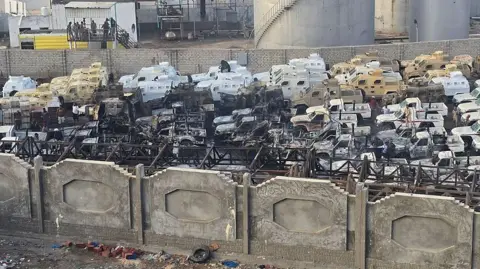 AFP
AFPAlimi’s announcement came after a spokesman for the Saudi-led coalition, which includes the UAE, said it had carried out “limited” airstrikes against weapons and military vehicles for STC forces in the southern Yemeni port of Mukalla, which arrived on two ships from the UAE.
General Turki al-Maliki called the shipment “an imminent threat and escalation that threatens peace and stability.”
A port official told AFP that an evacuation warning was received at 04:00 local time (01:00 GMT) and that open areas of the facility came under attack about 15 minutes later.
Photos showed a number of burned-out military vehicles and pickup trucks in the walled area of the port, as well as damage to nearby buildings. No casualties were reported.
The UAE Foreign Ministry said it was surprised by the Mukalla airstrikes and that the coalition statement was issued without consultation with member states.
It claimed that the shipment in question “did not contain any weapons and that the unloaded vehicles were not for use by Yemeni political parties but rather for use by the United Arab Emirates military operating in Yemen.”
On Saturday, the Saudi-led coalition called on STC forces to withdraw “peacefully” from Hadhrama’ut and al-Mahra, a day after the Saudi air force reportedly bombed separatist positions in Hadhrama’ut’s Wadi Nahab district.
STC forces launched offensives in two areas early this month amid heightened tensions, leading to direct clashes with government forces.
The report said the operation was needed to “restore stability” in the south and combat the Houthis as well as jihadist groups al-Qaeda and the Islamic State.
Yemen has been ravaged by a civil war that began in 2014 when Houthi rebels ousted the internationally recognized government in the capital Sanaa. The conflict has intensified since the Saudi-led coalition of Arab states intervened in 2015 to restore government rule.
The fighting has reportedly killed more than 150,000 people and created one of the world’s worst humanitarian crises.
As the war began, separatist forces, including the STC, which seeks independence for southern Yemen, which was a separate country before unification with the north in 1990, formed an uneasy alliance with the government to prevent Houthi rebels from taking over the southern city of Aden.
But in recent years, the STC and its allies have turned against the government and gradually taken control of Aden and much of the south.







