






A key hostage and prisoner exchange on Monday marked a major step in ending two years of war in the Gaza Strip, drawing celebrations across Israel and the Palestinian territories.
In an important first step in the U.S.-brokered plan to end the war, Hamas returned all living Israeli hostages, and Israel released nearly 2,000 Palestinian prisoners and detainees.
US President Donald Trump landed in Israel minutes after the first hostages were tearfully reunited with their families, and declared a “historic dawn of a new Middle East” in a speech to the Israeli parliament.
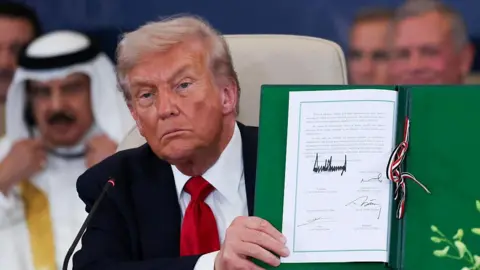
President Trump then held a summit in Sharm el-Sheikh, Egypt, where he met with more than 20 leaders to discuss later stages of the Gaza peace plan.
At the summit, Egypt, Qatar, Turkey and the United States signed a declaration as guarantors of a cease-fire agreement to end two years of war that has devastated the Gaza Strip.
But despite the diplomatic celebrations and joy of reunions in Israel and the Palestinian territories, many challenges remain to achieve a cease-fire that will lead to lasting peace.
The latter half of President Trump’s 20-point peace plan is fraught with challenges and will require intense negotiations to move forward.
Monday’s hostage and prisoner exchange completed the initial phase of the deal and came after a ceasefire went into effect on Friday and humanitarian aid increased in Gaza over the weekend.
Israeli hostage families were seen screaming and crying in happiness as they hugged their freed loved ones.
“I was overwhelmed with emotion and joy,” said former hostage Arbel Yehoud, who was freed on Monday and reunited with his partner Ariel Kunio.
“For more than two years, the hope of holding Ariel again has sustained and driven me every day,” she said.
Buses carrying people released from Israeli prisons through the Gaza Strip and the occupied West Bank were surrounded by large crowds waving flags and playing patriotic music.
A Palestinian woman who was reunited with her son said she finally felt at peace.
The release went largely as planned, but families of Israeli hostages expressed outrage that Hamas said it would return the bodies of only four of the dead hostages. It is believed that the remains of up to 24 hostages remain in the Gaza Strip.
According to this agreement, about 1,700 Palestinian detainees detained in Israel were released.
About 250 Palestinian prisoners serving life sentences were also released by Israel, and about 100 were released to the occupied West Bank. Others were deported and a few were released to East Jerusalem.
As the prisoners disembarked from the Red Cross bus in Ramallah, many wearing traditional keffiyeh scarves, they received loud cheers. But many looked pale and gaunt, and some had difficulty walking.
“There is joy, there is pain, there is happiness, there is sadness,” said Khalil Muhammad Abdulrahman al-Qatros, gathered outside Nasser Hospital in Khan Younis. He gathered to collect his son, who had been detained in Israel for about three months.
After being welcomed by Israeli Prime Minister Benjamin Netanyahu, President Trump visited the Knesset, the Israeli parliament, and delivered the first speech by an American president since 2008.
He said, “Finally, the long and painful nightmare is finally over, not only for Israelis but also for Palestinians,” and some politicians even chanted “Trump, Trump, Trump.”
There was a brief pause as an opposition lawmaker held up a piece of paper that said “Recognize Palestine.”
Trump then flew to Sharm el-Sheikh and met with more than 20 world leaders, including British Prime Minister Sir Kyr Starmer, French President Emmanuel Macron and leaders of many Muslim and Arab countries.
He was photographed with other leaders on a stage emblazoned with the words ‘Peace in the Middle East’.
Also in attendance was former British Prime Minister Tony Blair, who will play a key role in a “peace commission” for Gaza to be chaired by the US president under Trump’s plan.
Under the plan, Gaza would initially be governed by an ad hoc transitional council of Palestinian technocrats overseen by a “peace council” and then, after reforms, power would eventually be transferred to the Palestinian Authority (PA).
But advancing the later stages of the plan will require difficult negotiations.
Among the points of contention are the scope and timeline for Israeli military withdrawal, the disarmament of Hamas, and the future governance of the Gaza Strip.
Hamas has previously said it would not disarm unless a Palestinian state is established and has rejected the idea of foreign rule over the Gaza Strip.
Netanyahu has rejected any future PA intervention.
When asked when negotiations for the second phase of the peace agreement would begin, President Trump responded, “It has begun.”
“Every step is a little bit of a mix of each other,” he added.
Israel launched an offensive on October 7, 2003, in response to Hamas attacks on southern Israel. The attack left 1,200 people dead and 251 taken hostage to the Gaza Strip.
According to the Gaza Strip’s Hamas-run health ministry, more than 67,000 people have died since Israel’s offensive. The United Nations and other international organizations consider the figures reliable. More than nine in 10 residential buildings were damaged or destroyed, according to the United Nations.


