





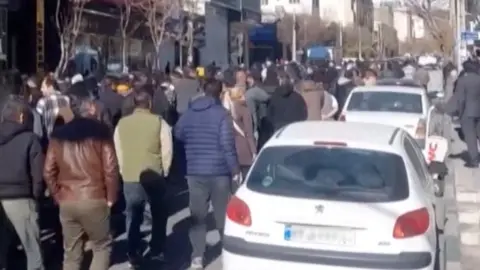
US President Donald Trump warned Iranian authorities not to kill peaceful protesters and said the US would come to their rescue.
“We are locked and ready to go,” he wrote in a short post on social media, but gave no further details.
A senior adviser to Iran’s Supreme Leader Ayatollah Ali Khamenei warned of potential chaos across the Middle East if Trump intervened, saying “we have to be careful.”
At least eight people have reportedly died in Iran after nearly a week of large-scale protests sparked by worsening economic conditions.
“If Iran continues their custom of shooting and violently murdering peaceful protesters, America will come to their rescue,” Trump wrote Friday on Truth Social.
President Trump did not specify what actions the United States might take against Iranian authorities in his position.
Last June, the United States conducted an airstrike on Iranian nuclear facilities at the direction of President Trump.
U.S. officials later claimed that the strikes significantly set back Tehran’s prospects for building nuclear weapons, a claim disputed by Iran.
In retaliation, Iran launched a missile attack on a major US military base in Qatar.
Shortly after Trump’s latest social media post, Khamenei’s adviser Ali Larijani issued his own warning.
“Trump must realize that American interference in these internal affairs means destabilizing the entire region and destroying American interests,” he wrote.
But for some protesters, U.S. intervention would be welcomed.
A young woman protesting in Tehran told the BBC’s NewsHour program that “they (the security forces) are scared to the core when President Trump or Israeli Prime Minister Benjamin Netanyahu says anything.”
She, who prefers to remain anonymous for her own safety, said protesters have been asking for U.S. support for years. Security forces “believe that if President Trump says something, he will do it” and “know that if something happens, they will have to live with the consequences.”
On Thursday, six people were reported dead in Iran, marking the fifth day of protests.
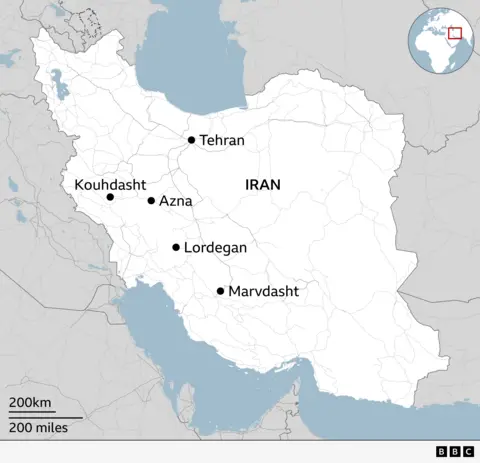
Two people were killed in clashes between protesters and security forces in the southwestern city of Lorgan, named as Ahmad Jalil and Sajjad Balamaneshi, according to the semi-official Fars news agency and human rights group Hengau.
Fars reported three deaths in the western provinces of Azna and Kouhdasht. It was not specified whether they were protesters or members of the security forces.
One person died in Fuladshahr, central Iran, and another person died in Mavdasht, southern Iran.
The BBC could not independently confirm the death toll.
Videos posted on social media showed cars catching fire during fighting between protesters and security forces.
BBC Persian has seen videos showing protests taking place in Lordegan, Tehran and Marvdasht on Thursday.
Earlier, Iranian officials said a young member of Iran’s security forces was killed in the western Iranian city of Kudasht on Wednesday. But protesters said the man was one of their colleagues and was shot dead by security forces.
Clashes were reported at his funeral last Friday, which was attended by thousands of mourners. Security forces wearing military uniforms tried to carry his coffin, but the crowd snatched it and chased them away.

The protests began in Tehran on Sunday among shopkeepers angered by another plunge in the value of the Iranian currency, the rial, against the U.S. dollar on the open market.
By Tuesday, university students had joined in and protests had spread to several cities, with people singing songs against the country’s clerical rulers.
Many protesters have since called for an end to Khamenei’s rule. Some people said they wanted a return to the monarchy.
“There is no freedom of any kind here,” said one protester interviewed by the BBC. “We are fighting every day. We face the most brutal things every day. We want to end the regime. Even if we sacrifice our lives, we have nothing.”
These protests have been most widespread, but not on the same scale, since the 2022 uprising sparked by the in-custody death of Mahsa Amini, a young woman accused by morality police of not wearing a proper veil.
President Massoud Fezeshkian said he would listen to the protesters’ “legitimate demands.”
But Prosecutor General Mohammad Movahedi-Azad warned that any attempt to foment instability would face a “firm response.”


Follow the twists and turns of Trump’s second term with North American correspondent Anthony Zurcher’s weekly US Politics Unspun newsletter. UK readers can sign up here. If you are outside the UK, you can sign up here.


