



Henri Astierand
Bernd Debusmann Jr.,white house reporter

 Reuters
European leaders came under fire after U.S. President Donald Trump threatened to impose new tariffs on eight allies who oppose his proposed acquisition of Greenland.
British Prime Minister Keir Starmer said it was “a completely wrong move,” and French President Emmanuel Macron said it was “unacceptable.”
The comments come after President Trump announced that 10% tariffs on goods from Denmark, Norway, Sweden, France, Germany, the UK, the Netherlands and Finland will take effect on February 1, but could later rise to 25% and will remain in place until an agreement is reached.
President Trump has argued that the Danish territory is important to U.S. security and has not ruled out taking it by force.
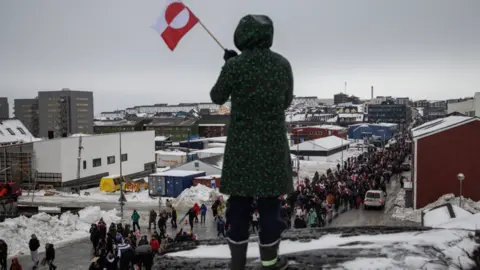
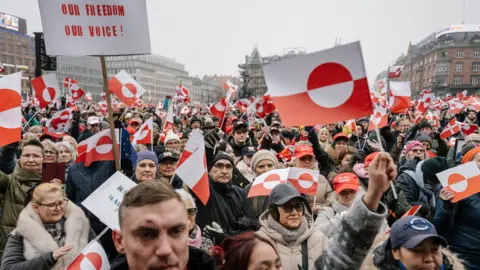
Meanwhile, thousands of people took to the streets in Greenland and Denmark on Saturday to protest the proposed US takeover.
Greenland is sparsely populated but rich in resources and its location between North America and the Arctic makes it ideal for establishing an early warning system in the event of a missile attack and for monitoring ships in the area.
Trump has previously said Washington will gain territory “the easy way” or the “hard way.”
European countries joined forces in Denmark’s support. They have argued that security in the Arctic region should be a shared responsibility of NATO.
France, Germany, Sweden, Norway, Finland, the Netherlands and Britain sent small numbers of troops to Greenland on so-called reconnaissance missions.
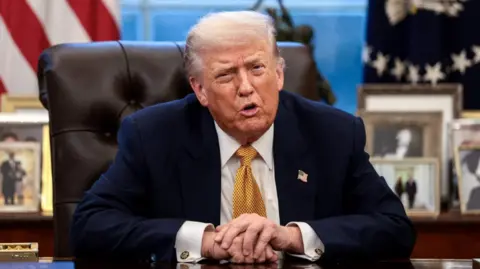
In a post on his Truth Social platform on Saturday, President Trump said these countries were playing a “very dangerous game” when he announced the new tariffs. He said the “safety, security and survival of our planet” was at stake.
He said the proposed 10% levy to be introduced next month on goods exported to the United States would rise to 25% in June and would be “payable until a deal is reached for the full and complete purchase of Greenland.”
Prime Minister Starmer said in response, “It is completely wrong to impose tariffs on NATO allies in pursuit of their collective security,” and added, “Of course, we will pursue this directly with the US administration.”
“Tariff threats are unacceptable in this context,” French President Emmanuel Macron said. “We will not be swayed by any threats.”
“We will not be intimidated,” Swedish Prime Minister Ulf Kristersson said.
“Sweden is currently in intensive discussions with other EU countries, Norway and the UK to find a joint response,” he added.
“The European Union will always take a very firm position in upholding international law,” said European Council President Antonio Costa. “Of course, international law begins within the territory of the EU member states.”
Danish Foreign Minister Lars Lokke Rasmussen called the threat “alarming.”
Meanwhile, German lawmaker Manfred Weber, head of the conservative EPP group in the European Parliament, said Trump’s move raised questions about the EU-US trade deal negotiated last year.
Brussels and Washington struck a deal that would impose a 15 percent U.S. tariff on all EU goods, while the 27 member countries agreed to impose a 0 percent tariff on certain products, opening their markets to U.S. exporters.
Weber told
 Reuters
But U.S. Ambassador to the United Nations Mike Waltz said Denmark “doesn’t have the resources or capacity to do what needs to be done in the north.”
He told Fox News that Greenlanders’ lives would be “safer, stronger and more prosperous under the protection of the United States.”
Trump has often considered “tariffs” his favorite word, and has made clear that he views it as a blunt tool to persuade or force countries around the world to adjust their policies to the White House’s desired outcomes.
But his announcement represents a significant expansion of his drive to acquire Greenland despite recent opposition.
It’s unclear what immediately prompted the tariff announcement, which Trump first hinted at while speaking to reporters at the White House on Friday.
Although he has repeatedly said in recent weeks that a variety of options, including the potential use of military force, remain on the table, the announcement comes just days after U.S. and Danish officials agreed to form a high-level working group to discuss the island’s future.
Many in diplomatic and political circles in Washington saw the announcement as a “best case” scenario for Denmark and its European allies. This would at least delay a White House decision or further escalation.
Instead, the recent tariffs have injected a new sense of urgency on the issue and strained relations with important NATO allies and trading partners.
 EPA
EPAOpinion polls show that 85% of Greenlanders oppose annexing the territory to the United States.
Protests against Trump’s takeover plan took place in the Danish city and the Greenlandic capital Nuuk on Saturday before the tariff announcement.
In Copenhagen, the capital of Denmark, placards were erected saying ‘Hands off Greenland’ and ‘Greenland for Greenland’.
“We demand respect for the Kingdom of Denmark and Greenland’s right to self-determination,” said Camilla Sijing, head of the Inuit group, which is part of the Greenland Association.
In Nuuk, Greenland’s Prime Minister Jens Frederik Nielsen joined protesters heading to the U.S. consulate holding signs reading “Greenland is not for sale” and “We create our own future.”
The rally coincides with the U.S. congressional delegation’s visit to Copenhagen. Democratic Senator Chris Coons, the leader of the party, described Trump’s comments as “not constructive.”







