



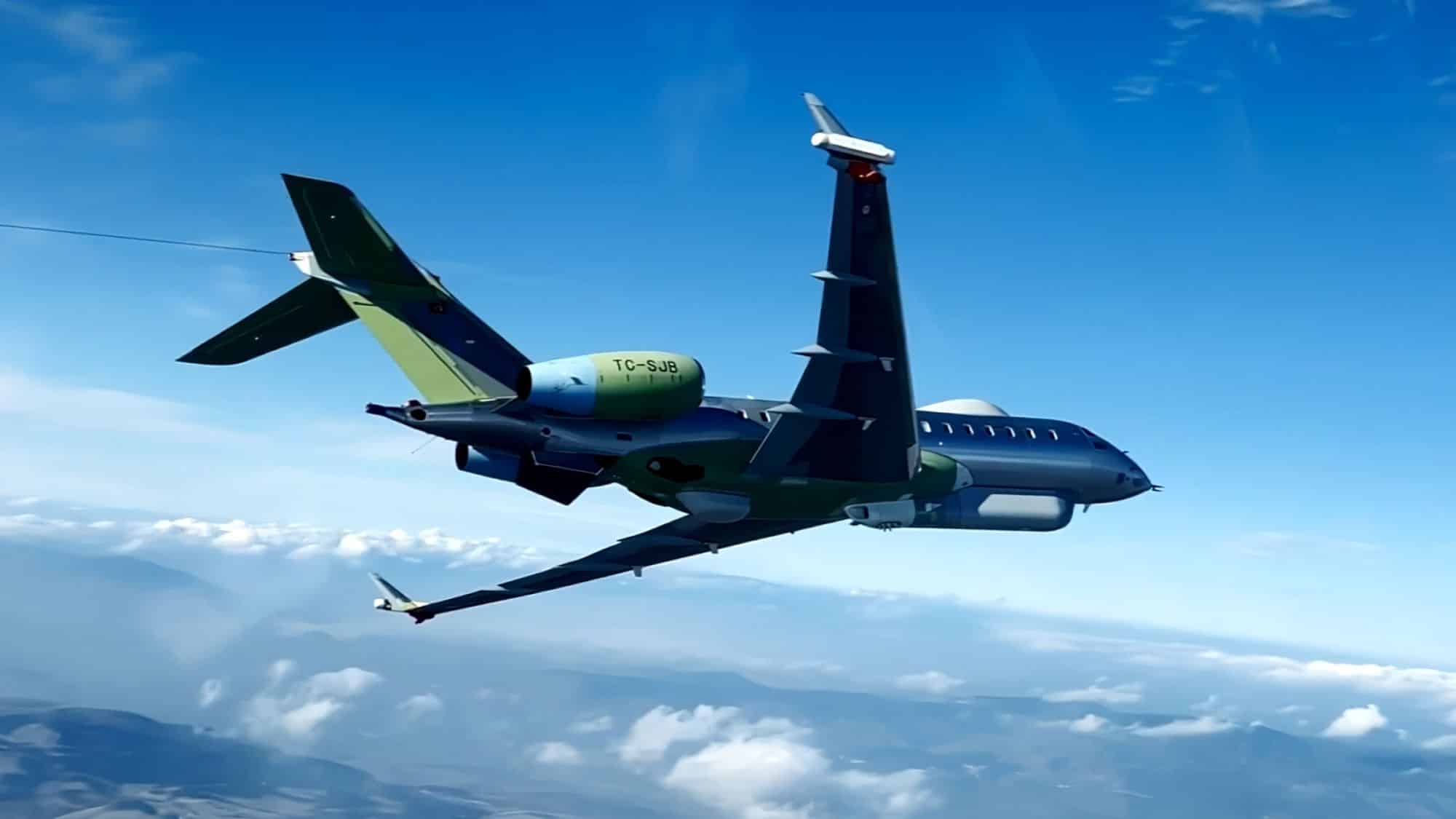
New footage of the Hava SOJ aircraft provides a closer look at the modifications to the Bombardier Global 6000 jet required to accommodate EW payloads, while also revealing other exciting features.
Exactly three months after Turkey’s first Hava SOJ aerial jamming device broke cover in grainy images during a flight from the Turkish Aerospace Industries (TAI) facility in Ankara, the aircraft has now emerged in its clearest official footage yet. A promotional video by the Ministry of National Defense (MND – Millî Savunma Bakanlığı) commemorating the 115th anniversary of the founding of the Turkish Air Force (Türk Hava Kuvvetleri – THK/TurAF) features a second-long video of the aircraft in flight.
External electronic warfare (EW) payloads and other capabilities integrated into the carrier-based Bombardier Global 6000 business jet are now clearly visible. The aircraft, also referred to as ASOJ 23-A by some Turkish defense journalists and analysts, makes THK one of the few air forces in the Mediterranean and Levant regions with this capability.
Another service in the wider region slated to acquire similar capabilities is the Aeronautica Militare (Italian Air Force). In fact, the U.S. Air Force signed a contract around the same time last year to acquire two EA-37B Compass Calls, which are currently only operated by the U.S. Air Force.
HAVA SOJ is the key to electronic domination of the skies 🇹🇷
Four electronic warfare special mission aircraft are being developed for the Turkish Air Force within the scope of the HAVA SOJ project, which started in 2018.
Detect, identify, disrupt and deceive enemy radar and communications systems… https://t.co/qa8mblVSvC pic.twitter.com/w2QH7T4ukO
— Industry & Defense 🇹🇷 (@SanayiSavunmaTR) June 1, 2026
Another European member of the North Atlantic Treaty Organization (NATO) alliance with similar capabilities is France. Archange Signals Intelligence (SIGINT) EW platforms share similar radio, radar emission interception, and jamming mission profiles.
Deliveries of the four Global 6000-based Hava SOJ aircraft are expected to begin in 2026. At least two of the aircraft were officially displayed at TAI facilities in 2019 before conversion.
What’s new in Hava SOJ
TAI is responsible for modifying the airframe and integrating the EW payload manufactured by defense electronics company Aselsan, followed by flight testing and issuance of a Supplementary Type Certificate (STC) prior to induction by THK. We do not know the exact technical designation for Aselsan’s EW payload developed for Hava SOJ.
The company has a large portfolio of such hardware. Two popular ones are the ground-based KORAL system and the ANTIDOT family of ELINT/EW pods mounted on the TB2T-AI, an AI-enabled version of the Bayraktar TB-2.
Simultaneous implementation of radar and jammer projects based on land and air platforms
➡️ Air Soj
➡️MIT Intelligent Aircraft
➡️IHA-SOJ (ASOJ-234U)
➡️KARA-SOJ 1 (Coral-1)
➡️Kara-SOJ 2 (Coral-2)
➡️AEW-C (ALP-200A)
➡️IHA AEW-C (Baykar-S band early warning radar) https://t.co/pfcATqqKWq See More pic.twitter.com/rv1sqF5Lt6— TR_tech (@T_Nblty) March 1, 2026
According to a November 2021 report, the only system officially known to be carried by the Hava SOJ aircraft is Leonardo’s Miysis Directed Infrared Countermeasures (DIRCM). defenseist. Nonetheless, the new image shows the rest of the payload more clearly.
The lower canoe-shaped fairing and long dorsal dome-shaped antennae are seen in more detail. The latter is typically associated with beyond-line-of-sight (SATCOM) (BLOS) satellite communications.
The back of the large ventral ‘canoe’ also has small circular arrays of slanted blade antennae. This typically involves encrypted, software-defined communications transceivers operating in a variety of bands and frequencies, and can also allow Hava SOJ aircraft to relay communications to friendly assets.
Another ventral oval-shaped fairing can be seen posteriorly between the wing roots, next to a series of oblique antennae under the wings.
A notable feature is the wingtip-mounted pods, which are very similar to the AN/ALQ-218 tactical jamming system on the US Navy’s EA-18G Growler. The Growler receives electronic emissions for Electronic Intelligence (ELINT) missions and sends transmissions for Electronic Support Measures (ESM) functions.
HAVA SOJ project that can only be carried out in a few countries around the world
Türkiye is expected to have an electronic warfare fleet through HAVA-SOJ in 2026.
Türkiye’s electronic warfare capabilities:
▪️Air SOJ with remote mixing function
▪️People who can mix within the company… pic.twitter.com/LiZgKf60hh— Oğuzhan Uygun (@ogzhn_uyg) February 20, 2026
The trailing cable at the end of the vertical stabilizer may be a tow target/decoy for self-protection, or it may be a trailing cone, which is common on many new aircraft when testing and flight certification. The latter is typically used to collect data from disturbances in airflow caused by gases.
The extended tail ‘sting’ boom below the rudder displays a collection of small oval sensors. Sensors placed at the rear of special mission aircraft are typically missile approach warning systems.
It is unknown whether Hava SOJ also has an Intelligence Surveillance Targeting (ISTAR) role. If so, the larger ventral canoe fairing could accommodate an Active Electronically Scanned Array (AESA) module to provide Synthetic Aperture Radar (SAR) mapping or Ground Moving Target Indicator (GMTI) imaging.
The nose of the aircraft still has a flight data probe and a tail registration TC-SJB, which may be a local serial post-conversion. As we originally reported, the two known Global 6000 airframes flown to TAI for conversion had serial numbers 9855 and 9854, the latter carrying C-GBYG registration. It is not known which of the two was spotted on the recent flight.
The HAVA SOJ, which will be one of the Turkish Air Force’s most strategic aircraft, is flying although officials have not yet revealed it to the media. Will we finally get a glimpse of this beast? We are waiting… https://t.co/BJHe5TqUCv pic.twitter.com/0op79IZqoj
— TR_tech (@T_Nblty) November 27, 2025
Importance of Türkiye
Turkey’s Defense Industry Secretariat (SSB) outlines Hava SOJ’s tactical role and national efforts to develop indigenous capabilities in the strategically sensitive EW area.
“Standoff jamming (SOJ) platforms are high-value assets that suppress enemy air defense radars, disrupt command and control cycles, and disrupt communications by performing deception and noise jamming at long ranges without entering enemy airspace. This creates a conduit for friendly air forces to penetrate enemy airspace. The effective use of these platforms has become an undeniable reality of modern warfare, serving as a force multiplier and generating powerful asymmetric effects.”
SSB will also oversee the handover of SOJ’s “related facilities, including hangars, squadron buildings, planning and training centers” to the Turkish Air Force Command. SOJ aircraft represent the nation’s desire to “integrate radar and communications electronic support/electronic attack (ES/EA) systems and acquire them natively across domestic resources.”







